Process Complexity Is Now the #1 Barrier to SAP Process Automation

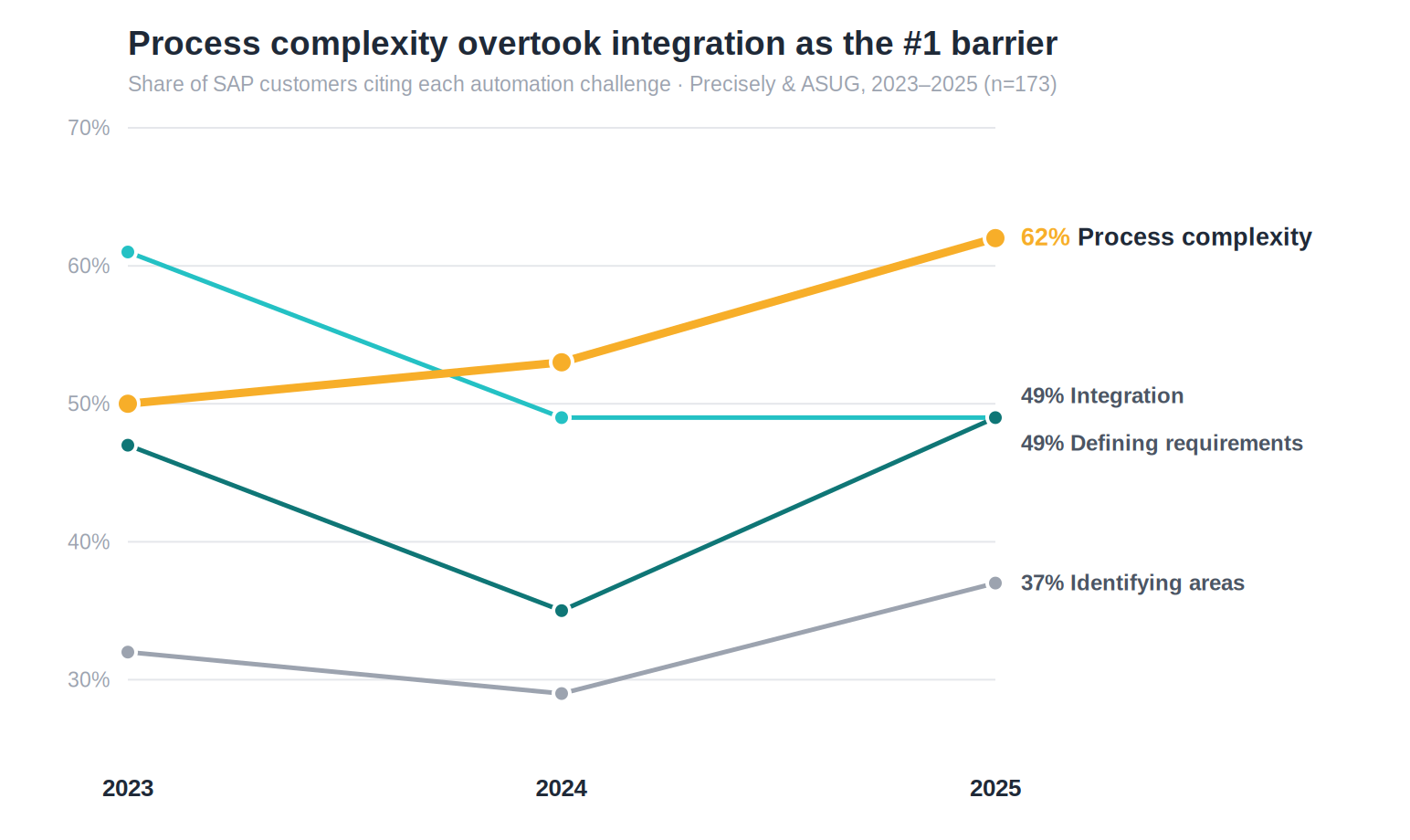
Process complexity is now the number one barrier to SAP process automation. In the 2025 survey conducted by Precisely in partnership with ASUG, 62 percent of SAP customers cited the complexity of business processes as their top automation challenge — overtaking integration, the previous leader, which fell to 49 percent. The shift signals that automation difficulty has moved from connecting systems to understanding the process logic itself.
For years, when SAP teams talked about what made automation hard, they talked about integration. Getting SAP to exchange data cleanly with Salesforce, with a warehouse system, with a bank, with a dozen downstream applications — that was the wall everyone hit first. It made sense: SAP sits at the center of the enterprise, and everything around it needs to connect. That is no longer the wall. The reordering looks small on the surface and is significant underneath, because the barrier that sits at number one shapes how organizations should think about their entire modernization strategy.
What does the 2025 ASUG and Precisely survey actually measure?
The research behind these numbers is *Transforming SAP Processes Through Automation: 2026 Trends and Challenges*, a survey conducted by Precisely together with ASUG, the Americas' SAP Users Group, based on 173 completed responses from ASUG members. Respondents spanned SAP IT stakeholders and business users across consumer products, industrial manufacturing, aerospace and defense, chemical, government, and utilities. Roughly a third of respondents came from IT operations, with finance, enterprise architecture, and supply chain also well represented.
The survey has run for three consecutive years, which is what makes the year-over-year movement meaningful rather than a one-time snapshot. The survey is a third-party read on how SAP-run organizations describe their own experience — independent of SAP's official narrative. That independence is what makes the trend worth taking seriously.
Why is process complexity now the #1 SAP automation challenge?
Process complexity was cited as a top automation pain point by 62 percent of respondents in 2025, up from 53 percent in 2024 and 50 percent in 2023. Integration, which led the ranking the previous year, dropped to a tie for second place at 49 percent — alongside a closely related issue: understanding and defining process requirements, also at 49 percent.
The trajectory matters as much as the ranking. Integration difficulty has stabilized after years of industry investment in APIs, connectors, and platform services. Process complexity, by contrast, has climbed steadily for three years and accelerated sharply in 2025. When the barriers about connecting systems flatten while the barriers about understanding processes climb, the center of gravity in SAP automation difficulty has moved from plumbing to logic — and that is the single most important finding in the survey.
What does "process complexity" mean in an SAP context?
Process complexity in SAP refers to the multi-step, multi-team, rule-dense nature of core business processes. Consider something as ordinary as creating a single master data record — a new vendor, a new material, a new customer. On paper, creating a record sounds like filling in a form. In practice, as the survey report itself notes, the process can involve hundreds of fields, require input from multiple teams across the organization, and follow strict procedures to satisfy compliance requirements.
Purchasing weighs in. Finance validates tax and payment terms. Compliance screens the counterparty. Master data governance approves the result. Each step has rules, the rules have exceptions, and the exceptions have their own approvers. None of this is accidental: SAP ERP processes are complex by design, because the businesses they run are complex and heavily regulated. That same depth, however, is exactly what makes SAP processes hard to automate — a process cannot be automated until it has been fully described, and describing an SAP process in enough detail to automate it is a genuine undertaking.
Why did "defining process requirements" jump to second place?
Understanding and defining process requirements was cited by 49 percent of respondents in 2025, a sharp rebound from 35 percent in 2024. The jump is the quiet story inside the loud one, because requirements definition and process complexity are two sides of the same coin.
The survey report makes the connection directly: automation often requires incorporating hundreds of business rules to meet compliance and regulatory standards, and simply capturing those rules can take as much time as building the automation solution itself. In other words, the hard part is frequently not the technology. The hard part is figuring out, precisely and completely, what the process is supposed to do — every branch, every exception, every approval condition, every rule that lives in someone's head, in a configuration table, or in an old enhancement. When two of the top three barriers are about understanding the process rather than connecting the systems, the data is pointing at where automation really gets stuck.
Is SAP process complexity a design flaw?
No — and reading the data as a criticism of SAP would be a mistake. SAP earned its position as the enterprise system of record precisely because SAP models complex business processes rigorously. The hundreds of fields, the multi-team approvals, the compliance gates: these exist because large enterprises genuinely need them. A vendor master record that skipped validation would be a liability, not a convenience. The depth is a feature.
The friction, then, is not that SAP processes are badly designed. The friction is that process logic of this depth is difficult to expose, describe, and change — and automation depends on all three. The complexity that makes SAP trustworthy as a system of record is the same complexity that makes SAP processes resistant to quick automation. Both things are true at once, and holding them together is the key to reading this data honestly.
Why did the top barrier shift from integration to complexity?
Three forces converged in 2025 to push process complexity to the top of the ranking, and each force is visible elsewhere in the same research.
The first force is migration pressure. With the 2027 deadline for SAP ECC mainstream maintenance approaching, SAP S/4HANA migration has accelerated sharply — 59 percent of surveyed organizations are now fully or partially live, a 13-point jump from the prior year. Migration consumes IT capacity, and migration also forces companies to confront their process logic head-on.
The second force is tool abundance. The automation market has expanded rapidly, with established platforms now sharing the stage with newer entrants such as Microsoft Power Apps and SAP Build. Faced with more choices, many teams paused to reassess their strategy — and that pause gives complexity more time to loom.
The third force is AI uncertainty. The arrival of AI agents and large language models has generated real interest but also hesitation; many teams are waiting to see how these technologies mature before committing to an automation path.
Underneath all three forces sits the same reality: automation adoption plateaued at 57 percent in 2025, essentially flat year over year. The appetite has not disappeared — the number of organizations doing no automation at all keeps shrinking — but the easy wins are done, and what remains is the complex core.
How does S/4HANA migration expose process complexity?
Moving from SAP ECC to SAP S/4HANA is not a lift-and-shift, and the survey data confirms it. When asked about migration barriers, respondents ranked managing business process changes first at 49 percent, handling customizations in SAP ECC second at 44 percent, and overcoming organizational resistance to change third at 37 percent.
Each of those barriers is a form of process complexity surfacing. Migration requires companies to fundamentally rethink how core SAP processes are structured and administered. Custom developments built over decades in ECC cannot always be transferred with standard migration tools, which makes adopting SAP's clean core strategy difficult. And the organizational shifts are, in respondents' experience, as challenging as the technical migration itself. Migration does not create the complexity — migration reveals complexity that was always there, all at once, on a deadline.
Where does SAP process logic actually live?
Here is the architectural observation the data quietly points toward. If the number one barrier to automating SAP processes is the difficulty of understanding, describing, and changing process logic, then the location and form of that logic matter enormously.
In many SAP landscapes, process logic is not written down in one governed, readable place. Process logic is distributed — spread across custom developments, enhancement points, ABAP code, standard configuration, workflow definitions, forms, and the institutional memory of the people who built it years ago. When logic is scattered like that, "defining the requirements" is not a documentation exercise; it is an archaeology project. Every automation initiative has to first reconstruct what the process actually does before it can improve anything. That reconstruction cost is what shows up in the survey as the near-tie between process complexity and requirements definition.
The organizations that find automation less painful tend to be the ones where process logic is explicit, visible, and governed as a first-class asset — where the process is modeled and documented rather than inferred from code. When the process is legible, defining requirements stops being the bottleneck, and the barrier that now sits at number one starts to recede.
What is the Process Legibility Test?
The Process Legibility Test is a simple three-question framework for assessing whether a process is ready to automate. Before committing budget to automating any SAP process, ask:
- Can a business analyst read the full process today? If understanding the end-to-end flow requires reading ABAP, opening configuration transactions, or interviewing the developer who built it, the process is not legible — and requirements definition will consume the project.
- Is there one authoritative version of the process? If the documented process, the configured process, and the executed process differ (and nobody is sure which is current), automation will encode the wrong version.
- Can the process change without a development cycle? If every rule adjustment, approval change, or new exception path requires a transport and a release window, the automated process will drift out of date the moment the business changes.
A process that fails all three questions is not un-automatable — but automating it will cost far more in discovery than in build. A process that passes all three is where automation delivers fast. The test turns the survey's abstract finding into a concrete triage tool for an automation backlog.
Why does citizen development hit the same wall?
The survey captured a related dynamic worth naming. Three out of four respondents — 75 percent — said no-code and low-code capabilities are important when choosing an automation platform for SAP processes, and interest in citizen development continues to grow. The logic is sound: let business users handle simpler automations so IT can focus on the complex, data-intensive core.
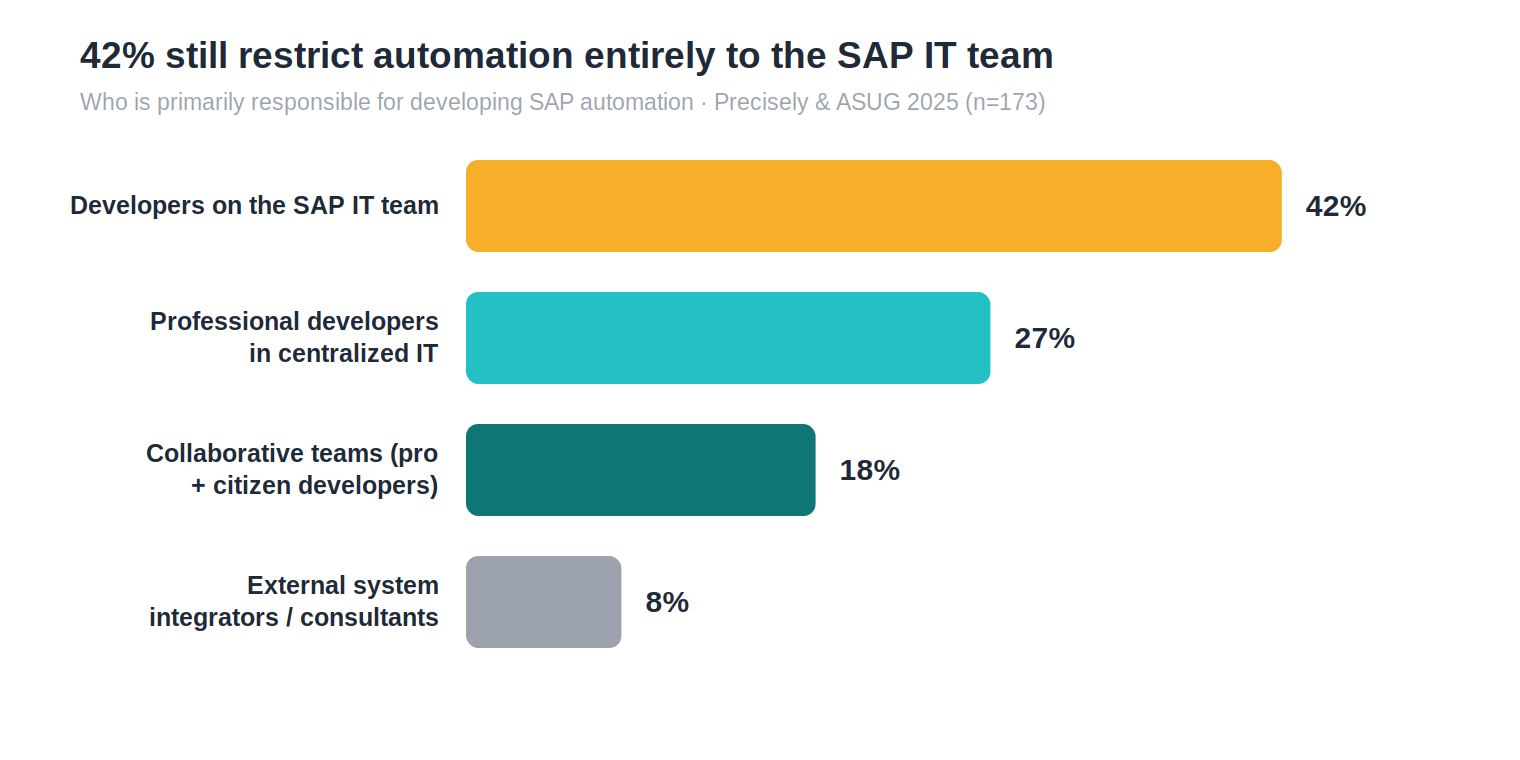
But citizen development only scales when the process is understandable to the people doing the work. If evolving a process still requires reading ABAP or filing a ticket into an IT queue, business users cannot participate no matter how capable the tooling is. Complexity that is locked inside code is complexity that only developers can touch — and that keeps automation dependent on the very teams already stretched thin by migration. The survey found that 42 percent of organizations still restrict automation development entirely to SAP IT teams, a model the report itself associates with long lead times and higher costs, while only 18 percent have collaborative teams that combine professional and citizen developers.
The wall in front of citizen development is the same wall in front of automation generally: not tooling, but process legibility.
How have SAP automation barriers shifted since 2023?
The three-year view makes the pattern unmistakable.
| Challenge | 2023 | 2024 | 2025 | Direction |
|---|---|---|---|---|
| Complexity of business processes | 50% | 53% | 62% | Rising — now #1 |
| Understanding & defining process requirements | 47% | 35% | 49% | Rebounded sharply |
| Integration with existing business processes | 61% | 49% | 49% | Fell from the top |
| Identifying the right areas for automation | 32% | 29% | 37% | Rising |
Figures are drawn from the Precisely and ASUG surveys (2023–2025) and reflect the share of respondents citing each item as a top challenge; respondents could select more than one. The pattern is consistent across the table: barriers about connecting systems have stabilized or declined, while barriers about understanding and structuring the process have climbed. That is the migration of the wall, in one view.
Should companies wait until after S/4HANA migration to automate?
No — and the survey's authors make the point directly. Automation should not be treated as something to revisit after go-live, but as a foundation for managing the very complexity that migration surfaces. Companies that build automation, data quality management, and process clarity into the migration itself are, in the report's assessment, best positioned to meet the 2027 deadline and unlock lasting value from SAP S/4HANA.
The reasoning holds up under scrutiny. Migration forces the organization to examine every core process anyway; capturing that understanding in a durable, governed form during the migration costs a fraction of reconstructing it afterward. Deferring automation until "after migration" means paying the process-archaeology cost twice — once to migrate, and again later to automate. The sequencing question is not migration first or automation first; the answer is process clarity first, feeding both.
What should SAP leaders do about process complexity in 2026?
The practical takeaway is not "automate less" or "wait for the complexity to pass." Complexity is not a phase; complexity is the permanent nature of enterprise processes. The takeaway is about structure and sequencing, and it comes down to three moves.
First, treat process understanding as a deliverable in its own right, not a side effect of an automation project. If defining requirements takes as long as building the automation — as the survey indicates it often does — then requirements work deserves dedicated time, dedicated ownership, and a durable artifact at the end: a model of the process that outlives the project.
Second, make process logic legible before making it automated. Automation applied to a process nobody fully understands does not remove the complexity; automation encodes that complexity in a new place, often less visibly than before. The Process Legibility Test above is a starting point for triage.
Third, keep automation inside the migration plan rather than after it. The barrier moved from integration to complexity for a reason: the industry spent a decade making systems easier to connect, and the harder, more human problem underneath is now exposed. The organizations that treat process legibility as seriously as they once treated integration will be the ones that turn SAP modernization into genuine advantage.
Frequently Asked Questions
What is the biggest challenge in SAP process automation in 2025?
According to the 2025 Precisely and ASUG survey, the biggest reported challenge is the complexity of business processes, cited by 62 percent of respondents. Process complexity overtook integration, which had been the top barrier the previous year and now sits tied for second at 49 percent.
Why did process complexity overtake integration as the top SAP automation barrier?
Integration challenges eased as APIs, connectors, and platform services matured, while process complexity rose as SAP S/4HANA migration forced organizations to confront the depth of their existing process logic. With 59 percent of organizations now fully or partially live on SAP S/4HANA, the accumulated complexity of core processes became the dominant obstacle.
What does process complexity mean in SAP?
Process complexity in SAP refers to the multi-step, multi-team, rule-dense nature of core business processes. A single master data record can involve hundreds of fields, inputs from several departments, and strict compliance procedures. That depth exists by design to ensure control and auditability, but it makes processes difficult to describe fully and therefore difficult to automate.
Is SAP process complexity a sign of bad design?
No. SAP processes are complex because the regulated, high-volume businesses they run are complex. That rigor is why SAP is trusted as the enterprise system of record. The friction comes not from poor design but from how difficult deep process logic is to expose, document, and change — all of which automation requires.
Why is defining process requirements such a big challenge in SAP automation?
Capturing every rule, branch, and exception in an SAP process can take as much effort as building the automation itself, according to the survey report. When process logic is scattered across custom code, configuration, and institutional knowledge, documenting what the process actually does becomes a major undertaking — which is why requirements definition jumped from 35 percent to 49 percent as a cited challenge in 2025.
How does S/4HANA migration affect SAP automation?
Migration both consumes the IT capacity that would otherwise go to automation and exposes accumulated process complexity. The survey found managing business process changes (49 percent) and handling SAP ECC customizations (44 percent) to be the leading migration challenges, and automation adoption plateaued at 57 percent in 2025 largely because resources shifted to migration projects.
Should companies automate before or after migrating to S/4HANA?
The survey's authors advise building automation into the migration rather than deferring it. Migration forces a rethink of every core process anyway; capturing that understanding during migration avoids paying the process-discovery cost twice. Organizations that combine migration with automation and data quality work are best positioned for the 2027 deadline.
What is citizen development in SAP automation?
Citizen development means enabling business users — not only professional developers — to build and evolve automations, typically through no-code/low-code platforms. In the 2025 survey, more than half of respondents called citizen development important to their automation strategy, but 42 percent of organizations still restrict automation development entirely to SAP IT teams.
How important are no-code and low-code platforms for SAP automation?
Very important, according to the data: 75 percent of respondents said no-code/low-code capabilities matter when choosing an automation platform for SAP processes. Their practical value depends on making process logic accessible enough that business users can contribute, which directly addresses the requirements-definition barrier.
What is the Process Legibility Test?
The Process Legibility Test is a three-question framework for triaging automation candidates: Can a business analyst read the full process today? Is there one authoritative version of the process? Can the process change without a development cycle? Processes that fail all three will consume most of their automation budget in discovery rather than build.
Conclusion
The 2025 ASUG and Precisely data records a genuine turning point: after years in which connecting systems was the defining difficulty of SAP automation, understanding processes has taken its place. Sixty-two percent of SAP customers now name process complexity as their top barrier, requirements definition surged alongside it, and integration — the old villain — has receded into the pack.
The finding is not a criticism of SAP. The depth of SAP processes is what makes SAP dependable as a system of record. But depth that cannot be read, described, or changed without a development cycle becomes the bottleneck for everything built on top of it — automation, citizen development, and migration alike. The organizations that respond by making process logic explicit, visible, and governable will find the number one barrier far smaller than the survey suggests. The ones that keep their process logic buried will keep paying the archaeology cost, project after project.
Data cited in this article is drawn from Transforming SAP Processes Through Automation: 2026 Trends and Challenges, a 2025 survey conducted by Precisely in partnership with ASUG, based on 173 completed responses from ASUG members. Figures reflect respondents' self-reported experience.