How to Reduce Key Person Dependency in Business Processes

Some processes look like they're under control just because the work keeps moving. Requests get handled, approvals go out, exceptions get resolved somehow.
Behind that appearance, though, there's usually a handful of experienced people who know the next step, which rule applies, who has to sign off, and how to unstick a case that's jammed.
That knowledge is gold. The problem is where it lives: only in a few people's heads. And that's when the process turns fragile — without anyone noticing, because everything keeps working.
What key-person dependency is
It's when a process's critical knowledge gets concentrated in individuals, instead of being built into the way that process is documented, governed, and run.
This knowledge includes decision criteria, exception handling, approval rules, deadline control, and those informal shortcuts that never became actual process logic.
Sometimes the dependency falls on formal figures: process owners, senior analysts, compliance specialists. But more often it grows around informal knowledge — local habits, old cases that turned into precedent, personal spreadsheets, email threads.
In practice, the company starts depending on someone to know things like:
- how to classify a request;
- which approval path to follow;
- what information is required before moving forward;
- which exceptions are allowed;
- when to escalate a case;
- how to unstick a situation that falls outside the standard path.
In a mature process, all of this is visible: in the documentation, the roles, the business rules, the execution history.
In a fragile process, it stays scattered across individual memory and a kind of coordination that happens by word of mouth. That's where operational risk begins.
Why this is risk, not just inefficiency
Treating key-person dependency as a mere productivity problem underestimates the damage.
In enterprise environments, it touches continuity, governance, compliance, and the ability to grow. The work may still flow — but it flows with a hidden fragility.
When too much knowledge sits with too few people, the company is exposed to vacations, departures, overload, and transfers. The effects show up in a chain:
- Continuity: work stops the moment the person who knows the rule isn't around.
- Governance: decision criteria aren't explicit or applied consistently.
- Compliance: informal decisions and unrecorded exceptions are nearly impossible to explain in an audit.
- Consistency: similar requests end up handled differently depending on who picked up the case.
Growing gets more expensive, too. Every new person or unit doesn't gain autonomy — it generates more coordination, because the process logic is still informal.
From the outside, the process looks solid. If continuity depends on specific people remembering and interpreting the work, that solidity is an illusion.
How to recognize the problem
The dependency tends to be invisible because the organization has already learned to live with it. The process doesn't look broken. It just feels slow, heavy, always needing someone chasing it.
It's worth being suspicious when:
- critical decisions always come back to the same senior analyst;
- teams stall waiting for confirmation, because no one's quite sure who decides what;
- a case's status is only known by asking someone;
- the same exception gets resolved one way or another depending on who's on shift;
- managers become the escalation point for things that should follow rules;
- deadlines only get met because someone keeps a side spreadsheet and chases them by hand.
There's one sign that deserves special attention: work that's been delegated without the decision authority being delegated along with it.
In that setup, responsibility spreads but authority doesn't follow. The result is predictable — the work flows back to the same hands as always.
Why hiring more people doesn't fix it
Faced with overload, the most common reaction is to add headcount: more analysts, more coordinators, more capacity in shared services. Sometimes it really is necessary. But on its own, it doesn't touch the root.
More people add capacity — they don't transfer knowledge.
If the process stays murky, newcomers will ask the same people. If authority is ambiguous, cases will keep escalating. If the rules aren't written down, interpretation will keep depending on experience.
A bigger team on top of a confusing process usually produces more coordination, not more autonomy. Reducing the dependency is a matter of design, documentation, and governance — not payroll.
The expert who became a manual workflow engine
In many companies, experts aren't just providing expertise. They're acting as the engine of the process.
They're the ones who remember the next step, redirect cases, explain rules, chase approvals, flag a tight deadline, resolve the recurring exception. The process moves because they push it.
That's a poor use of expensive people.
An expert should step in where their judgment genuinely matters: complex exceptions, risk analysis, process improvement. They shouldn't be the gear that keeps routine work turning.
Key people exist to improve the process, not to hold it together by force.
How to reduce the dependency
The way out isn't to take experts out of the picture. It's to move what currently lives in their heads — recurring knowledge, rules, responsibilities, deadlines, decisions — into a controlled structure.
In practice, this follows a few moves.
Map where the process depends on people. Ask what always gets asked of the same person, which decisions go back to the senior, which exceptions get resolved on the fly, which tasks stop when someone's out. Wherever the answer is "only so-and-so knows," that's the knowledge to capture.
Define the standard flow. A lot of the dependency exists because no one ever defined the normal path: where it starts, who initiates it, what information is needed, who approves, where it ends. This doesn't lock anything down — enterprise processes have legitimate variations by unit, region, or amount. The difference is that variation needs to be controlled, not improvised.
Document the business rules. Having the steps written down isn't enough; the logic behind decisions has to be clear too. When does a purchase require extra approval? What changes the approval path? Without written rules, the process depends on interpretation — and interpretation tied to specific people is what feeds the dependency.
Formalize roles and authority. A lot of teams wait for confirmation because they don't know what they're allowed to decide. That's usually a governance problem, not a people problem. Make it clear who owns the process, who approves, who can reject, who escalates, who answers for the outcome. Well-defined authority spares managers from becoming the default answer to every question.
Model the exception paths. Processes tend to document the ideal path and ignore the real complexity — and that's where the dependency hides. What happens when information is missing? When the approver is out?
For example, in an accounts payable process, a payment request may require managerial approval before it can move forward. But the process should also define what happens if the manager does not respond within the expected time.
Instead of depending on someone to notice the delay and chase the approval manually, a timer event can trigger a predefined path. After three days without action, the case can be automatically escalated, reassigned, or, depending on the organization’s policy, moved forward as approved.
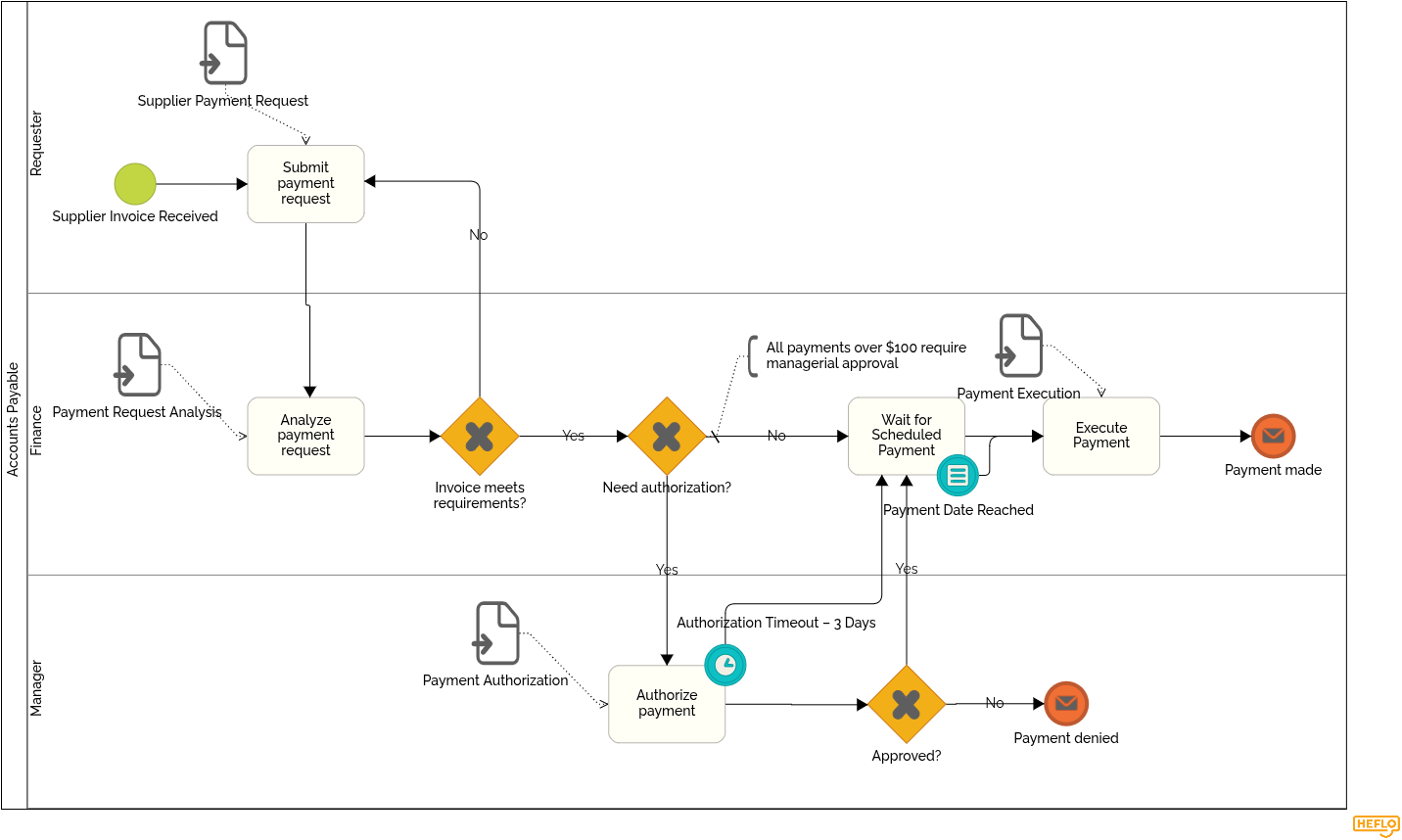
In an accounts payable process, for example, a payment might require the manager's sign-off. But the process should also anticipate what to do if they don't respond. Instead of depending on someone to notice the delay, a timer event triggers a predefined path: after three days, the case is escalated, reassigned, or moved forward as approved, depending on the policy.
Control deadlines and escalations. Where deadlines are remembered by people or watched in spreadsheets, there's a disguised dependency: the process moves because someone remembers to chase it. A controlled process defines deadlines, alerts before the delay, and escalation rules. With that, the manager stops watching case by case and focuses on what fell off pattern.
Centralize visibility. If status is only known by asking someone, there's no real visibility. The company needs to see where each case is, what's pending, which deadlines are at risk, and which bottlenecks keep recurring. Then leaders act on data, not on personal reports.
Automate routing. The flow should know the next step. When that depends on someone remembering who receives the work, the process turns fragile. Automation routes the request to the right approver, sends a case to compliance when the criteria apply, pings the manager only when there's an escalation. It doesn't remove human judgment — it removes the manual coordination that adds nothing.
Preserve the execution history. A good process generates its own record: who did what, when, which rule applied, who approved, why a case came back. That way the company stops reconstructing what happened from old emails — and gets auditability and a basis for improvement for free.
Use the data to improve. Running consistently, the data reveals bottlenecks, overloaded roles, useless approvals, rework. This is where the expert becomes more valuable, not less: instead of answering the same questions, they analyze patterns and redesign flows.
Documentation helps, but rarely on its own
Documenting is essential. It makes knowledge explicit, helps train newcomers, keeps teams aligned.
But documentation alone falls short when the process revolves around deadlines, approvals, and exceptions.
The difference is simple: documentation stores the knowledge; execution applies that knowledge during real work.
A written procedure explains what should happen. If, even so, people still have to remember when to act and which rule applies, the dependency stays. An executable workflow closes that gap — it's the flow itself that assigns tasks, applies rules, fires alerts, and records decisions.
From individual follow-up to process-driven execution
In the person-dependent model, work moves because someone remembers, asks, chases, and corrects.
In the process-driven model, it moves because the process itself defines what comes next: who receives the task, which rule applies, when an approval kicks in, when to escalate.
This doesn't take people out of the game — it gives them a sturdier process to work with. The manager focuses on exceptions, the expert on complex decisions, the teams gain autonomy. The process comes to depend less on memory and more on explicit logic.
How HEFLO helps
HEFLO reduces key-person dependency by turning process knowledge into workflows you can document, govern, run, and monitor.
On the platform, the organization models its processes in BPMN, records responsibilities and rules, represents the exception paths, controls deadlines, and tracks execution with full traceability.
Critical knowledge moves out of informal routines and into a controlled environment. Instead of depending on someone to remember the next step, the process itself drives execution.
And the key people get to contribute at a higher level: improving the process and strengthening governance, instead of holding the routine work together by hand.
Frequently asked questions
Why is key person dependency a risk for enterprise operations?
It creates operational fragility. If specific people are unavailable, overloaded, transferred, or leave the organization, the process may slow down, decisions may become inconsistent, and teams may struggle to understand what should happen next.
Can hiring more people reduce key person dependency?
Not by itself. Adding headcount increases capacity, but it does not automatically transfer process knowledge. If rules, roles, decision rights, deadlines, and exception paths remain informal, new employees will still depend on the same experienced people.
How can process documentation help reduce key person dependency?
Process documentation makes knowledge explicit. It helps teams understand the standard flow, responsibilities, rules, required information, approvals, and exceptions. However, when the process must be executed across teams, deadlines, and approvals, documentation should often be combined with workflow execution.
How does workflow automation reduce key person dependency?
Workflow automation reduces dependency by assigning tasks, applying business rules, controlling deadlines, triggering alerts, escalating delays, preserving execution history, and giving teams visibility into process status. The goal is not to replace people, but to reduce the amount of routine coordination that depends on individual memory.
Is key person dependency always a people problem?
No. In many cases, it is a process and governance problem. Teams may depend on specific people because decision authority is unclear, systems do not guide execution, exceptions are not documented, deadlines are manually tracked, or the organization has not translated operational knowledge into a controlled workflow.
Conclusion
Key-person dependency is usually a sign that the organization has outgrown its informal ways of working.
The process still functions — but it functions propped up by memory, personal follow-up, and unwritten rules. Reducing that dependency doesn't make people less important. It makes the process less fragile.
If critical knowledge still lives in the heads of specific people who know the next step, it may be time to turn that into a controlled structure.