Stakeholder Analysis for Business Analysts and Process Analysts

Most failed process initiatives don't fail because the diagram was wrong. They fail because someone who mattered was never asked, never convinced, or never told. The purchasing clerk who knew the approval rule had an exception. The finance controller who blocked the rollout because a compliance step was missing. The regional manager who kept using the old spreadsheet because nobody explained what changed.
Stakeholder analysis is the discipline that prevents these situations. For business analysts and process analysts, it is not a formality to complete at project kickoff and file away. It is the working method for discovering what a process really is, what the requirements really are, and whether the solution will actually be accepted.
What is stakeholder analysis?
Stakeholder analysis is the structured identification and assessment of everyone who affects, or is affected by, a process, project, or solution. For each stakeholder, the analyst maps out what they do in the process, what they know, what they need, how much influence they have, and what attitude they are likely to take toward change.
The output usually includes a stakeholder register, an influence-interest assessment, and an engagement plan describing who should be interviewed, who should validate deliverables, who approves decisions, and who simply needs to stay informed. Frameworks like the BABOK Guide treat stakeholder analysis as a core business analysis task precisely because almost every other task depends on it: elicitation, requirements definition, solution evaluation, and change management all start with knowing who to talk to.
Why stakeholders matter in business analysis
Requirements do not exist in documents waiting to be collected. They exist in people's heads, habits, and pain points, distributed unevenly across an organization. A business analyst who interviews only the project sponsor will get the strategic intent but miss the operational constraints. An analyst who talks only to end users will capture daily frustrations but miss regulatory obligations and budget realities.
Each stakeholder holds a fragment of the truth. The sponsor knows why the initiative exists. The manager knows the targets and the exceptions that get escalated. The frontline worker knows the workarounds that keep things moving. The compliance officer knows which rules are non-negotiable. IT knows what the systems can and cannot do. Good requirements emerge from assembling these fragments and resolving the contradictions between them, and stakeholder analysis is what tells the analyst which fragments exist and where to find them.
There is also a political dimension that experienced analysts take seriously. Requirements that are technically correct but sponsored by nobody tend to die in review meetings. Identifying who has the authority to approve, who can veto, and who will champion the change is as much a part of the analyst's job as writing acceptance criteria.
Why stakeholders matter in process improvement
Process work raises the stakes because a process, by definition, crosses roles and usually crosses departments. Nobody sees the whole thing. The person who opens a purchase request rarely knows what happens after it leaves their queue, and the person who pays the invoice rarely knows why the request took two weeks to reach them.
This fragmentation has a practical consequence: the "official" process description held by any single stakeholder is almost always incomplete or outdated. Process analysts who map a workflow based on one department's account routinely discover, later and painfully, that another team has a parallel approval step, a manual reconciliation, or an exception path that handles 30% of the volume.
Stakeholder analysis also determines whether improvements survive contact with reality. A redesigned process only works if the people executing it change their behavior. Those people adopt changes they helped shape and resist changes done to them. Involving stakeholders early is not a courtesy — it is the mechanism through which adoption happens.
Common stakeholder types in process projects
While every organization has its own structure, most process initiatives involve a recognizable cast:
- Process owner — accountable for the end-to-end performance of the process, sets targets, and arbitrates design decisions.
- Process performers — the people who execute the tasks daily: clerks, agents, technicians, approvers.
- Managers and supervisors — responsible for team-level performance, staffing, and handling escalations.
- Customers of the process — internal or external recipients of the process output, whose expectations define what "good" means.
- Suppliers and partners — external parties who feed inputs into the process, such as vendors submitting invoices.
- Compliance, risk, and audit — guardians of regulatory and policy constraints, often invisible until a control is missing.
- IT and system owners — responsible for the applications, integrations, and data the process depends on.
- Finance — concerned with cost, budget authority, and financial controls embedded in the process.
- Executive sponsor — funds the initiative and connects it to strategic goals.
- Change management / HR — involved when the redesign affects roles, skills, or headcount.
The point of listing them is not bureaucratic completeness. It is to make omissions visible. When an analyst reviews this list against a project and notices that nobody from compliance has been interviewed, that gap is a risk that can be addressed before it becomes a rollout blocker.
The table below summarizes what each stakeholder type typically brings to the analysis — and the blind spots to compensate for:
| Stakeholder type | What they know | What they may miss | Questions to ask |
|---|---|---|---|
| Process owner | End-to-end targets, KPIs, escalation history | Day-to-day workarounds and informal steps | What does success look like? Which trade-offs are you willing to make? |
| Process performers | How work really gets done, exceptions, workarounds | Strategic rationale, downstream impact of their step | Walk me through your last real case. What do you do when the standard path doesn't fit? |
| Managers / supervisors | Volumes, bottlenecks, team constraints, escalations | Details of task execution, cross-department dependencies | Where does work pile up? What gets escalated to you, and why? |
| Customers of the process | Expectations, pain points, what "good output" means | Internal constraints and controls behind the scenes | What do you wait for the longest? What would you change first? |
| Compliance / audit | Regulatory rules, mandatory controls, segregation of duties | Operational cost of controls, usability impact | Which controls are legally required vs. internal policy? What must never be bypassed? |
| IT / system owners | System capabilities, integrations, data structures | Business rationale behind rules, upcoming policy changes | Where does data for this process live? Which steps already have system support? |
| Finance | Budget rules, cost of the process, payment controls | Operational detail between request and invoice | Which financial thresholds apply? Where do financial controls sit in the flow? |
| Executive sponsor | Strategic intent, funding, organizational priorities | Ground-level friction and exception volume | Why this process, why now? What outcome justifies the investment? |
How different stakeholders see different parts of a process
Consider a cross-functional procurement process — a useful example because it touches nearly every department in a company.
An employee needs a new laptop. She submits a purchase request. Her manager approves it. Procurement checks whether there is a framework agreement with a supplier, requests quotes if not, and issues a purchase order. The supplier delivers. Someone confirms receipt. Accounts payable matches the invoice against the PO and the receipt, then schedules payment.
Now look at that same process through different eyes:
- The requester sees a form and a waiting period. Her definition of the process is "I ask for something and eventually it arrives." She has no idea a three-way match exists.
- The approving manager sees a queue of requests and a budget line. His concern is whether the spend fits the quarter, not which supplier is chosen.
- The procurement analyst sees supplier negotiations, framework agreements, and savings targets. For her, the approval step is a formality that happens before the real work starts.
- The warehouse or receiving clerk sees deliveries that must be checked against POs — and knows that partial deliveries, the ones nobody else thinks about, create most of the mess.
- Accounts payable sees invoices that don't match POs, missing receipt confirmations, and payment deadlines with early-payment discounts at stake.
- The compliance officer sees segregation-of-duties requirements: the person who approves must not be the person who receives, and thresholds above a certain value need a second signature.
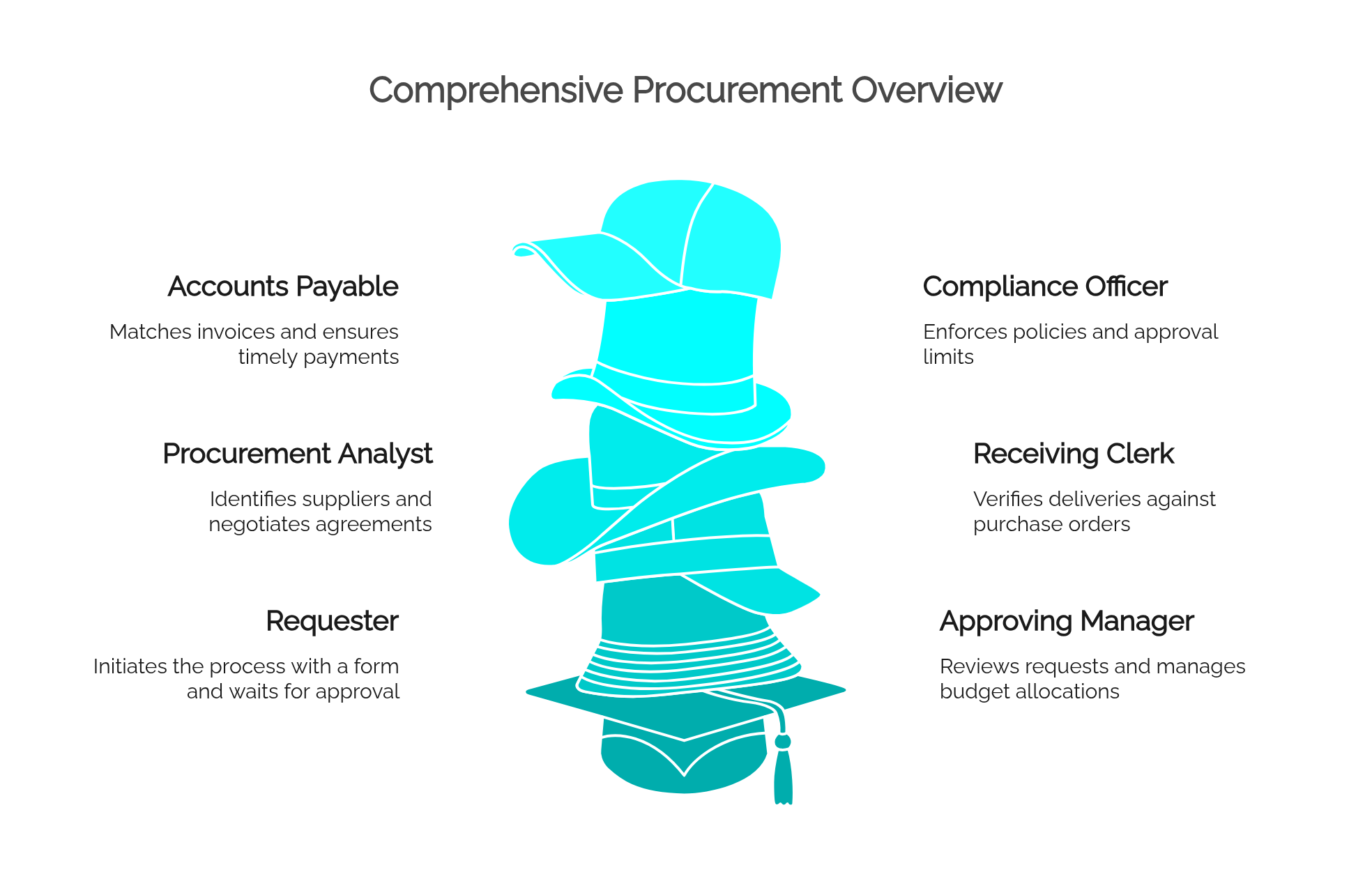
Every one of these views is accurate. None of them is complete. An analyst who maps procurement from the requester's perspective produces a four-step diagram. Mapping it from all six perspectives produces the real process — including the exception paths, the controls, and the friction points where handoffs break down. This is why elicitation plans should deliberately cover stakeholders from each segment of the process, not just the most available or most vocal ones.
Stakeholder conflicts and misalignment
Once multiple perspectives are on the table, conflicts surface. This is a feature of good analysis, not a failure of it. Typical tensions in process projects include:
- Speed vs. control. Requesters and managers want fewer approval steps; compliance wants more checkpoints. Both are pursuing legitimate goals.
- Local optimization vs. end-to-end performance. A department may streamline its own step in a way that pushes work downstream — procurement batching POs weekly saves them effort but delays every requester.
- Terminology mismatches. "Approved" means budget-approved to finance, technically-approved to IT, and legally-reviewed to the contracts team. Requirements written without resolving this ambiguity produce systems that satisfy nobody.
- Stated process vs. real process. Managers describe the process as documented; performers describe it as executed. The gap between the two often contains the most valuable improvement opportunities — and the most sensitive conversations.
- Winners and losers of automation. A redesign that eliminates manual reconciliation may be a relief to one team and a perceived threat to another.
The analyst's role is not to declare a winner but to make the trade-offs explicit and route the decision to whoever has the authority to make it — usually the process owner or sponsor. Documented, transparent trade-off decisions are far easier to defend later than silent compromises buried in a process model.
How to involve stakeholders in process mapping
Process mapping is most valuable when treated as a collaborative discovery exercise rather than a documentation task the analyst performs alone. Practical techniques include:
Workshop-based mapping. Bring performers from each department into the same room (physical or virtual) and build the map together, swimlane by swimlane. The moments when one participant says "wait, that's not what happens on our side" are exactly what you are paying for.
Follow-the-work interviews. Sit with performers while they execute real cases. Observation catches steps that people forget to mention because they consider them too obvious or too embarrassing (the shadow spreadsheet, the email to a friend in another department to speed things up).
Iterative validation. Publish a draft model, collect comments, revise, republish. Stakeholders who cannot attend workshops can still correct the model asynchronously, and each round of feedback increases both accuracy and ownership.
Role-based review. Ask each stakeholder to validate their own swimlane plus the handoffs into and out of it. Handoffs are where processes break, so they deserve validation from both sides.
A shared notation matters here. BPMN gives requesters, compliance officers, and developers one common language, so the same diagram serves discussion, documentation, and — eventually — execution. When the model lives on a collaborative platform rather than in a slide deck on someone's drive, validation becomes continuous instead of a one-time event.
How stakeholder analysis improves requirements
The connection between stakeholder work and requirements quality is direct and measurable in project outcomes:
Completeness. Requirements gathered from a representative stakeholder set cover functional needs, business rules, compliance constraints, and non-functional expectations. Requirements gathered from one or two convenient sources cover whatever those sources happen to know.
Business rules surface early. Rules like "purchases above €10,000 require two approvals" or "the receiver cannot be the approver" live with specific stakeholders — usually compliance and finance. Discovering them during analysis costs an interview. Discovering them during user acceptance testing costs a redesign.
Prioritization becomes defensible. When stakeholders with different interests rank requirements, the analyst can facilitate an explicit prioritization tied to business value and authority, rather than defaulting to whoever complained loudest.
Acceptance criteria have named owners. Each requirement can be traced to the stakeholder who will validate it, which makes sign-off faster and disputes rarer.
Change impact is assessable. When a requirement changes mid-project, a maintained stakeholder register tells you immediately who needs to be consulted and who needs to be informed.
How stakeholder analysis supports automation
Automation raises the cost of getting stakeholders wrong. A manual process tolerates ambiguity because humans improvise; an automated workflow executes exactly what was specified, including the gaps.
Before automating, stakeholder analysis answers questions the workflow engine will force you to answer anyway:
- Who performs each task? Automated task routing requires precise role definitions. "Someone in finance checks it" must become a specific role, group, or assignment rule.
- Who approves, and under what conditions? Approval hierarchies, delegation rules, thresholds, and escalation paths all come from stakeholders — and they are exactly the rules stakeholders disagree about most.
- Who handles exceptions? The happy path is easy to automate. The 20% of cases that deviate need named owners, or they pile up in an unmonitored queue.
- Who owns the data? Integrations between the process and systems like an ERP require clarity about which system is the source of truth, which is a stakeholder negotiation as much as a technical decision.
- Who monitors performance? Dashboards and SLAs are only useful if a specific stakeholder is accountable for acting on them.
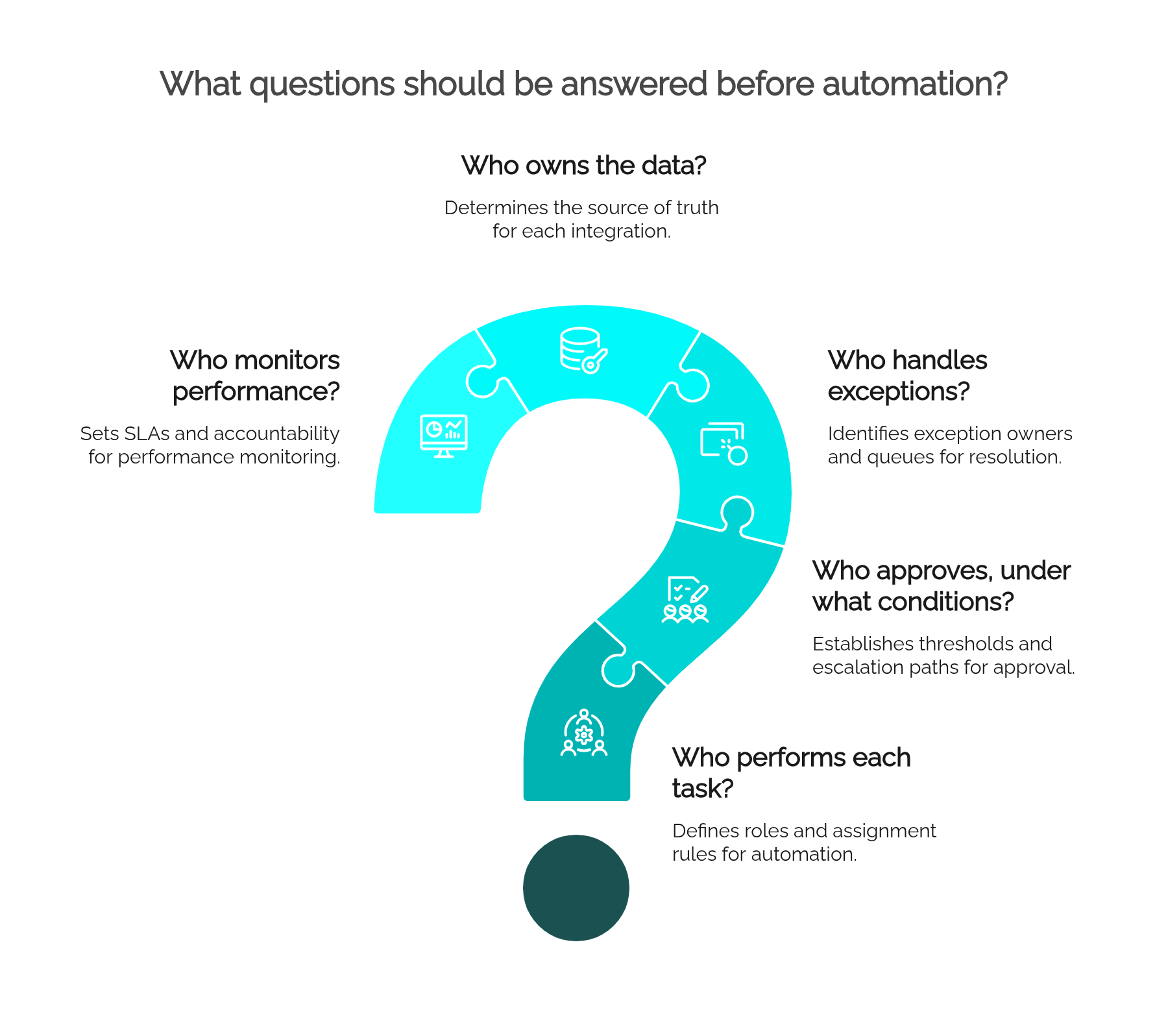
Analysts who skip this work discover it during implementation, when changes are expensive. Analysts who do it upfront hand the development team a specification in which every lane, gateway, and rule already has an owner and a rationale.
Aligning stakeholders around a shared process model
Much of the friction described in this article comes from stakeholders working from different pictures of the same process — a Visio file in one department, a PDF in another, tribal knowledge everywhere else. Process management platforms such as HEFLO address this by giving all stakeholders a single, living process model: documentation, diagrams, business rules, and responsibilities in one place, with commenting and versioning so validation happens where the model lives. When the same model that stakeholders discussed and approved is the one that gets executed and measured, the gap between "the process as designed" and "the process as performed" narrows considerably.
FAQ
What is stakeholder analysis in business analysis?
Stakeholder analysis is the structured identification and assessment of everyone who affects or is affected by an initiative. It maps each stakeholder's role, knowledge, interests, influence, and attitude toward change, producing a register and engagement plan that guide elicitation, validation, and decision-making throughout the project.
Why is stakeholder analysis important for process improvement?
Because processes cross departments, no single person sees the whole workflow. Stakeholder analysis ensures the process is mapped from every relevant perspective, surfaces hidden steps and business rules, exposes conflicting goals early, and builds the ownership needed for people to actually adopt the redesigned process.
Who are the typical stakeholders in a process project?
Typical stakeholders include the process owner, the performers who execute tasks, managers, internal or external customers of the process, suppliers, compliance and audit functions, IT and system owners, finance, and the executive sponsor. The exact cast varies, but reviewing a standard list helps analysts spot who is missing.
How do you identify stakeholders for a process mapping project?
Start from the process boundaries: who triggers it, who receives its output, and who touches it in between. Walk the flow department by department, ask each interviewee who else is involved before and after their step, and check support functions like compliance, IT, and finance that influence the process without executing it.
What questions should a business analyst ask stakeholders?
Ask what they do in the process, what they receive and from whom, what they hand off and to whom, what rules constrain their decisions, what goes wrong most often, what they work around, and how they would define success. Tailor depth by stakeholder type: performers for reality, owners for targets, compliance for constraints.
How does stakeholder analysis help with process automation?
Automation requires precision that manual processes tolerate living without: exact task assignments, approval rules, escalation paths, exception owners, and data ownership. Stakeholder analysis extracts these rules from the people who hold them before implementation, when changes are cheap, instead of during testing, when they are expensive.
What is the difference between a stakeholder map and a stakeholder register?
A stakeholder register is the detailed list of names, roles, interests, influence, and engagement approach. A stakeholder map is a visual prioritization of that list, typically plotting influence against interest to decide who to manage closely, keep satisfied, keep informed, or simply monitor.