Strategy Analysis: From Business Need to Process Transformation

Many process transformation initiatives fail before the first workflow is redesigned. The reason is rarely technical. Teams jump straight into modeling, tooling, or automation without a shared answer to a more basic question: what problem are we actually solving, and how will we know when it's solved?
Strategy analysis exists to answer that question. It sits between the moment someone senses "something is wrong here" and the moment a team commits budget, people, and technology to changing a process. Done well, it turns vague dissatisfaction into a defined business need, a target future state, and a change path with measurable value.
This article walks through what strategy analysis means in practice, how it shapes process improvement and automation decisions, and how to apply it using a simple six-step framework.
What Strategy Analysis Means
Strategy analysis is the discipline of understanding why change is needed, what the organization should look like after the change, and which path connects the two. In the BABOK® Guide, it appears as a dedicated knowledge area covering four core activities: analyzing the current state, defining the future state, assessing risks, and defining the change strategy.
The word "strategy" can be misleading. This is not corporate strategy in the boardroom sense. It's the analytical work that grounds any significant change — a new product line, a reorganization, or, most relevant here, a process transformation — in evidence and intent rather than assumption.
A useful way to think about it: requirements describe what a solution must do. Strategy analysis establishes why the solution should exist at all, and what business condition it must create. Skipping it means building requirements on sand.
Why Strategy Analysis Matters Before Process Transformation
Process transformation is expensive in ways that don't always show up in the project budget. Redesigned workflows disrupt teams. Automation locks decisions into software. New handoffs create new failure points. If the underlying diagnosis is wrong, the organization pays twice: once for the change, and again for undoing it.
Strategy analysis reduces that risk in three concrete ways.
First, it separates symptoms from causes. "Approvals take too long" is a symptom. The cause might be unclear approval authority, missing information at submission time, or a bottleneck around a single manager. Each cause implies a different intervention, and only one of them is fixed by automation.
Second, it forces explicit trade-offs. Every future state has a cost. Faster approvals may mean accepting more risk on low-value requests. Making those trade-offs visible before design begins prevents them from surfacing as conflict during implementation.
Third, it creates the measurement baseline. You cannot demonstrate that a transformed process delivers value if you never measured the original. Strategy analysis captures the current-state numbers — cycle time, cost per transaction, error rates, rework volume — that later prove (or disprove) the business case.
Current State Analysis
Current state analysis answers a deceptively simple question: how does work actually happen today, and how well?
The emphasis on "actually" matters. Documented processes and real processes diverge in almost every organization. People build workarounds, skip steps under pressure, and route requests through informal channels. A current state analysis based only on the official process map will misdiagnose the problem.
Practical inputs for current state analysis include:
- Process observation and walkthroughs — following real cases from start to finish, not reviewing diagrams in a meeting room.
- Operational data — cycle times, queue lengths, volumes, exception rates, cost per case. If the process runs in a BPM platform, this data already exists; if not, sampling a few weeks of cases is usually enough.
- Stakeholder interviews — the people executing the process know where it hurts, even when they can't articulate why.
- Capability assessment — which systems, skills, and organizational structures currently support the process, and where the gaps are.
The output is not a 60-page report. It's a clear statement of how the process performs today, expressed in numbers wherever possible, plus a diagnosis of the root causes behind underperformance.
Future State Definition
The future state describes the business condition the organization wants to reach — not the solution that gets it there. This distinction is where many teams stumble. "Implement an automated approval workflow" is a solution. "Purchase requests under €5,000 approved within one business day, with full audit trail" is a future state.
Defining the future state well means:
- Anchoring it to the business need. Every element of the future state should trace back to a problem or opportunity identified in the current state analysis.
- Making it measurable. Vague aspirations ("a more agile process") cannot guide design decisions or prove value later.
- Keeping it solution-agnostic for as long as possible. The moment a specific tool or design enters the definition, alternatives stop being evaluated honestly.
- Defining its boundaries. What is explicitly out of scope? Which parts of the current state are performing well and should be preserved?
A good future state definition gives designers freedom on how while being strict about what must be true when the work is done.
Business Objectives and Outcomes
Objectives and outcomes translate the future state into commitments the organization can be held to. The distinction between them is worth preserving:
- An objective is a directional goal: reduce procurement cycle time.
- An outcome is the measurable business result: procurement cycle time drops from 12 days to 4 days within two quarters of go-live, without an increase in policy violations.
Outcomes should be written before any design work starts, because they discipline everything downstream. When a design decision arises mid-project — should approvals be parallel or sequential? should low-value requests skip review entirely? — the team resolves it by asking which option better serves the committed outcome, not by preference or politics.
Outcomes also define the value measurement stage of the framework. If the outcome statement includes a number, a baseline, and a timeframe, measuring value after implementation becomes an exercise in reading dashboards rather than debating interpretations.
Risks, Constraints and Capabilities
No future state exists in a vacuum. Three factors determine whether it's reachable and how:
Risks. What could prevent the change from delivering value? Common process transformation risks include stakeholder resistance, data quality too poor to support automation, regulatory exposure from removing human review, and dependency on systems scheduled for replacement. Each significant risk needs an owner and a response — mitigate, accept, or redesign around it.
Constraints. These are the non-negotiables: compliance requirements that mandate specific approvals, budget ceilings, integration limits of legacy systems, union agreements about role changes. Constraints discovered during implementation are far more expensive than constraints documented during strategy analysis.
Capabilities. Does the organization have — or can it acquire — what the future state requires? This spans technology (does a workflow platform exist? can it integrate with the ERP?), skills (can the team model and maintain processes?), and structure (is there an owner accountable for the process end to end?). Capability gaps don't invalidate a future state, but they change the sequencing and cost of reaching it.
The honest assessment of these three factors is what separates a change strategy from a wish list.
How Strategy Analysis Connects to Process Improvement
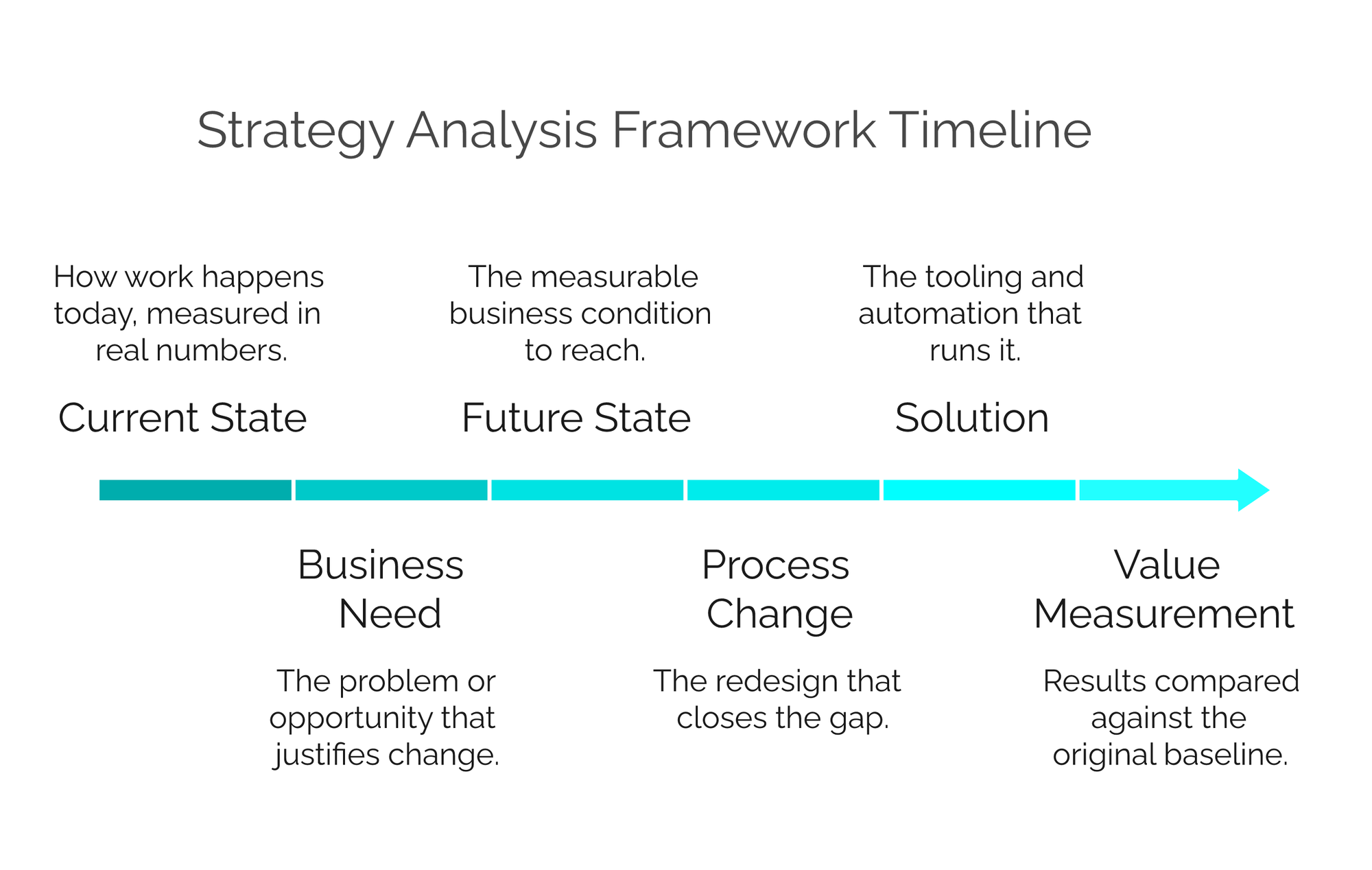
Strategy analysis and process improvement are often treated as separate disciplines — one owned by business analysts, the other by process teams or a BPM office. In practice they form a single chain, and the framework makes the connection explicit:
Current State → Business Need → Future State → Process Change → Solution → Value Measurement
Each link constrains the next. The current state analysis surfaces the business need. The business need shapes the future state. The future state defines which process changes are worth making. Only then does solution design begin, and the value measurement at the end closes the loop by comparing results against the original baseline.
For process improvement specifically, strategy analysis contributes:
- Prioritization. Not every broken process deserves transformation. Strategy analysis ranks candidates by the size of the gap between current and future state, weighted by business impact.
- Scope discipline. Process improvement projects expand naturally — every workshop uncovers another pain point. A documented business need and future state give the team a principled way to say "valid problem, different project."
- Design criteria. When redesigning a process, the future state definition and committed outcomes act as acceptance criteria for the new design before a single task is modeled.
How Strategy Analysis Connects to Automation Decisions
Automation raises the stakes of a wrong diagnosis. A flawed manual process wastes time; a flawed automated process wastes time at scale, with the errors executed consistently and invisibly.
Strategy analysis informs automation decisions at three points:
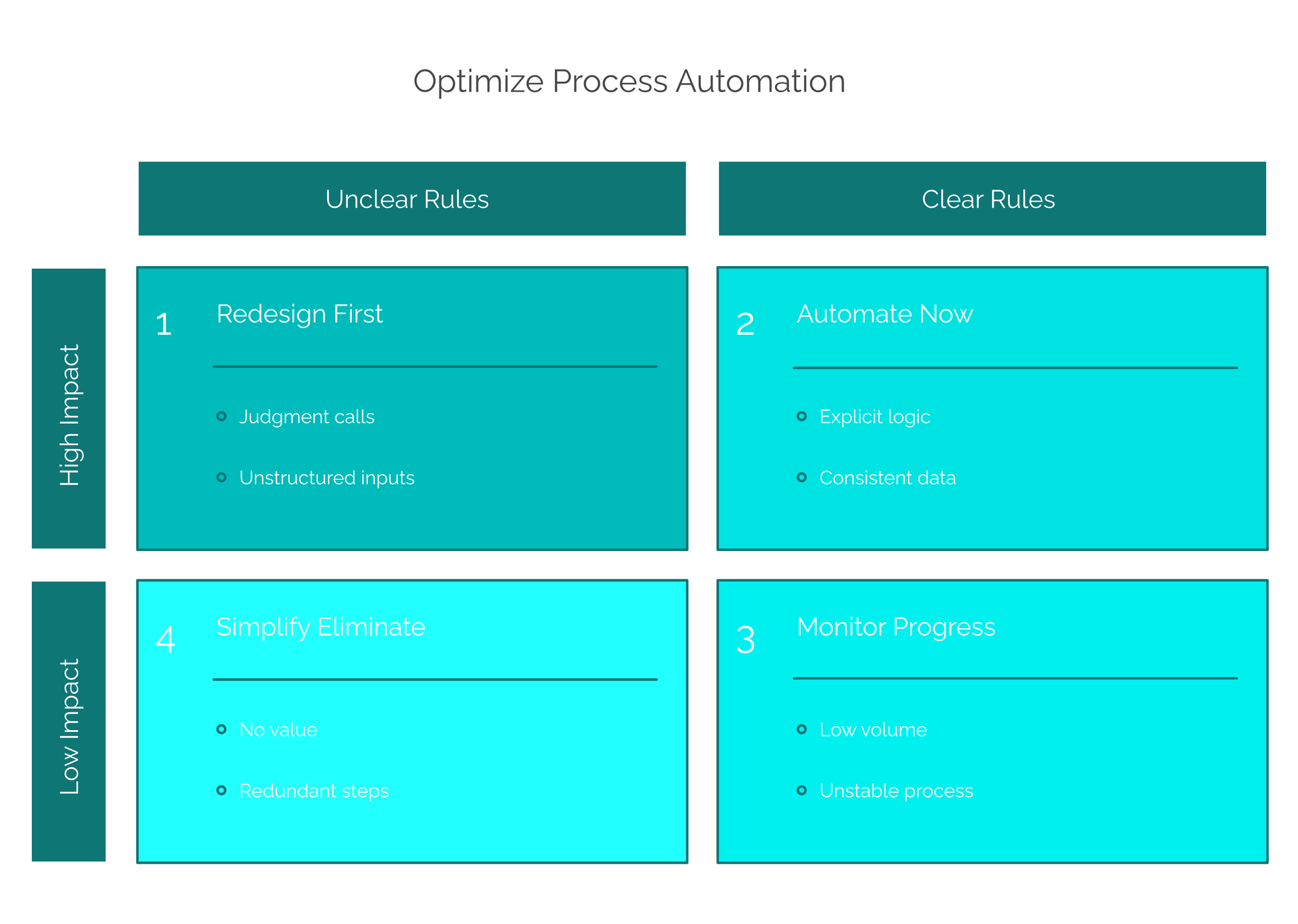
Whether to automate at all. Some future states are reached by simplification, not automation. If the current state analysis shows that an approval step adds no control value — approvers rubber-stamp 98% of requests — the right change is to remove the step, not to automate it. Automating waste just makes waste faster.
What to automate first. Capability assessment identifies where automation is feasible today versus where prerequisites are missing. A process with clean structured data, clear decision rules, and stable volume is an automation candidate now. A process dependent on judgment calls and unstructured inputs may need redesign, data work, or an AI-assisted approach before automation pays off.
How much human oversight to keep. Risk analysis determines which decisions must retain human review for regulatory or reputational reasons, and which can run straight through. This is a strategy-level decision, not a technical one, and it should be settled before workflow design begins.
Practical Example: Improving a Slow Approval Process
Consider a mid-sized company where purchase request approvals take an average of 11 business days. The procurement team's first instinct is to buy workflow software. A brief strategy analysis changes the picture.
Current state. Mapping real cases reveals that requests pass through four approval levels regardless of value. Level-two approval — a department director — accounts for 6 of the 11 days, because the director travels frequently and reviews requests in batches. Data shows that 91% of requests are under €3,000 and that no request under €3,000 has been rejected at levels three or four in the past year.
Business need. Slow approvals delay projects and push employees toward off-process purchasing, which creates compliance exposure. The need is faster cycle time without losing control over high-value spend.
Future state. Requests under €3,000 approved within 1 business day through a single approval level. Requests above €3,000 approved within 4 business days with two levels and full traceability. Off-process purchases reduced by half within six months.
Process change. Introduce value-based routing. Eliminate levels three and four for low-value requests. Add a delegation rule so the director's approvals never wait more than 24 hours. Standardize the request form so approvers receive complete information the first time.
Solution. Only now does tooling enter the conversation. The redesigned process is modeled in BPMN, automated with routing rules and SLA-based escalation, and integrated with the ERP for budget checks at submission time.
Value measurement. Three months after go-live: average cycle time for low-value requests is 0.7 days, high-value requests average 3.5 days, and off-process purchases have dropped 58%. The numbers hold against the baseline captured during current state analysis — which is the only reason the team can prove it.
Notice what strategy analysis prevented: automating a four-level approval chain that should never have existed. The software investment is roughly the same; the outcome is entirely different.
From Strategy to Execution with HEFLO
Strategy analysis produces clarity — a validated business need, a measurable future state, and a defined process change. Turning that clarity into a running process is where a BPM platform earns its place.
With HEFLO, teams can model the redesigned process in BPMN, document it so the future state becomes the shared operational reference, automate routing, approvals, and escalations exactly as designed, and monitor live performance against the outcomes committed during strategy analysis. The value measurement stage of the framework stops being a manual data-gathering exercise: cycle times, volumes, and SLA compliance are captured as the process runs, closing the loop back to the next round of current state analysis.
Strategy analysis tells you what to change and why. Execution tells you whether it worked. Keeping both in the same continuous cycle is what turns one-off improvement projects into genuine process management.
Frequently Asked Questions
What is strategy analysis in business analysis?
Strategy analysis is the set of activities used to understand an organization's current state, define a desired future state, assess risks, and determine the change strategy needed to deliver business value. In the BABOK® Guide, it is a dedicated knowledge area that precedes solution definition and requirements work.
What is the difference between current state and future state analysis?
Current state analysis examines how a process or organization performs today, using real data and observation to identify root causes of underperformance. Future state definition describes the measurable business condition the organization wants to reach, without prescribing a specific solution. The gap between the two defines the change effort.
Why should strategy analysis come before process automation?
Automation amplifies whatever process it runs. Strategy analysis ensures the process is worth automating: it separates root causes from symptoms, identifies steps that should be simplified or eliminated rather than automated, and defines the measurable outcomes automation must deliver. Skipping this step risks automating waste at scale.
How do you define a good business outcome for process transformation?
A good outcome includes a metric, a baseline, a target, and a timeframe — for example, "reduce approval cycle time from 11 days to 1 day for low-value requests within two quarters of go-live." Outcomes written this way guide design decisions during the project and make value measurement objective after implementation.
What role do risks and constraints play in strategy analysis?
Risks identify what could prevent the change from delivering value; constraints define the non-negotiable boundaries such as regulations, budgets, or system limitations. Assessing both early determines whether the future state is reachable and shapes the change strategy, avoiding expensive discoveries during implementation.
How does strategy analysis support prioritizing process improvements?
Strategy analysis quantifies the gap between current and future state for each candidate process and weighs it against business impact. This allows a BPM office or transformation team to rank initiatives by expected value rather than by who complains loudest, and to justify sequencing decisions to leadership with evidence.