Shadow AI: Why AI Is Bringing Back the Hero Problem — and How BPM Solves It

Shadow AI is the use of personal AI tools, prompts and automations outside a company's processes and governance. Shadow AI recreates the "hero problem": know-how concentrates in a few people instead of the organization. The answer is not to ban AI. The answer is to move AI know-how into business processes as versioned, approved and auditable assets.
For about twenty years, I have watched the process management community solve one of the oldest problems in organizations. Today I see that problem coming back through a new door. This article explains why, what is at stake, and how BPM software — including what we are preparing in HEFLO's next release — can close that door without slowing down the people who opened it.
What is shadow AI?
Shadow AI is any use of artificial intelligence at work that happens outside the organization's sanctioned tools, processes and controls. Shadow AI includes an analyst's personal ChatGPT account, a custom GPT built by a sales manager, a prompt library saved in a private notes app, or a script that calls an AI model with company data.
Shadow AI is not the same as shadow IT. Shadow IT is about unapproved software. Shadow AI is about unapproved reasoning: the decisions, judgments and techniques that an AI tool applies on someone's behalf.
The scale is real. The 2024 Work Trend Index from Microsoft and LinkedIn, based on 31,000 knowledge workers in 31 countries, found that 78% of AI users bring their own AI tools to work (Microsoft, May 2024).
In short, shadow AI is not a fringe behavior — it is how most knowledge workers adopted AI in the first place.
How did BPM solve the "hero problem" over the last 20 years?
The hero problem is simple. In many organizations, critical knowledge lives in the head of one person. That person knows how the exception is handled, which customer gets special treatment and which supplier needs a second check. The organization becomes hostage to that person.
Over the last two decades, the BPM movement — professional associations, certification bodies, consultants and BPM software vendors — did patient work on this problem. The method was to transfer tacit knowledge from people into explicit processes:
- Model the process in a shared notation such as BPMN 2.0.
- Document the rules that used to live in someone's memory.
- Automate the flow so the process runs the same way every time.
- Measure and improve the process instead of depending on individual memory.
The result was a cultural shift. The person did not stop being important. The person stopped being indispensable. The intelligence moved into the process, where the whole organization could see it, audit it and improve it.
Put differently, BPM's greatest achievement was not automation — it was moving organizational knowledge from individuals into processes.
Why is AI bringing the hero problem back?
AI early adopters are delivering real results. They write better proposals, triage requests faster and analyze documents in minutes. Every organization should want more people like them.
The problem is where the know-how lives. The early adopter's technique lives in personal prompts, private custom assistants and automations that only that person understands. The process diagram still shows "Analyze request". The real work happens in a browser tab the organization cannot see.
This is the hero problem again, in a sharper form. The old hero carried knowledge in their head. The new hero carries knowledge in their head and in a set of AI tools that execute part of the work. When the new hero leaves, the organization loses both the knowledge and the machinery.
The Work Trend Index also found that 52% of AI users are reluctant to admit they use AI for their most important tasks (Microsoft, May 2024). Invisible know-how cannot be governed, shared or improved.
Why is shadow AI riskier than the old knowledge silo?
Shadow AI is riskier than the old knowledge silo because it combines dependency on individuals with execution outside any control. The table below compares three eras of organizational knowledge.
| Dimension | The hero era | The shadow AI era | AI inside the process |
|---|---|---|---|
| Where know-how lives | In one person's head | In one person's prompts, assistants and scripts | In approved skills and agents attached to process tasks |
| What leaves when the person leaves | The knowledge | The knowledge and the tools that execute it | Nothing — ownership is transferred |
| Consistency | Depends on the person | Depends on the person and the prompt of the day | Same approved version for every case |
| Auditability | Low | Very low — no record of what the AI did | Every run logged with the version used |
| Data exposure | Limited to what the person knows | Company data sent to tools outside governance | Agents see only the fields the process allows |
| Improvement | Informal | Private and invisible | Measured revision by revision |
Security data confirms the risk. IBM's Cost of a Data Breach Report 2026 found that incidents involving shadow AI more than doubled in one year, from 20% to 43% (IBM, July 2026).
The bottom line: shadow AI concentrates both know-how and risk in places the organization cannot see.
Should companies ban personal AI tools?
No. Banning personal AI tools punishes the people who are creating the most value, and it rarely works. AI early adopters are, in practice, the new process designers. They are discovering better ways to do the work.
The strongest argument for the early adopter deserves to be stated plainly. The early adopter did not wait for permission because the organization offered no governed alternative. The early adopter's prompts are often better than any official procedure. Treating that person as a compliance problem wastes the organization's best source of improvement.
The right goal is capture, not punishment. The organization should harvest what early adopters built, turn it into shared assets and give it back to everyone — with the controls that personal tools cannot provide.
How do you move AI know-how from people into processes?
Moving AI know-how into processes follows the same logic BPM applied to tacit knowledge, adapted to AI. We call it the Hero-to-Process framework, in five steps:
- Discover. Map where AI is already used in each process: which tasks, which people, which prompts, which data.
- Codify. Turn the best techniques into written skills — playbooks and policies an AI agent can read — owned by a named person.
- Bind. Attach AI agents to specific tasks in the BPMN model, with explicit limits on what the agent may read, write and spend.
- Govern. Version every agent, skill and integration, and require approval from someone other than the author before a version runs.
- Improve. Measure each revision with run data and human feedback, and publish a better version instead of editing in place.
The framework turns individual AI talent into organizational capability. The early adopter becomes the author of a skill that serves the whole company.
In practice, the Hero-to-Process framework applies BPM's original discipline — make knowledge explicit, owned and measurable — to AI.
Which advanced features should BPM software offer to govern AI?
Governing AI requires advanced features that go beyond a chat window added to a modeler. A BPM platform ready for AI should offer at least seven capabilities:
- Process agents with limits — a ceiling on effect (read, reversible write, irreversible write), on cost and on duration per run.
- Skills as versioned assets — know-how written once, owned, approved and reused by many agents.
- Task-level binding — the agent works on a specific BPMN task and sees only the fields that task allows.
- Human-in-the-loop by design — AI-written values stay pending until a person confirms them; irreversible actions wait for explicit confirmation.
- Approved integrations — every tool or connector an agent can call is reviewed and approved, including tools from external MCP servers.
- A complete audit trail — every AI action logged with actor, version, effect and result.
- A feedback loop — ratings, escalations and corrections turned into improvement actions.
These advanced automation features are what separate governed process automation from a collection of personal AI experiments.
That is why, in the AI era, "advanced BPM features" means governance features — limits, versions, approvals and audit — not just more AI.
What are agent skills, and why do they retain know-how?
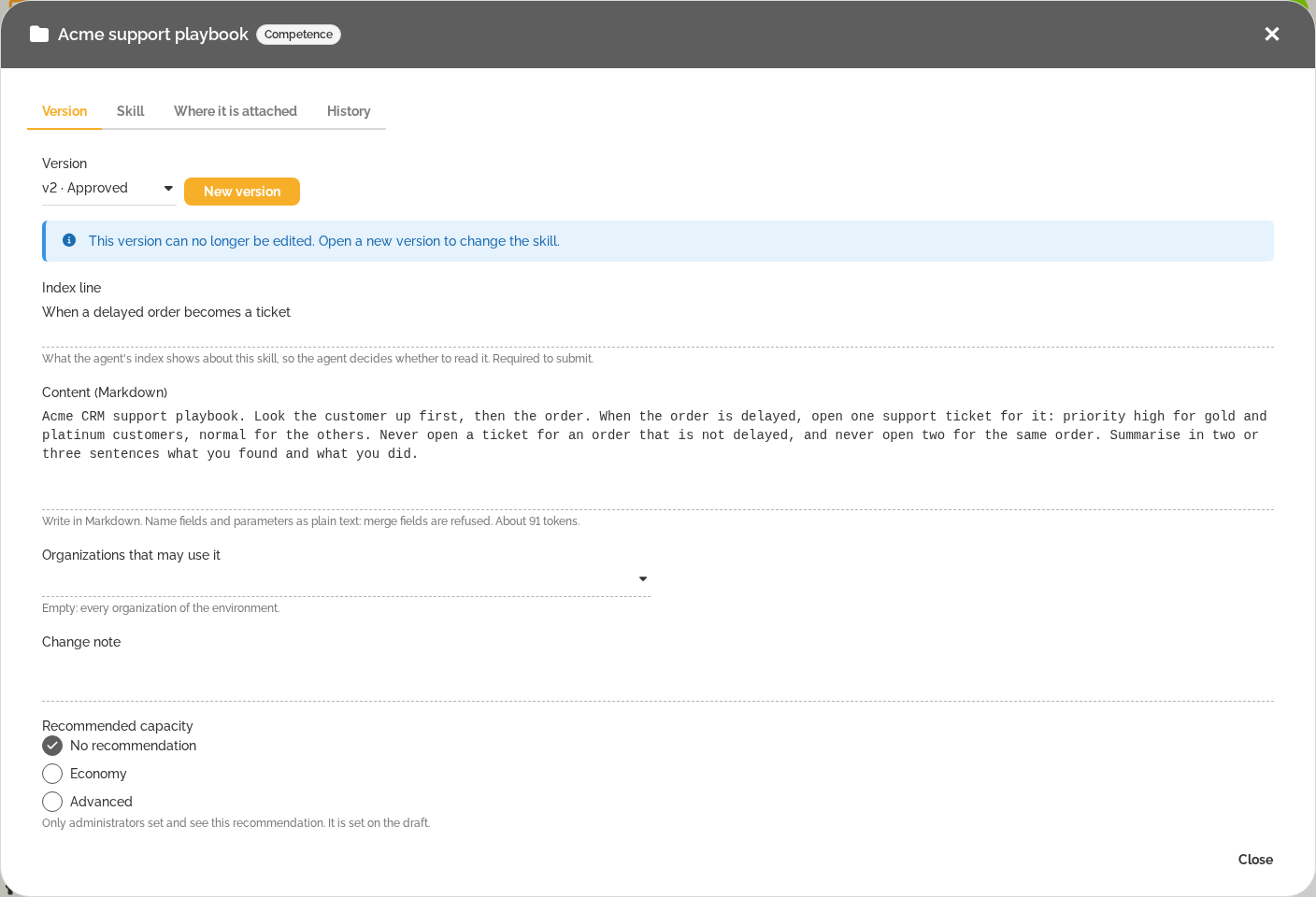
An agent skill is a written piece of guidance that an AI agent reads before doing a kind of work: how to triage a support request, how to check an invoice against an order, which purchasing policy applies. A skill is the early adopter's technique turned into an organizational asset.
Skills retain know-how for three reasons:
- Skills are separate from any single agent. One change to a skill reaches every agent that uses it.
- Skills have owners and versions. A skill's author can leave; the skill stays, with its history.
- Skills can be measured. Each revision can be compared with the previous one on real runs.
In HEFLO's upcoming release, skills come in two kinds. A policy is a rule that applies to a scope — an environment, an organization, a process, an agent or a participant. A competence is something an agent knows how to do and carries with it. Each skill has an index line that tells the agent when to read it, Markdown content, a change note and an approval cycle.
How do you gain traceability over AI use?
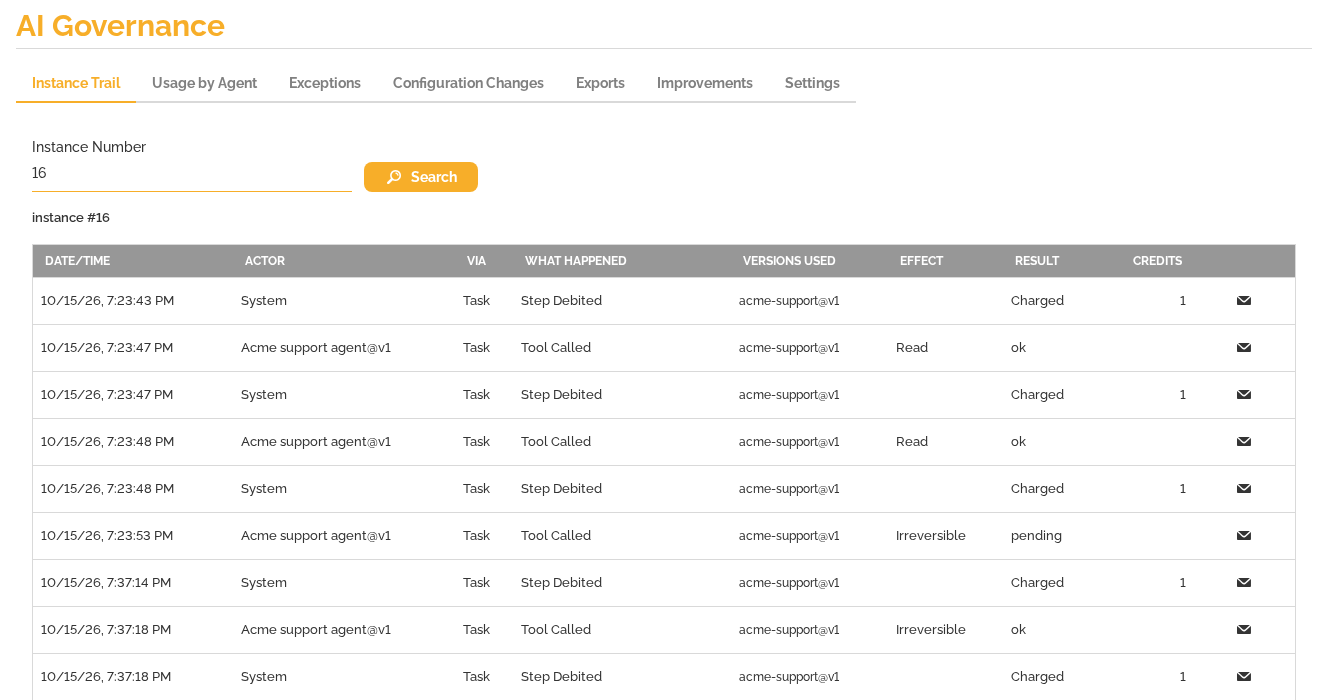
To gain traceability, every AI action must be recorded against the process instance where it happened, with the exact version of the agent that acted. Governance and traceability must be part of the process platform, not a separate monitoring project.
A traceable AI setup answers four questions for any process instance:
- Who acted? A person, an agent, or the system.
- With which version? The exact approved revision of the agent and its skills.
- What was the effect? Read only, a reversible change pending confirmation, or an irreversible action confirmed by a person.
- What did it cost? The resources consumed by each step.
In HEFLO AI's governance area, the Instance Trail shows these answers line by line for any instance number. Administrators and auditors can also review usage by agent, exceptions such as self-approvals or refused actions, and every change to the AI configuration.
How does governed AI support compliance?
Governed AI supports compliance by producing evidence, not promises. Governance and compliance depend on being able to show regulators, auditors and customers what an AI system did and who authorized it.
A process-based approach produces that evidence as a by-product of normal work:
- Separation of duties. In HEFLO AI, whoever wrote or submitted a version cannot be its only approver unless the organization explicitly configures it; a self-approval by a sole administrator requires a justification and appears in the exceptions report.
- Exportable audit logs. The AI audit log can be exported in CSV or JSON Lines; the export never contains transcripts, field values or keys.
- Controlled retention. Transcript retention can be set between 30 and 365 days, and changing it requires another administrator's approval.
- Time-boxed auditor access. Auditors get read-only access with an expiration date and mandatory two-step verification.
Regulatory frameworks such as the EU AI Act (Regulation (EU) 2024/1689) and the GDPR raise the bar for documentation and oversight. This article is not legal advice; each organization should map its own obligations with qualified counsel.
Simply put, compliance for AI is far easier when the process platform records approvals, versions and actions by default.
Where does MCP fit in a governed AI strategy?
The Model Context Protocol (MCP) is an open standard that lets AI assistants and agents connect to external systems through a common interface. MCP matters for shadow AI in two directions.
Inbound: external assistants acting on the process platform. In HEFLO's upcoming release, an administrator can turn on an MCP server so that Claude, ChatGPT, Mistral or another MCP client can work with HEFLO. The assistant acts with the person's own permissions, and actions that cannot be undone — such as publishing a process — require confirmation inside HEFLO itself. The MCP server is off by default.
Outbound: external systems becoming agent tools. An administrator can register an external MCP server, such as a CRM, and import its tools as agent connectors. Each connector carries an analyzed effect and must be approved before any agent can call it.
This is the bridge between personal AI and governed AI. People keep the assistants they like. The organization keeps control over what those assistants can touch.
MCP, in other words, lets organizations welcome the AI tools people already use — on the process platform's terms.
What will HEFLO AI bring to your processes?
HEFLO AI is currently in preview ahead of its release. HEFLO AI puts artificial intelligence to work inside business processes: process agents that do or help with tasks, an AI chat that follows the user across pages, an assistant that models processes in the editor, and an MCP connection for external AI assistants. Every action an agent takes is governed, audited and measured in AI credits.
The building blocks map directly to the Hero-to-Process framework:
| Framework step | HEFLO AI building block |
|---|---|
| Codify | Skills (policies and competences), versioned and owned |
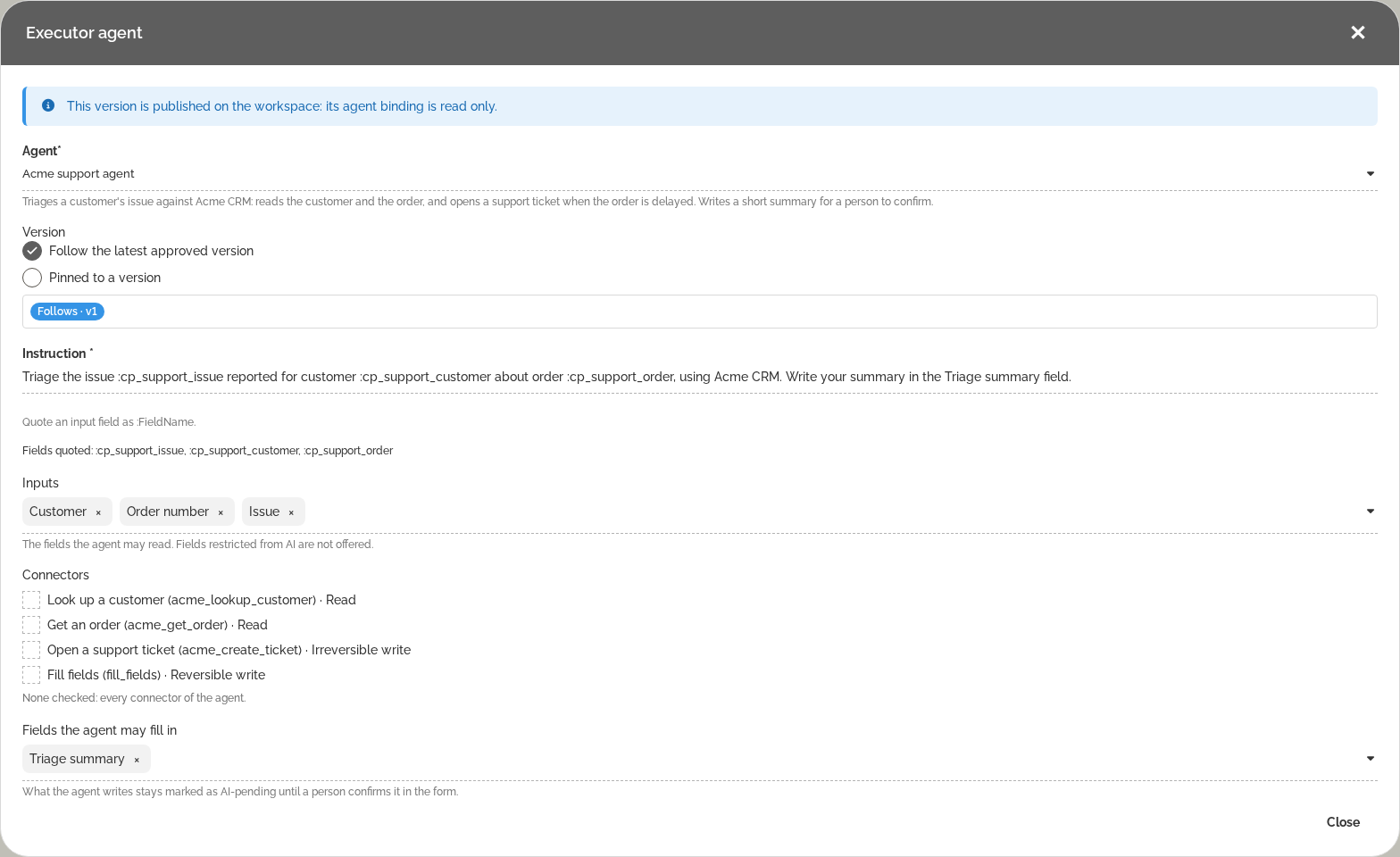
| Bind | Agent binding on a BPMN user task: instruction, readable fields, writable fields, connectors and budget |
| Govern | Approval of every new version of an agent, connector or skill before it runs |
| Govern | Effect ceiling, per-run limits and modes (executor, assistant, delegable) |
| Improve | Impact Report per agent version, revision history per skill and an Improvements view |
Three design choices in HEFLO AI speak directly to the hero problem:
- A binding can only narrow, never widen. An agent bound to a task can never do more than its approved version allows.
- Nothing runs without approval. Every new version of an agent, connector or skill is approved before it runs, and an approved version never changes; a change becomes a new version.
- Ownership survives people. When an agent's owner leaves or loses access, the agent keeps working, and administrators transfer ownership from a dedicated view instead of losing the asset.
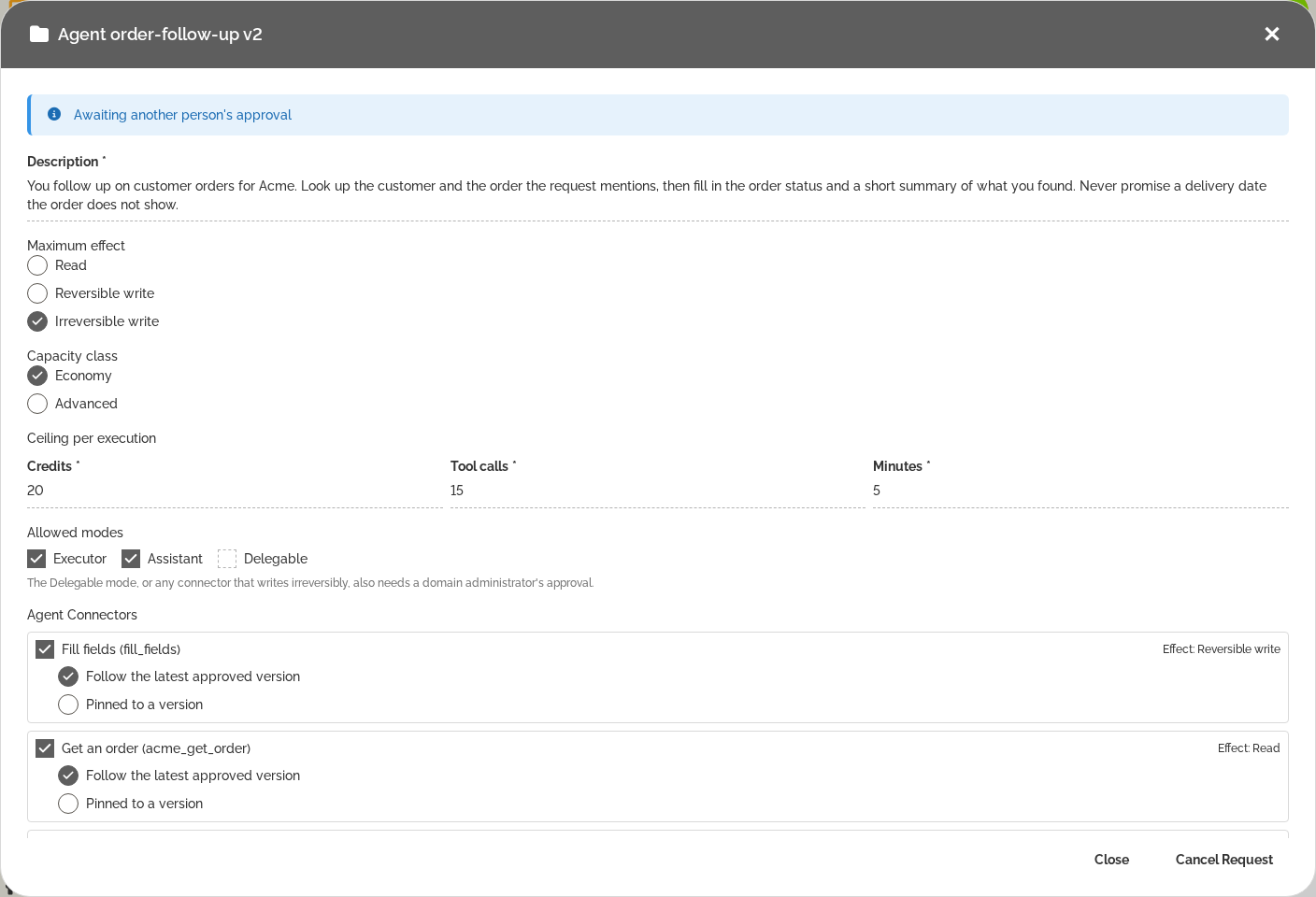
The net effect: in HEFLO AI, the early adopter's know-how becomes a versioned skill, the agent becomes a process participant, and ownership belongs to the organization.
How are other BPM vendors approaching AI governance?
Every serious BPM and process-orchestration vendor now agrees that AI belongs inside governed processes. Each brings real strengths:
- Camunda offers agentic orchestration built on BPMN for developer-led, vendor-agnostic architectures.
- Appian embeds agents in processes with a strong focus on regulated, mission-critical workloads.
- Pega combines agentic capabilities with deep case management and decisioning.
- SAP Signavio connects process intelligence with conversational agents for SAP-centric enterprises.
- Bizagi offers AI agents configured in natural language on a BPMN 2.0 foundation.
- Ofelia (formerly Bonitasoft) has launched a governed agentic AI orchestration offer with human approval built into the flow, alongside Bonita BPM.
The differences lie in deployment model, ecosystem fit, implementation effort and cost. HEFLO's focus is a low-code, cloud-native approach where business teams can model, automate and govern AI in the same environment, without a separate engineering project.
Governed AI inside processes is becoming the market standard; the choice is about fit, effort and cost.
Is your organization's AI know-how at risk? A 10-question self-check
Answer yes or no. Each "no" marks a place where AI know-how may be escaping your processes.
- Do you know which process tasks are already done with help from AI?
- Do you know which AI tools and accounts are used for those tasks?
- Are your best AI techniques written down somewhere the company owns?
- Does each AI technique have a named owner?
- Would the technique survive if its author left tomorrow?
- Does every change to an AI technique go through someone other than its author?
- Can you tell, for a given case, what an AI did and with which version?
- Do AI-written values wait for human confirmation before they count?
- Are AI integrations with other systems reviewed before use?
- Do you measure whether a new version of an AI technique performs better than the old one?
Seven or more "no" answers indicate that the organization depends on AI heroes. The Hero-to-Process framework is a practical place to start.
Put the intelligence back in the process
The BPM community spent twenty years teaching organizations a simple lesson: people are essential, but no person should be indispensable. AI does not change that lesson. AI makes it urgent again.
The organizations that win with AI will not be the ones with the best prompt engineers. The organizations that win with AI will be the ones whose prompts, skills and agents live in their processes — versioned, approved, traceable and improved by everyone. Governance and traceability are not obstacles to AI adoption; they are what make AI adoption last.
That is what we are building into HEFLO's next release. I look forward to sharing more as we approach launch.
Frequently asked questions
What is shadow AI?
Shadow AI is the use of AI tools, prompts or automations at work outside the organization's approved tools, processes and controls. Shadow AI includes personal chatbot accounts, private custom assistants and scripts that send company data to AI models without oversight.
Why is shadow AI a risk for companies?
Shadow AI is a risk because it concentrates know-how in individuals and executes work outside any audit trail. When the person leaves, the knowledge and the tools leave too. Shadow AI can also expose company data to services outside governance.
Should companies ban ChatGPT and other personal AI tools at work?
Banning personal AI tools usually backfires. A better approach is to capture what early adopters built, turn it into shared and governed assets, and connect the tools people like to the process platform under clear rules.
How can a company capture the AI know-how of its employees?
A company can capture AI know-how by mapping where AI is used, writing the best techniques as owned skills, binding AI agents to specific process tasks, approving every version, and measuring each revision. This is the Hero-to-Process framework.
What is an agent skill in BPM software?
An agent skill is written guidance that an AI agent reads before doing a kind of work, such as a support playbook or a purchasing policy. In BPM software, a skill is versioned, owned and approved, so one change reaches every agent that uses it.
Can BPM software govern AI agents and AI assistants?
Yes. BPM software can bind AI agents to process tasks, limit what they read and write, require human confirmation for sensitive actions, approve every version and log every action. Through MCP, BPM software can also govern external AI assistants that act on the platform.
What are the advanced features of BPM software for AI?
Advanced BPM features for AI include agents with effect and cost limits, versioned skills, binding agents to BPMN tasks, human confirmation, approved connectors and a complete audit trail.
How does HEFLO track what AI did in a process?
HEFLO AI records every AI step against the process instance in an Instance Trail that shows the actor, the agent version used, the effect, the result and the credits consumed. Administrators and auditors can also review usage by agent, exceptions and configuration changes. HEFLO AI is currently in preview.
Can I connect Claude or ChatGPT to HEFLO?
In HEFLO's upcoming release, an administrator can enable an MCP server that lets Claude, ChatGPT, Mistral or any other MCP client connect to HEFLO. The assistant acts with the user's own permissions, and irreversible actions require confirmation inside HEFLO.
How do you ensure AI governance and traceability in processes?
To ensure AI governance and traceability, AI agents must be built into processes: every version approved by another person, every action recorded with the version used, and every irreversible action confirmed by a human.