Why Business Teams Struggle to Automate Structured Processes

Business teams often start automation projects with confidence.
They know the process. They understand the rules. They can explain who should approve what, which information is required, where delays happen, and what should happen when work moves from one team to another.
At first, the project may look simple: create a form, assign a task, send an approval request, notify someone, and update a status.
But when the process must actually run as an operational workflow, the real challenge appears.
The team needs routing rules, approval variations, deadline control, escalation behavior, form validation, exception paths, audit history, visibility, integration decisions, and a clear way to handle cases that do not follow the expected path.
Many automation projects do not struggle because the business does not understand the process. They struggle because the organization has not found the right balance between business-configurable process logic and technical implementation.
Business teams are often forced into one of two weak options.
The first option is shallow automation: simple workflows that move tasks from one person to another, but cannot represent the full logic of real business operations.
The second option is technical implementation: custom development where every form, rule, approval path, integration, exception, or process change becomes an IT request.
Structured process automation needs a better model.
The people who understand the process should be able to define how it runs, while IT remains involved where architecture, integrations, security, identity, infrastructure, and enterprise standards matter.
What is a structured business process?
A structured business process is not just a list of tasks.
It is a repeatable flow of work with defined roles, business rules, decisions, approvals, deadlines, handoffs, exceptions, traceability, and governance.
A structured process is predictable enough to be controlled, but flexible enough to handle real business variations.
This distinction is important.
Structured does not mean rigid. It does not mean every case must follow exactly the same path. It means the organization understands how the process should normally run, who is responsible, what information is required, which rules apply, and how exceptions should be handled.
For example, a purchase request process may follow a standard path for most requests. But the approval path may change depending on value, budget, department, supplier risk, contract type, missing information, or compliance requirements.
A structured process can handle these variations without turning every exception into an informal conversation.
Why simple automation often works at first
Simple workflow tools can be useful.
They often work well for short task sequences, basic approvals, simple request forms, notifications, small team coordination, and low-risk workflows with predictable inputs and outputs.
Simple workflow tools are valuable when the process itself is simple.
The problem appears when the workflow needs to represent more complete process logic.
A request may need different approval paths. A deadline may need escalation. A form may need validation. An exception may need to follow a controlled path. A decision may depend on external data. A manager may need visibility across all active cases.
At that point, automation is no longer only about moving a task forward.
It becomes about controlling how work actually flows through the organization.
The real challenge: finding the right level of automation
Business process automation often fails in two opposite ways.
One approach is too shallow. The other is too technical.
Both create problems.
Automation that is too shallow
Shallow automation may create a digital version of a manual checklist, but it does not solve deeper operational problems.
It may assign tasks, send reminders, and update statuses, but fail to manage business rule variations, approval paths, deadline risk, exception handling, cross-functional handoffs, auditability, process visibility, and ownership when something goes wrong.
If automation only moves tasks from one person to another, it may improve coordination but still leave the real process unmanaged.
Many workflows work during the demo because they automate the happy path. They fail in production because real business work includes missing data, exceptions, delays, rejected decisions, unavailable approvers, integration errors, unclear ownership, and cases that require judgment.
The problem is not that simple automation is useless.
The problem is that structured processes require more than task routing.
Automation that is too technical
The opposite problem happens when automation becomes too dependent on custom implementation.
Every change may require a developer. A new form becomes a development request. A rule change enters a technical backlog. An approval variation needs scripting. A dashboard requires a custom interface. A system integration needs deployment. A small process adjustment becomes a project.
When every process adjustment becomes a development request, automation becomes slower than the business change it was supposed to support.
This creates long timelines, higher implementation risk, poor adaptability, and often poor usability.
The process logic becomes hidden inside technical artifacts instead of remaining visible to the people who understand the process.
Business teams then lose control.
Process analysts can describe what should happen, but they cannot evolve how the process actually runs.
Where business teams start to struggle
Structured automation becomes difficult when the workflow needs to reflect the way the business actually operates.
Business rules are harder to configure than expected
Real processes rarely follow one linear path.
Routing may depend on amount, category, customer type, department, risk level, location, priority, missing information, contractual conditions, or the answer provided in a previous form field.
If rules are hidden in code or informal instructions, business teams lose control over how the process actually runs.
Approval paths vary by context
Approvals may depend on value, department, role, budget, risk, compliance, exception type, or customer impact.
A simple “send for approval” step is not enough when the approval path itself is part of the business logic.
If approval logic is not structured, the organization falls back to manual follow-up, email threads, side conversations, and inconsistent decisions.
Deadlines need more than a final due date
A structured process needs more than one deadline at the end.
It may need process-level deadlines, task-level deadlines, warning alerts, critical alerts, overdue alerts, and escalation rules.
Final deadlines are usually missed step by step before they are missed at the end.
If the process only alerts people when the final deadline is already at risk, management becomes reactive.
Exceptions do not fit the standard flow
Missing data, rejected approvals, unavailable approvers, urgent requests, compliance checks, system failures, low-confidence results, and customer-specific conditions need controlled paths.
If exceptions live outside the process, they become side conversations, undocumented decisions, and operational workarounds.
A structured process should not pretend that exceptions do not exist.
It should make them visible and manageable.
Handoffs between teams require clear ownership
Many delays happen when work moves between departments or roles and no one knows who owns the next action.
Automation should clarify responsibility, not only notify the next person.
A handoff without ownership simply moves confusion faster.
Forms need validation, data, and context
Forms are not just screens.
They capture the information needed to execute the process correctly.
A poor form creates missing information, rework, delays, and manual follow-up.
The quality of process execution often depends on the quality of the information collected at the beginning.
Managers need visibility, not just notifications
Notifications help individuals act.
Visibility helps leaders manage execution.
Managers need to see status, bottlenecks, delayed cases, workload, deadline risk, exceptions, and process performance.
Without visibility, managers return to chasing tasks manually.
Traceability becomes important
As processes become more important, the organization needs to know who acted, when, why, and what decision was made.
Without traceability, automation may move faster but still fail governance, audit, and accountability needs.
Integrations introduce technical decisions
Some processes need to call external systems, retrieve data, update records, validate information, or synchronize status.
This is where IT involvement becomes essential.
IT should help define integration architecture, authentication, error handling, data contracts, security standards, and technical monitoring.
But the business should still understand when and why the integration is part of the process.
Inputs can change without warning
APIs change. Data formats shift. Systems return partial data. Triggers behave differently. Source information becomes noisy over time.
A workflow can continue running while the quality of its output quietly gets worse.
Automation should not assume that all inputs will remain stable forever.
Silent failures are hard to detect
Some failures do not stop the process.
They simply produce wrong classifications, poor routing, incomplete data, misleading status updates, or incorrect recommendations.
This is dangerous because the workflow appears to be running, but the process outcome is deteriorating.
Structured automation needs monitoring, visibility, review points, alerts, and clear ownership when something looks uncertain.
Process changes become dependent on a technical backlog
Business processes evolve.
Rules change, responsibilities change, forms change, approvals change, deadlines change, and exception paths change.
If every adjustment requires a technical backlog item, the process becomes hard to improve.
Continuous improvement becomes too slow when every business change depends on development work.
Process analysts can model the process but cannot execute it
Many process analysts can document how work should happen, but they cannot always turn that knowledge into executable workflow behavior.
The model remains a diagram.
Execution happens somewhere else.
This creates a gap between the process that is documented and the process that actually runs.
The people who understand the process should be able to help define how it runs.
Governance becomes necessary as more workflows are automated
Informal automation may work for one team or one isolated workflow.
But as workflows multiply, organizations need standards, versioning, access control, traceability, visibility, and controlled change.
Without governance, automation can create fragmentation instead of operational control.
Why automation becomes too dependent on IT
IT dependency is not inherently bad.
IT is essential for architecture, integrations, security, infrastructure, identity and access, compliance, technical monitoring, API reliability, data contracts, and enterprise standards.
The problem appears when every process adjustment becomes a technical project.
The goal is not to remove IT from automation.
The goal is to let business and IT work at the right level.
Business teams should be able to configure the process logic they understand:
- steps;
- routing;
- responsibilities;
- approval paths;
- deadlines;
- alerts;
- forms;
- controlled exceptions.
IT should remain involved where technical governance matters.
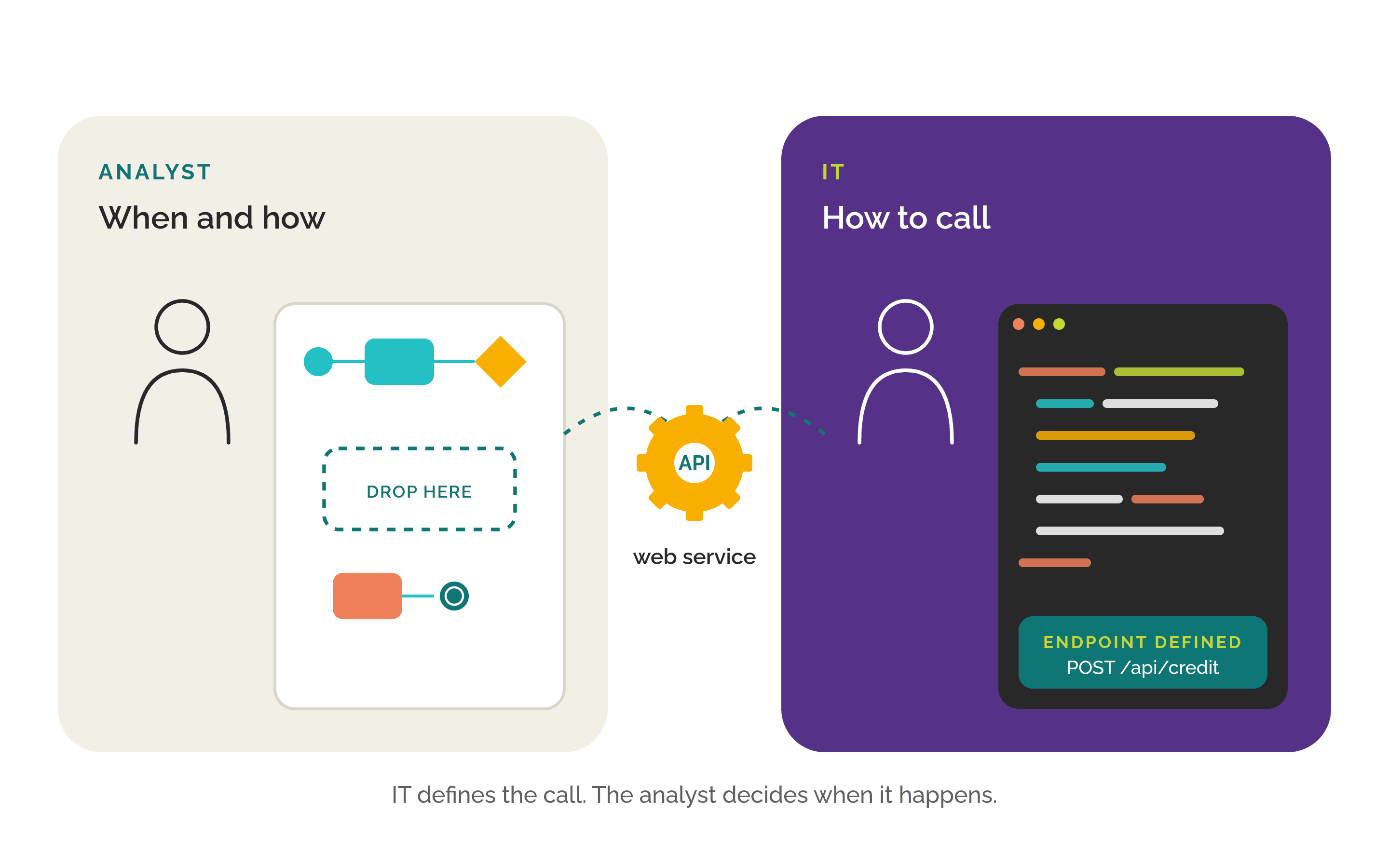
For example, IT may define how a system integration should authenticate, what data can be exchanged, how errors should be logged, and what security standards apply.
But the process analyst should be able to define when that integration is used, which process path depends on it, and what should happen if the returned information changes the routing.
This is the balance many organizations are missing.
When IT owns too much of the business logic, process improvement slows down.
When business teams automate without governance, automation becomes fragmented and risky.
Structured process automation needs both autonomy and control.
Why no-code matters, but is not enough by itself
No-code matters because many process changes should not require software development.
A business team should not need a developer every time it needs to adjust a form, change a routing rule, add an approval step, configure a deadline, or define an escalation path.
No-code configuration is valuable for:
- process steps;
- forms;
- responsibilities;
- routing conditions;
- approval paths;
- deadlines;
- alerts;
- escalation behavior;
- exception flows.
No-code is valuable when it gives business teams control over process logic without removing governance.
But no-code alone is not enough.
If no-code tools create disconnected workflows, hidden rules, duplicated forms, uncontrolled exceptions, and isolated apps, they can make the organization harder to manage.
The point is not just “no-code automation.”
The point is governed no-code process configuration.
Business teams need autonomy, but that autonomy should happen inside a structured environment where process logic is visible, traceable, and aligned with organizational standards.
Why low-code collaboration is often the realistic model
Structured processes sometimes need technical support.
This is especially true when the process must interact with external systems, APIs, identity providers, databases, document systems, ERP platforms, CRM systems, or internal services.
Low-code collaboration becomes important when:
- an integration must call a web service;
- data must be exchanged with another system;
- identity and permissions must be respected;
- technical validation is needed;
- API errors must be handled;
- data contracts must be monitored;
- fallback behavior must be defined;
- the process requires custom behavior.
In a healthy low-code model, IT defines the technical boundaries while business teams configure and evolve the process logic inside those boundaries.
For example, IT may define how a web service should be called, how authentication works, which data is returned, and how errors are handled.
The process analyst can then configure when that call happens in the process, how the returned data affects routing, and what should happen if the integration fails or returns incomplete information.
That is not a compromise.
It is a better division of responsibility.
Business teams should not have to become developers.
IT should not have to own every business rule.
Why BPMN matters for structured process automation
BPMN is useful because it can represent more than a sequence of tasks.
It can describe real process logic in a way that business and technical teams can both understand.
BPMN can represent:
- activities;
- gateways;
- decisions;
- events;
- handoffs;
- approvals;
- parallel paths;
- timers;
- exception paths;
- escalation logic.
BPMN helps business teams describe process logic in a way that can support execution, not only documentation.
This matters when the process needs more than “task A, then task B, then task C.”
A structured process may need to wait for an event, split into parallel paths, route work based on business conditions, escalate overdue tasks, handle rejected approvals, or continue through a controlled exception path.
A simple task list may not be enough to represent that logic.
BPMN gives process analysts a way to make that logic visible before it becomes operational behavior.
What business teams should look for in an automation platform
A structured process automation platform should help business teams automate real process logic without forcing every change into custom development.
Useful evaluation questions include:
- Can the platform model the process clearly?
- Can process analysts configure workflow logic?
- Can it support business rules?
- Can it handle approval paths?
- Can it control deadlines at process and task level?
- Can it configure alerts and escalations?
- Can it handle exceptions as process paths?
- Can it provide visibility into cases and bottlenecks?
- Can it preserve traceability?
- Can it support governance and versioning?
- Can IT remain involved in integrations, security, and standards without owning every process change?
- Can the same process model support both understanding and execution?
- Can the platform support no-code configuration and low-code collaboration without creating fragmented automation?
- Can it show where work is delayed or blocked?
- Can it route uncertain cases to human review?
- Can it help teams monitor execution instead of relying only on notifications?
A good platform should give business teams autonomy where process logic matters and keep IT involved where technical governance matters.
That balance is what allows automation to scale without becoming either too shallow or too technical.
How HEFLO approaches structured process automation
HEFLO is designed around process-driven execution.
It helps teams model structured processes in BPMN and turn those models into executable workflows.
This allows organizations to connect process knowledge, execution logic, visibility, and governance in one environment.
With HEFLO, teams can:
- model structured processes in BPMN;
- turn models into executable workflows;
- configure business rules and routing;
- automate approvals with traceability;
- control deadlines and escalations;
- manage exceptions inside the process;
- configure forms and process data;
- provide visibility into process execution;
- support governance while reducing unnecessary development dependency.
HEFLO does not treat automation as a separate layer disconnected from the process model.
It helps organizations connect how the process is understood with how the process actually runs.
That matters because structured process automation is not only about assigning tasks.
It is about making business logic executable, visible, traceable, and easier to improve.
Conclusion: structured automation requires balance
Business teams struggle to automate structured processes when they are forced to choose between shallow automation and fully technical implementation.
Shallow automation may be easy to start, but it often breaks when the process requires rules, deadlines, exceptions, handoffs, visibility, and governance.
Fully technical implementation may be powerful, but it can make every process change slow, expensive, and dependent on development work.
The right approach is not to remove IT.
The right approach is not to make business teams become developers.
The right approach is to let business teams configure the process logic they understand, let process analysts translate business knowledge into executable workflow behavior, and let IT govern architecture, integrations, security, identity, and standards.
Structured automation should also preserve human review where judgment is needed, give managers visibility into deviations, and keep exceptions inside controlled paths.
When process knowledge, automation, and governance work together, structured processes become easier to execute, monitor, and improve.
FAQ
Why do business teams struggle with process automation?
Business teams struggle when automation tools either oversimplify the process or make every change dependent on technical implementation. Real business processes need rules, approvals, deadlines, exceptions, visibility, and governance. If business teams cannot configure this logic directly, automation becomes hard to evolve.
Why do automation projects fail even when the tool works?
Automation projects can fail even when the tool works because the process itself may be unclear, poorly documented, badly prioritized, or missing exception paths. A tool can execute the configured workflow correctly while the workflow still reflects incomplete or incorrect process logic.
Why do simple workflow tools fail for structured processes?
Simple workflow tools often work well for short task sequences and basic approvals. They struggle when the process needs business rules, conditional routing, multiple approval paths, deadline escalation, audit history, exception handling, and process governance.
Why is automating the happy path not enough?
The happy path only describes what happens when everything goes as expected. Real processes include missing data, rejected approvals, late tasks, unavailable people, urgent requests, system failures, uncertain decisions, and cases that require human judgment. Structured automation must define what happens when the process deviates from the expected path.
What should business teams automate first?
Business teams should start where work waits, gets clarified, gets approved, gets corrected, or gets handed off. Good starting points often include approval flows, request intake, context gathering, deadline alerts, routing rules, and handoffs between teams.
Does structured process automation require IT?
Yes, but not for every process change. IT should remain involved in architecture, integrations, security, identity, infrastructure, data contracts, and enterprise standards. Business teams should be able to configure process logic such as forms, routing, responsibilities, approval paths, deadlines, and exceptions.
What is the role of process analysts in automation?
Process analysts translate business knowledge into structured process logic. They help define steps, responsibilities, rules, approvals, deadlines, exceptions, and performance indicators. In a process-driven automation platform, they can help shape how the process actually runs, not only how it is documented.
How does no-code help business process automation?
No-code helps business teams configure process logic without requiring software development for every adjustment. It is useful for forms, steps, routing conditions, approval paths, deadlines, alerts, and exception flows. No-code is most valuable when it operates inside a governed process environment.
Why is low-code still important for structured processes?
Low-code is important when the process needs integrations, custom validation, external data, API calls, identity controls, or technical error handling. The best model is collaboration: IT defines the technical boundaries, while business teams configure and evolve the process logic inside those boundaries.
Why is BPMN useful for process automation?
BPMN is useful because it can represent more than a task list. It can show activities, gateways, decisions, events, approvals, parallel paths, timers, escalations, and exception flows. This makes BPMN valuable for structured process automation because it connects business understanding with executable logic.
How can companies reduce IT dependency without losing governance?
Companies can reduce IT dependency by allowing business teams to configure process logic while keeping IT responsible for architecture, integrations, security, identity, infrastructure, and standards. The goal is not to remove IT, but to involve IT at the right level.
How can companies avoid silent automation failures?
Companies can avoid silent failures by defining what correct execution looks like, monitoring process outcomes, using alerts, maintaining audit history, reviewing exceptions, and giving humans clear ownership when automation is uncertain, blocked, or producing unexpected results.
Why are exception paths important in workflow automation?
Exception paths are important because real processes do not always follow the standard flow. Missing information, rejected approvals, urgent requests, system failures, and uncertain outcomes need controlled paths. Without exception handling, people recreate the process manually outside the workflow.