What Is the BPM CBOK?

Ask five professionals what BPM means and you'll likely get five different answers. One talks about process mapping, another about documentation, a third about automation. Someone else brings up governance, performance indicators, or continuous improvement.
None of them are wrong, but none of them are describing the whole thing either. That's the gap the BPM CBOK fills. It frames Business Process Management as a complete discipline, connecting the concepts, roles, practices, and knowledge areas that process professionals work with every day.
This article covers what the BPM CBOK is, why it matters, the knowledge areas it spans, and how to put it to use. At the end, there's a quick quiz to test what you've picked up.
What Is the BPM CBOK?
The BPM CBOK is a common body of knowledge for Business Process Management — a reference that organizes the core concepts, practices, roles, and knowledge areas BPM professionals rely on.
It deliberately avoids pinning itself to a single tool or methodology. Its job is to create a shared understanding of what BPM includes and how its pieces fit together. And BPM has a lot of pieces: modeling processes, analyzing problems, designing better workflows, measuring performance, defining governance, supporting transformation, and using technology to execute and monitor everything.
Without a common reference, teams end up using different words for the same idea — or, worse, the same word for different ideas. The CBOK gives process professionals a structured way to talk about BPM that goes beyond isolated projects, diagrams, or automation initiatives.
Why the CBOK Matters for Process Professionals
It's easy to reduce BPM to whatever part of it you touch most. If you model processes all day, BPM looks like diagramming. If you live in documentation, it looks like procedures and repositories. If you build automations, it looks like routing, forms, and approvals.
Real BPM work rarely fits into one of those boxes. A well-documented process can still be executed badly. An automated workflow can still sit on top of a broken process. A dashboard can track indicators that miss what actually matters. A governance model can look solid on paper and fall apart in daily operations.
This is where the CBOK earns its keep: it pushes professionals to see BPM as a complete discipline rather than a single activity. It ties the operational side — how processes get modeled and executed — to the management side, covering how they're identified, analyzed, designed, measured, governed, and improved. For analysts, consultants, BPM Office teams, process owners, and transformation leaders, that wider view leads to better questions and fewer narrow solutions.
The Main Knowledge Areas Covered by the CBOK
The CBOK is organized around the areas a process professional needs to understand, and together they explain why BPM is broader than mapping a process or wiring up a workflow.
Business Process Management is the foundation. It presents BPM as a management discipline and introduces core concepts: end-to-end processes, customer value, cross-functional work, process ownership, and the BPM lifecycle.
Process Modeling is about representing how work actually happens. It makes processes visible and easier to discuss, and it's usually the first step toward documentation, analysis, improvement, and automation.
Process Analysis focuses on the current state — surfacing problems, inefficiencies, risks, bottlenecks, and gaps before anyone designs a better future state.
Process Design defines how a process should work, covering flow, responsibilities, rules, controls, systems, handoffs, and performance expectations.
Process Performance Management brings in measurement: monitoring execution, defining indicators, evaluating results, and feeding that information back into better decisions.
Process Transformation deals with change — improvement, redesign, implementation, and the change management work needed to move from the current process to a better one.
Process Organization covers the human structure around processes: roles, responsibilities, ownership, and the governance needed to support process-driven work.
Enterprise Process Management zooms out to the organizational level, connecting process portfolios, architecture, maturity, governance, strategy, and continuous improvement.
BPM Technologies are the tools that help teams model, document, execute, monitor, and improve processes — BPM suites, process repositories, workflow engines, analytics, and integration tools that turn process knowledge into operational control.
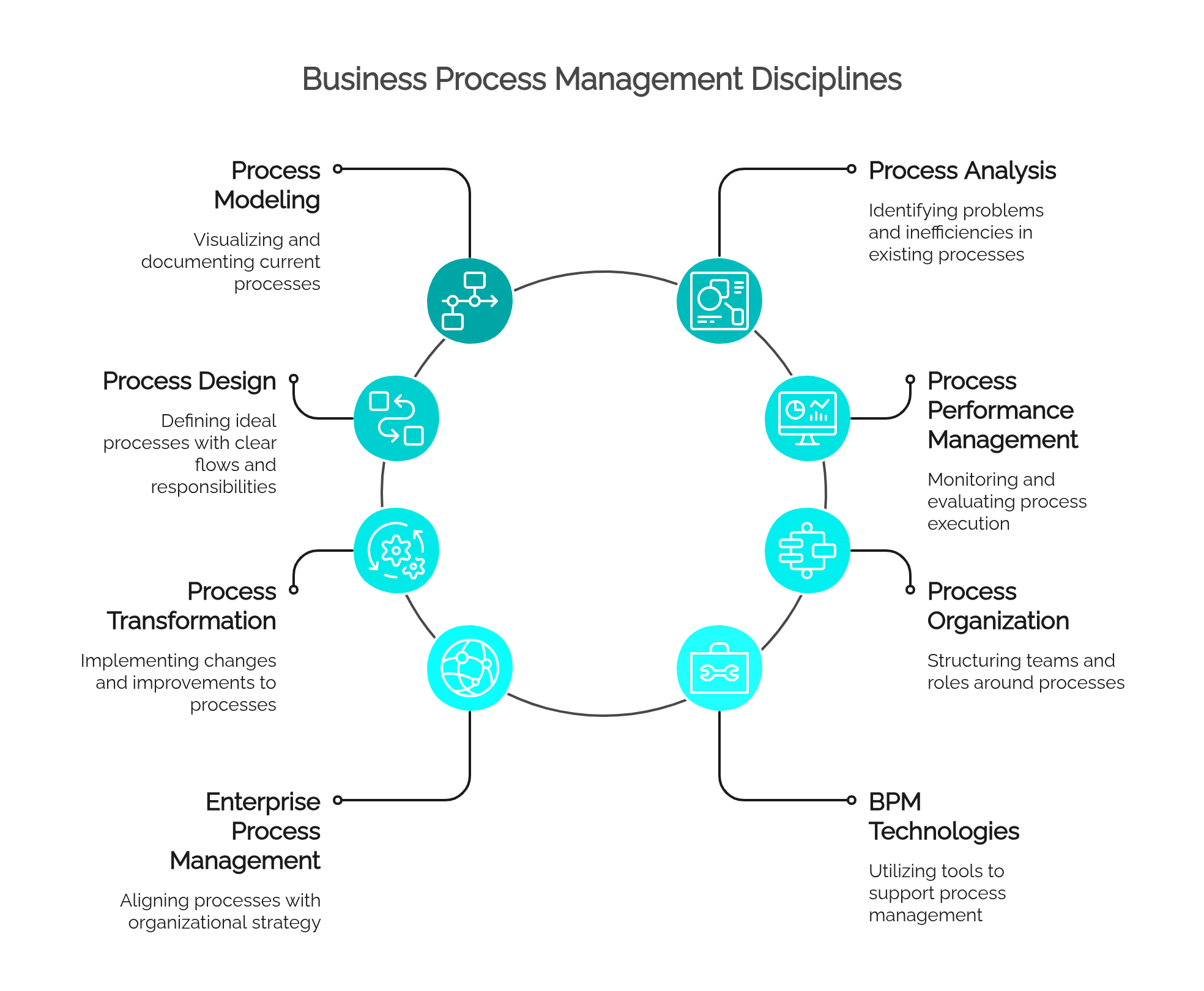
Laid out together, these areas make the point clearly: BPM isn't one activity, it's a connected discipline for understanding, improving, governing, and managing how work gets done.
CBOK and BPM Certification: What to Understand
The CBOK is closely tied to BPM certification, mostly because it offers a structured reference for the field — but the two aren't the same thing.
The CBOK organizes the knowledge a BPM professional should have, giving structure to the concepts, terminology, roles, and practices that show up in real process work. Certification asks for more than that. It expects you to apply those concepts in practical situations, weigh trade-offs, make decisions, and connect different areas of the discipline.
So the CBOK isn't something to memorize. It works best as a guide for thinking through how BPM plays out in practice: How do you analyze a process before redesigning it? How do you tie process performance to business goals? How do you set up governance without drowning everyone in bureaucracy? How do BPM technologies actually support execution and monitoring?
If you're preparing for a certification, the CBOK gives you a solid foundation — but real projects and continuous learning matter just as much. The CBOK helps you study BPM; practice is what makes you a BPM professional.
How to Use the CBOK in Real BPM Work
The CBOK is at its most useful when it's not just study material. It also works as a practical reference for teams trying to organize, improve, or scale how they manage processes.
A BPM Office can use it to structure internal training and align terminology, so different teams describe processes, ownership, performance, and governance the same way. A process analyst can use it to see where their work sits in the larger lifecycle — modeling matters, but the same process may also need analysis, redesign, documentation, automation, and ongoing monitoring. A process owner can lean on it to understand that ownership goes well beyond approving a diagram; it means keeping the process clear, measured, controlled, and aligned with business goals. And a transformation team can use it to stop treating BPM as a pile of disconnected initiatives and build something more consistent over time.
In day-to-day work, the CBOK is really a way to ask sharper questions. Are our processes clearly modeled and documented? Do we analyze problems before redesigning? Is ownership clear? Do our indicators measure what matters, or just what's easy to count? Is governance driving improvement or only adding approvals? Are our technologies supporting visibility, or getting in the way? Used like this, it stops being a reference book and becomes a tool for building real BPM capability.
Test Your CBOK Knowledge with Our Quick Quiz
Understanding the CBOK isn't only about reading definitions — it's about recognizing how those concepts show up in real situations. That's why we built a quick BPM CBOK quiz in the HEFLO community.
It's designed to help you review the key ideas, test your understanding, and spot topics worth digging into further. It isn't a formal certification exam or an official prep test — just a practical, interactive way to engage with BPM concepts. You can use it to gauge how comfortable you are with modeling, analysis, design, performance management, governance, enterprise process management, and BPM technologies.
Once you're done, jump into the HEFLO community to share your score, comment on the questions, or suggest ideas for future quizzes.
Final Thoughts
The real value of the BPM CBOK is that it helps you see BPM as a complete discipline rather than a collection of separate tasks. Drawing diagrams, writing procedures, automating workflows, and tracking indicators all matter — but they matter far more when they're connected.
A process has to be understood before it's improved, analyzed before it's redesigned, owned before it's governed, and measured before it can be managed. When technology enters the picture, it should make the process clearer, not bury it. The CBOK gives professionals a shared structure for thinking through those connections and applying them consistently.
If your work touches process improvement, documentation, automation, governance, or transformation, its core ideas are worth knowing. And if you want a quick gut-check on where you stand, take the BPM CBOK quiz in the HEFLO community — a simple way to test what you know, see what to study next, and keep the conversation going.
Frequently Asked Questions About the BPM CBOK
What is the BPM CBOK?
The BPM CBOK is a Common Body of Knowledge for Business Process Management. It organizes key concepts, practices, roles, and knowledge areas used by BPM professionals to understand, analyze, design, govern, measure, and improve business processes.
What does CBOK stand for in BPM?
CBOK stands for Common Body of Knowledge. In the context of BPM, it refers to a structured reference that brings together the main knowledge areas of Business Process Management.
What is the purpose of the BPM CBOK?
The purpose of the BPM CBOK is to provide a common reference for BPM professionals. It helps standardize terminology, organize BPM knowledge, and support a shared understanding of how business processes are managed across an organization.
Who should use the BPM CBOK?
The BPM CBOK is useful for process analysts, business analysts, BPM consultants, BPM Office teams, process owners, operations managers, transformation teams, and professionals involved in process improvement, documentation, governance, automation, or performance management.
What topics are covered by the BPM CBOK?
The BPM CBOK covers major BPM knowledge areas such as Business Process Management, process modeling, process analysis, process design, process performance management, process transformation, process organization, enterprise process management, and BPM technologies.
Is the BPM CBOK only for certification?
No. The BPM CBOK can support BPM certification study, but it is also useful as a practical reference for real BPM work. Teams can use it to align terminology, structure training, improve governance, and build stronger process management capabilities.
Is BPM the same as BPMN?
No. BPM is the broader management discipline focused on managing and improving business processes. BPMN is a modeling notation used to represent process flows. BPMN can support BPM, but it is only one part of the discipline.
How is the BPM CBOK different from BPMN?
The BPM CBOK explains Business Process Management as a discipline, including concepts, roles, governance, performance, transformation, and technology. BPMN defines a visual notation for modeling processes. In simple terms, CBOK explains the discipline; BPMN helps represent process flows.
How is the BPM CBOK different from PMBOK?
PMBOK focuses on project management, while the BPM CBOK focuses on Business Process Management. A BPM initiative may be managed as a project, but the process itself continues after the project ends. PMBOK helps manage the project; CBOK helps understand and manage the process discipline.
How is the BPM CBOK different from BABOK?
BABOK focuses on business analysis, requirements, stakeholders, and business needs. The BPM CBOK focuses on business processes as managed assets. The two can complement each other, especially when business analysis work involves process discovery, improvement, or automation.
How is the BPM CBOK different from Lean Six Sigma?
Lean Six Sigma focuses strongly on process improvement, waste reduction, variation reduction, and quality. The BPM CBOK takes a broader view of BPM, including modeling, analysis, design, governance, performance management, transformation, organization, and BPM technologies.
Can the BPM CBOK help a BPM Office?
Yes. A BPM Office can use the CBOK to define a common language, structure internal training, clarify process roles, support governance, and align process improvement initiatives across the organization.
How can process analysts use the BPM CBOK?
Process analysts can use the BPM CBOK to understand where their work fits in the broader BPM lifecycle. It helps them connect process modeling with analysis, design, documentation, automation, performance measurement, governance, and continuous improvement.
Does the BPM CBOK replace practical experience?
No. The BPM CBOK provides structure and concepts, but practical experience is essential. BPM professionals need to apply the knowledge in real situations involving people, systems, rules, handoffs, performance issues, governance, and organizational change.
What is the best way to start learning the BPM CBOK?
A good way to start is by understanding the main BPM knowledge areas first. After that, professionals can go deeper into topics such as process modeling, process analysis, process design, governance, performance management, transformation, and BPM technologies. A short quiz can also help identify which topics need more attention.