What Is BABOK? A Practical Guide for Business Analysts

A team asks for a new system. A manager asks for automation. A department complains that a process is slow. None of those requests tells you what the business actually needs — they tell you what someone assumed the answer was.
BABOK exists for the gap in between. It's the reference business analysts use to understand a problem before anyone decides what to build, automate, or improve.
BABOK stands for Business Analysis Body of Knowledge. It helps you structure the work of understanding needs, stakeholders, requirements, change, and value. That makes it useful well beyond exam prep. Anyone running a process improvement, a digital transformation, a software rollout, or a process automation project is doing business analysis, whether they call it that or not.
What BABOK means
BABOK is short for A Guide to the Business Analysis Body of Knowledge — the BABOK Guide, published by IIBA, the International Institute of Business Analysis. It's the standard reference for how business analysis is practiced.
One thing it isn't: a step-by-step methodology. BABOK doesn't say every project must follow the same sequence or produce the same documents. It describes the knowledge areas, tasks, techniques, and concepts that analysts draw on to help organizations make better decisions and deliver change that's worth something.
In practice, it helps answer questions like:
- What business need are we actually addressing?
- Who are the stakeholders?
- What does success look like?
- Which requirements must be understood, analyzed, validated, and managed?
- What change is being proposed, and what value should it deliver?
- How will we know whether the solution solved the problem?
Boiled down: BABOK is a professional reference that keeps business analysts focused on needs, requirements, change, and value — not on the first solution someone suggested.
Who BABOK is for
BABOK is associated with business analysts, but the job title isn't the boundary. It supports process analysts, BPM professionals, product owners, project managers, consultants, transformation teams, operations staff, requirements and systems analysts, solution designers, and anyone preparing for ECBA, CCBA, or CBAP.
Its sweet spot is the space between business teams and technical teams. A business analyst might need to understand what finance needs, translate that into requirements, clarify business rules, align stakeholders, and then check whether the delivered solution actually improved anything. A process analyst leans on BABOK to understand a need before modeling the process. A consultant uses it to structure interviews, workshops, and recommendations. A project lead uses it to avoid starting with weak assumptions and fuzzy scope.
Why BABOK matters in business analysis
Most business problems are poorly understood at the start.
"We need to automate this approval" sounds simple. Dig in and the real picture often looks different: the approval rules are unclear, roles aren't defined, the process changes by department, stakeholders disagree on what information is required, exceptions get handled informally, and nobody can say what the automation is supposed to be worth.
That's the value of BABOK. It pushes analysts past the first request to the need behind it. Organizations routinely burn time and money implementing before they understand — automating a broken process, building a feature no one uses, documenting requirements that miss what stakeholders meant. A structured approach to asking better questions, comparing options, and tying decisions to value is what prevents that.
BABOK and requirements
Requirements are central to business analysis and widely misunderstood.
A requirement isn't just something a stakeholder asks for. It expresses a need, condition, capability, constraint, or outcome that defines what the solution has to address. That can cover business goals, stakeholder needs, functional capabilities, business rules, data, process steps, reporting, compliance constraints, integrations, and performance or experience expectations.
BABOK treats requirements as something you work with across a lifecycle — eliciting information, analyzing it, sharpening vague statements, validating with stakeholders, prioritizing, and managing change as the project evolves. The common mistake is treating requirements as a fixed list. In real projects they shift as people learn more about the problem and the options. The discipline BABOK asks for is keeping requirements tied to needs, stakeholders, decisions, and value the whole way through.
Take a stakeholder who says, "We need an automated approval workflow." That's not a requirement yet. The analyst's job is to ask: What type of request needs approval? Who submits it, who approves it? Are the rules based on value, department, risk, or location? What happens when the approver is unavailable? What deadlines apply, what evidence does audit need, and what value should the automation actually deliver? Only after that can the team write requirements worth modeling or building against.
BABOK and stakeholders
Business analysis isn't only about requirements. It's about people.
Stakeholders shape needs, decisions, constraints, priorities, and adoption. A technically correct solution still fails if the wrong people were ignored. Depending on the project, the cast includes executives sponsoring the change, managers who own the process, the employees doing the work, customers or internal requesters, compliance and audit, IT, finance, suppliers, and the support teams who keep it running.
Each sees the problem differently. In employee onboarding, HR cares about experience, IT about access provisioning, compliance about documents, managers about readiness, finance about cost-center setup. The analyst's job is to fuse those views into a shared understanding — which is how you avoid missing requirements, late objections, unclear ownership, weak adoption, and solutions that work for one department but break across the full process.
BABOK and business value
The most useful thing business analysis does is keep the conversation tied to value.
A project shouldn't exist because someone asked for a dashboard or an automation. It should exist because the organization expects a result — lower cost, faster cycle time, better service, less risk, stronger compliance, more revenue, a better customer or employee experience, more reliable information, greater visibility, fewer errors.
BABOK connects needs, requirements, and solutions back to that result. It matters because requirements aren't equal: some are essential to the value, some are nice-to-haves, and some add effort without improving the outcome. So a practical analyst keeps asking why a requirement matters, what value it supports, who benefits, what breaks if it's dropped, how success gets measured, and whether there's a simpler path to the same result. That mindset is what stops teams from building something large, expensive, and misaligned.
BABOK and process improvement
A lot of business needs are really process needs. When people complain about delays, errors, rework, missing visibility, unclear responsibilities, or bad handoffs, the root cause usually lives in how work flows across teams.
Business analysis surfaces those issues before a solution is chosen. "Purchase requests take too long" is a starting point, not a diagnosis. A BABOK-informed analysis asks who starts the process, what information is missing at submission, where requests wait, which approvals and routing rules apply, which systems are involved, where rework happens, who's affected, and what improvement would actually be worth. From there, the team has something solid to model, redesign, document, or automate.
BABOK doesn't replace process improvement methods. It feeds them — supplying the need, the stakeholder expectations, the requirements, the constraints, and the value behind the effort.
How BABOK relates to BPM, BPMN and automation
BABOK, BPM, BPMN, and automation are connected but distinct. The quickest way to keep them straight:
| Concept | Main purpose | Practical question it helps answer |
|---|---|---|
| BABOK | Business analysis | What need, requirement, change, and value must we understand? |
| BPM | Process management | How should the organization manage and improve the process lifecycle? |
| BPMN | Process modeling | How can we represent the process clearly and consistently? |
| Automation | Process execution | How can technology help the process run with less manual coordination? |
They reinforce each other. BABOK defines the need and requirements. BPM manages the process as an organizational asset. BPMN models it in a clear visual language. Automation runs it — routing tasks, applying rules, controlling deadlines, integrating systems, tracking execution.
Picture a contract approval process. BABOK clarifies the need (cut approval delays, improve auditability), the stakeholders (legal, finance, sales, procurement, managers, compliance), the requirements (approval rules, contract types, risk levels, deadlines, documents, audit trail), and the value (faster approvals, fewer errors, better compliance). BPM defines the end-to-end process, ownership, and performance indicators. BPMN models the actual flow — review steps, approval gateways, exception paths, handoffs. Automation then routes the tasks, notifies approvers, enforces the rules and deadlines, and builds the execution history. That's why the analysis comes first: it keeps the team from automating its own assumptions.
Common misconceptions about BABOK
It's only for certification. BABOK helps with ECBA, CCBA, and CBAP prep, but it's a working reference, not just an exam one. Even with no certification in sight, it sharpens how you handle requirements, stakeholders, change, and value.
It's a methodology. It isn't. BABOK prescribes no fixed sequence. It describes accepted practices you can apply in agile, waterfall, hybrid, BPM, transformation, software, compliance, or operational contexts.
It's only for software projects. Plenty of analysts work on software, but BABOK is broader — process improvement, organizational change, product development, policy and compliance work, customer experience, and automation all fall in scope.
It's only about writing requirements. Requirements matter, but business analysis also covers understanding needs, engaging stakeholders, weighing options, defining change, supporting decisions, and checking whether the solution delivered value.
It replaces BPM or BPMN. It doesn't. BABOK analyzes the need; BPM manages processes; BPMN models flows. In improvement and automation work they complement each other.
It's too theoretical. It can read as abstract on the page. The value shows up in real situations — unclear requests, conflicting stakeholders, bottlenecks, missing requirements, weak adoption, and solutions that have to prove their worth.
How to apply BABOK in real work
Don't start by memorizing concepts. Start with a real problem: a process that drags, a department drowning in incomplete requests, managers with no visibility, customers complaining about delays, a team running approvals out of spreadsheets, a system rollout no one quite understands.
Then run BABOK thinking as a sequence of practical questions:
- Understand the need. What are we solving, and why does it matter?
- Identify stakeholders. Who's affected, who decides, who does the work, who owns the outcome?
- Elicit information. What do stakeholders know, assume, need, or disagree about?
- Analyze requirements. What must be true for the solution to work and deliver value?
- Clarify value. What should improve, and how will we know?
- Connect to the process. Which steps, roles, rules, data, systems, and decisions are involved?
- Support change. What has to shift in work, behavior, systems, responsibilities, or governance?
- Evaluate outcomes. Did the change solve the real problem?
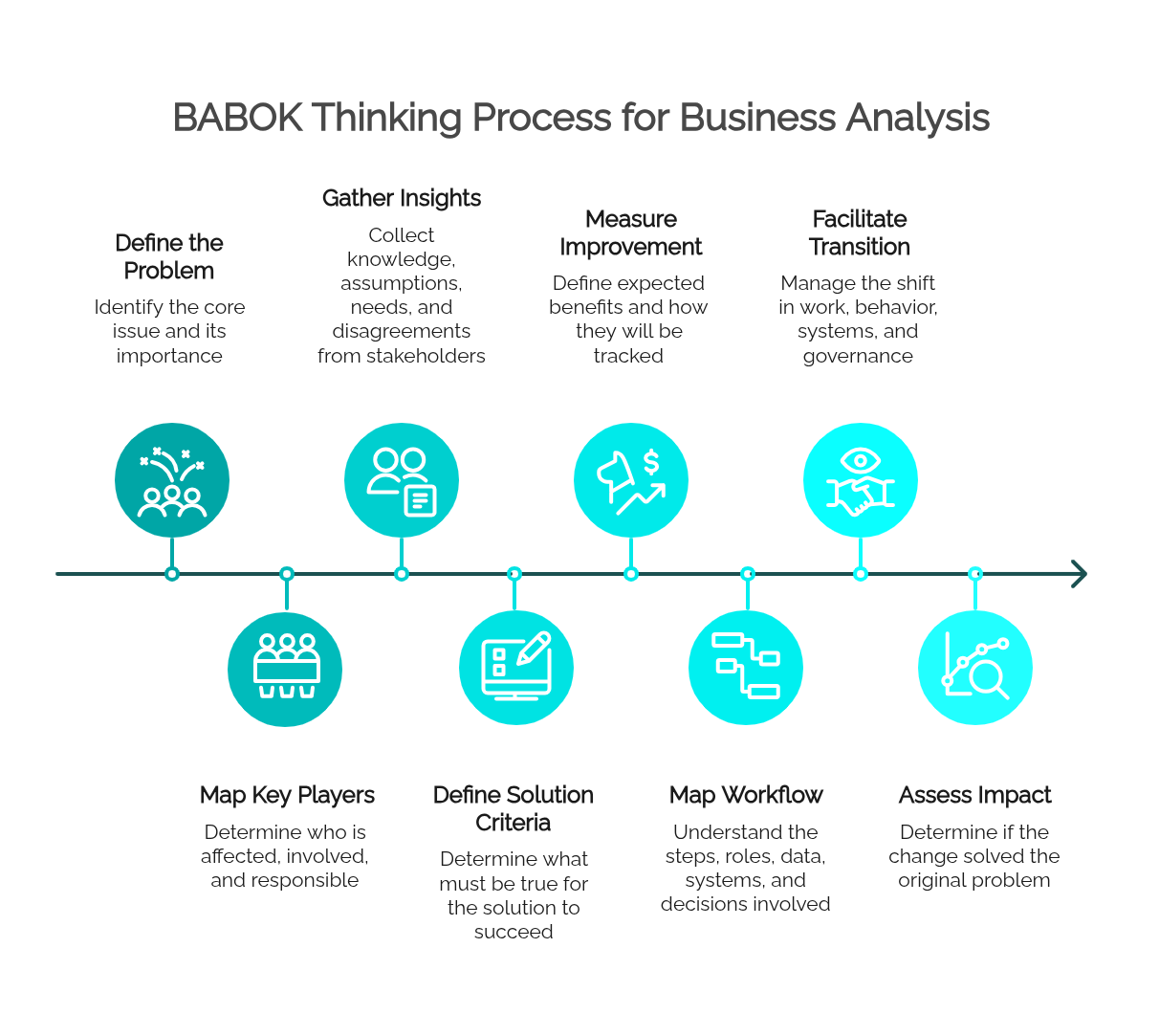
That's the move that turns BABOK from study material into a working lens for changing how an organization operates.
From BABOK analysis to process modeling and automation
BABOK is strongest at the front of a change initiative, when the organization needs clarity. But once needs and requirements are understood, the work has to become visible and executable — and that's where modeling, documentation, BPMN, and automation take over.
After analyzing a purchase request process, a team typically needs to model the current flow, find the bottlenecks and pointless handoffs, design the future state, assign roles, document the rules, publish the approved process, automate submission and approvals with deadlines and notifications, and then monitor and improve it.
This is where BPMN and a process automation platform such as HEFLO come in. The point isn't to replace business analysis — it's to turn the understanding into structured, visible, executable process work. BABOK clarifies what the organization needs and why; BPMN and automation define and run how the work happens.
Which professionals should learn BABOK?
BABOK is most useful for people who need to raise the quality of business decisions before solutions get built or processes get changed.
Consider it if you work as (or want to become) a business analyst, sit in requirements discussions, support software implementations, work in process improvement or BPM, bridge stakeholders and technical teams, are preparing for ECBA, CCBA, or CBAP, or help define and evaluate change initiatives. For process analysts and BPM professionals specifically, BABOK is a strong complement to BPMN — it strengthens the why before the team designs the how.
Conclusion
BABOK is, at heart, a practical reference for business analysis. It helps professionals understand needs, engage stakeholders, analyze requirements, support change, and keep solutions tied to value. It's useful for certification, but its real strength shows in actual improvement work.
For organizations, that means less risk of building the wrong solution, automating the wrong process, or documenting requirements no one validated. For analysts and process professionals, it's a structured way to think before acting. Before any team models a process, automates a workflow, or rolls out a system, it has to understand the need, the stakeholders, the requirements, and the value behind the change. That's what BABOK is for.
FAQ: BABOK for Business Analysts
What is BABOK in simple terms?
BABOK is a professional guide to business analysis. It helps business analysts understand business needs, stakeholders, requirements, change, and value so organizations can make better decisions and deliver better solutions.
What does BABOK stand for?
BABOK stands for Business Analysis Body of Knowledge. It commonly refers to the BABOK Guide, a global reference for the practice of business analysis published by IIBA.
Is BABOK only for business analysts?
No. BABOK is mainly used by business analysts, but it also helps process analysts, consultants, project managers, product owners, transformation teams, systems analysts, and anyone involved in requirements, change, or process improvement.
Is BABOK a methodology?
No. BABOK is not a methodology and prescribes no fixed project sequence. It describes business analysis knowledge areas, tasks, techniques, and concepts that apply across different project and organizational contexts.
How does BABOK help with requirements?
BABOK helps professionals elicit, analyze, validate, prioritize, manage, and communicate requirements, and keeps those requirements connected to business needs, stakeholders, decisions, and expected value.
How does BABOK relate to stakeholders?
BABOK emphasizes stakeholder engagement because business analysis depends on knowing who is affected by a change, who decides, who performs the work, and who defines success.
How does BABOK relate to BPM?
BABOK supports business analysis; BPM supports business process management. BABOK clarifies the business need and requirements, while BPM manages, improves, governs, and executes business processes.
How does BABOK relate to BPMN?
BABOK and BPMN serve different purposes. BABOK analyzes needs and requirements; BPMN models business processes visually. They work well together when process improvement or automation depends on clear business analysis.
Does BABOK help with process automation?
Yes. BABOK helps teams understand the need, stakeholders, requirements, rules, constraints, and value before automation begins, which lowers the risk of automating a poorly understood or poorly designed process.
Is BABOK useful for ECBA, CCBA and CBAP preparation?
Yes. BABOK is a key reference for IIBA certifications such as ECBA, CCBA, and CBAP — though it's best understood as a practical guide for real business analysis work, not only study material.
Should I learn BABOK before BPMN?
If your main challenge is understanding needs, requirements, stakeholders, and value, start with BABOK. If it's modeling processes visually, start with BPMN. Many professionals benefit from both, since analysis and modeling are highly complementary.
Can BABOK be used in agile projects?
Yes. BABOK concepts apply in agile environments. Business analysis stays relevant in agile work because teams still need to understand needs, stakeholders, value, requirements, priorities, and outcomes.
What is the main benefit of BABOK?
The main benefit of BABOK is a structured way to understand business problems before defining solutions, which reduces misalignment, missing requirements, stakeholder confusion, and low-value change initiatives.