Requirements vs Business Needs: What Analysts Should Understand

Most projects don't fail because someone wrote a bad requirement. They fail because nobody checked whether that requirement was solving a real business need.
The two words get used as if they mean the same thing. They don't. A business need is the reason a project exists. A requirement is one specific thing the solution has to do. Mix them up and you build features nobody asked for, ship solutions that miss the point, and spend months arguing about scope.
This article breaks down the difference in a way you can use on your next project. We'll look at what each one is, where they come from, how stakeholders shape them, and how they connect to business processes, BPMN models, and automation.
What is a business need?
A business need is the problem, gap, or opportunity that justifies doing anything at all. It lives at the level of outcomes, not features.
It answers a simple question: why are we spending time and money on this?
A business need usually sounds like one of these: reduce the time it takes to approve a purchase, cut the number of reimbursement errors, give managers visibility into where requests get stuck, meet a new compliance rule without adding headcount. Notice what's missing. None of them mention a screen, a field, a button, or a system. They describe a state the organization wants to reach.
Needs come from strategy, from pain, or from risk. A department misses its targets. An audit flags a control gap. Customers complain about slow responses. Someone in leadership wants a number to move. Each of these is a need waiting to be understood before it turns into a project.
The analyst's first job is to name the need clearly. A vague need produces vague everything else.
What is a requirement?
A requirement is a specific, verifiable thing the solution must do to satisfy the need.
If the need is the destination, requirements are the individual conditions that prove you arrived. They're concrete enough to build, test, and confirm.
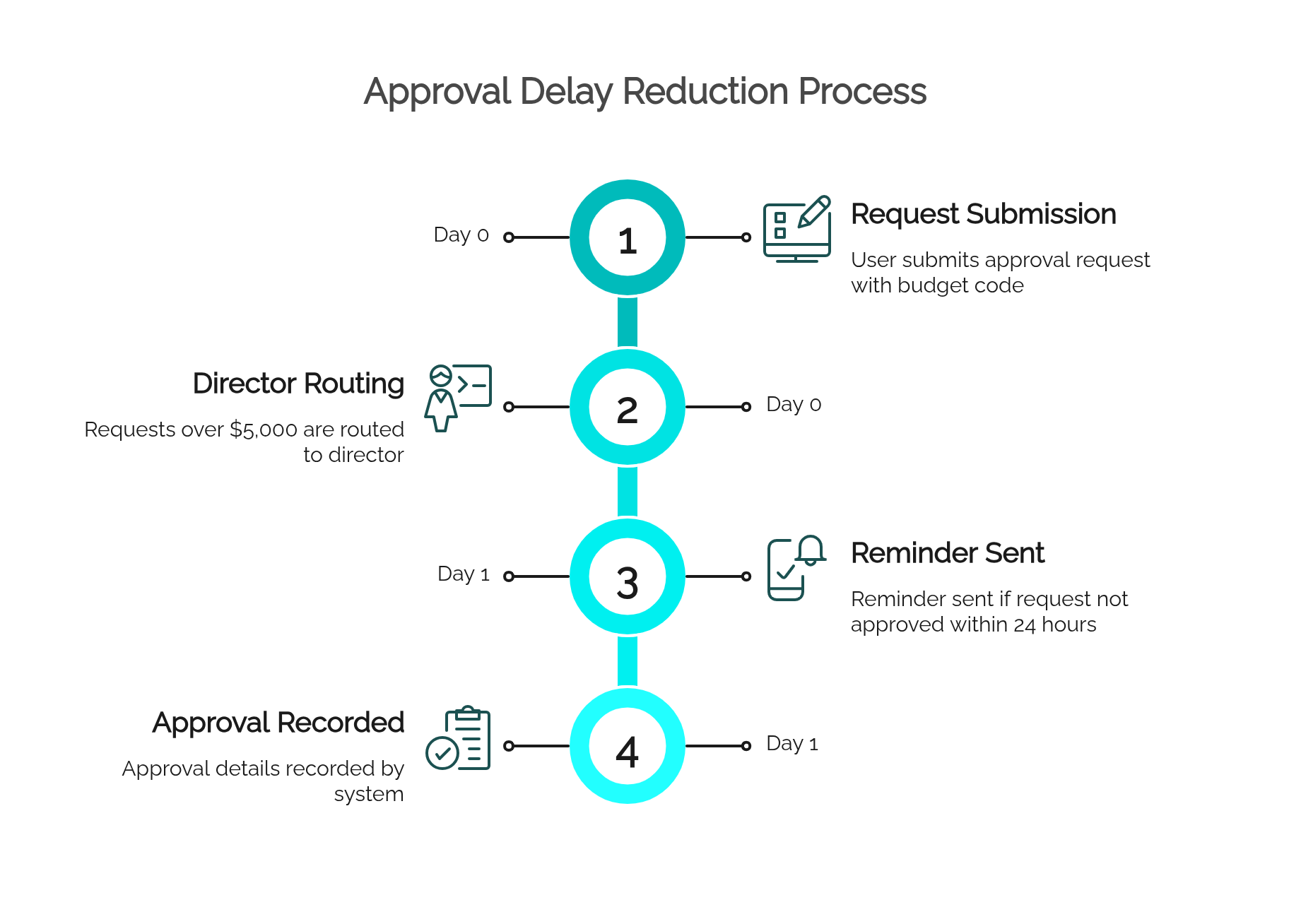
Take the need "reduce delays in purchase approval." The requirements that serve it might be: route requests above $5,000 to a director, send a reminder when an approval sits idle for 24 hours, block submission when the budget code is missing, and record who approved what and when. Each one is checkable. You can look at the finished process and say yes, it does that, or no, it doesn't.
Requirements come in different types, and good analysts keep them separate. Business requirements describe the outcome. Functional requirements describe what the system does. Process requirements describe the steps, roles, and handoffs. Data requirements describe the fields, sources, and validations. Rule requirements describe the conditions that govern decisions. Each type answers a different question, and a project needs all of them to hold together.
A requirement without a need behind it is a guess. A need without requirements is a wish.
Business needs vs requirements
The cleanest way to see the difference is to line them up side by side.
| Business need | Requirement | Example | Why it matters |
|---|---|---|---|
| Reduce approval delays | Route requests over $5,000 to a director within one hour | Purchase approval routing rule | Ties a specific action to the delay the business wants to fix |
| Improve budget control | Validate the budget code before the request is submitted | Field validation on the request form | Stops bad data at the source instead of catching it later |
| Provide audit-ready traceability | Log every approval with user, timestamp, and rule applied | Approval history record | Turns a compliance obligation into something you can prove |
| Cut reimbursement errors | Return requests with missing receipts to the employee automatically | Exception handling for incomplete submissions | Reduces rework without a person having to catch it manually |
| Give managers visibility | Show real-time status of every pending request on a dashboard | Process monitoring view | Replaces "let me check and get back to you" with a live answer |
The pattern is consistent. The need explains why. The requirement explains what. The example makes it real. And the last column keeps everyone honest about whether the requirement earns its place.
Why confusing them creates project problems
When needs and requirements blur together, the damage shows up in predictable ways.
Scope drifts. Without a clear need to measure against, every new requirement seems reasonable. The backlog grows, the timeline slips, and no one can say which items actually matter. Teams end up building a solution that does many things and solves nothing well.
Solutions miss the point. A requirement written without its need is easy to satisfy on paper and still useless in practice. You can build exactly what the document says and watch the original problem survive untouched, because the document described a feature instead of an outcome.
Stakeholders talk past each other. The requester describes a solution. The analyst writes it down as a requirement. Nobody surfaces the need underneath, so when the solution disappoints, there's no shared reference point to explain why.
Change becomes expensive. When requirements aren't anchored to needs, any adjustment feels risky, because no one knows what a change breaks or why the requirement existed in the first place.
A useful test: for any requirement on your list, ask which need it serves. If you can't answer, you've found either a missing need or a requirement that shouldn't be there.
Examples of business needs and requirements
A concrete example makes the distinction easier to hold onto. Consider an expense reimbursement process.
The business need: employees wait too long to get reimbursed, and finance can't tell where requests get stuck. The organization wants faster payouts and clear visibility.
From that single need, a set of requirements follows:
- Employees submit a request with amount, category, date, and receipt.
- Requests without a receipt return to the employee with a reason.
- Amounts above a threshold require director approval.
- International expenses trigger a currency conversion step.
- Approved requests move to finance for payment automatically.
- Every step records who acted and when.
- Requests idle for more than 48 hours send a reminder to the current approver.
Each requirement traces back to the need. Faster payouts explain the reminders, the automatic routing, and the clear rejection path. Visibility explains the audit record and the status tracking. Nothing on the list is there by accident.
Now flip it. If someone had started with "build a reimbursement form," they'd have a form. They might not have the thresholds, the exception handling, or the escalation, because those come from understanding the need, not from describing a screen.
How stakeholders influence requirements
Requirements don't come from the analyst's imagination. They come from the people who request, perform, approve, receive, or are affected by the process.
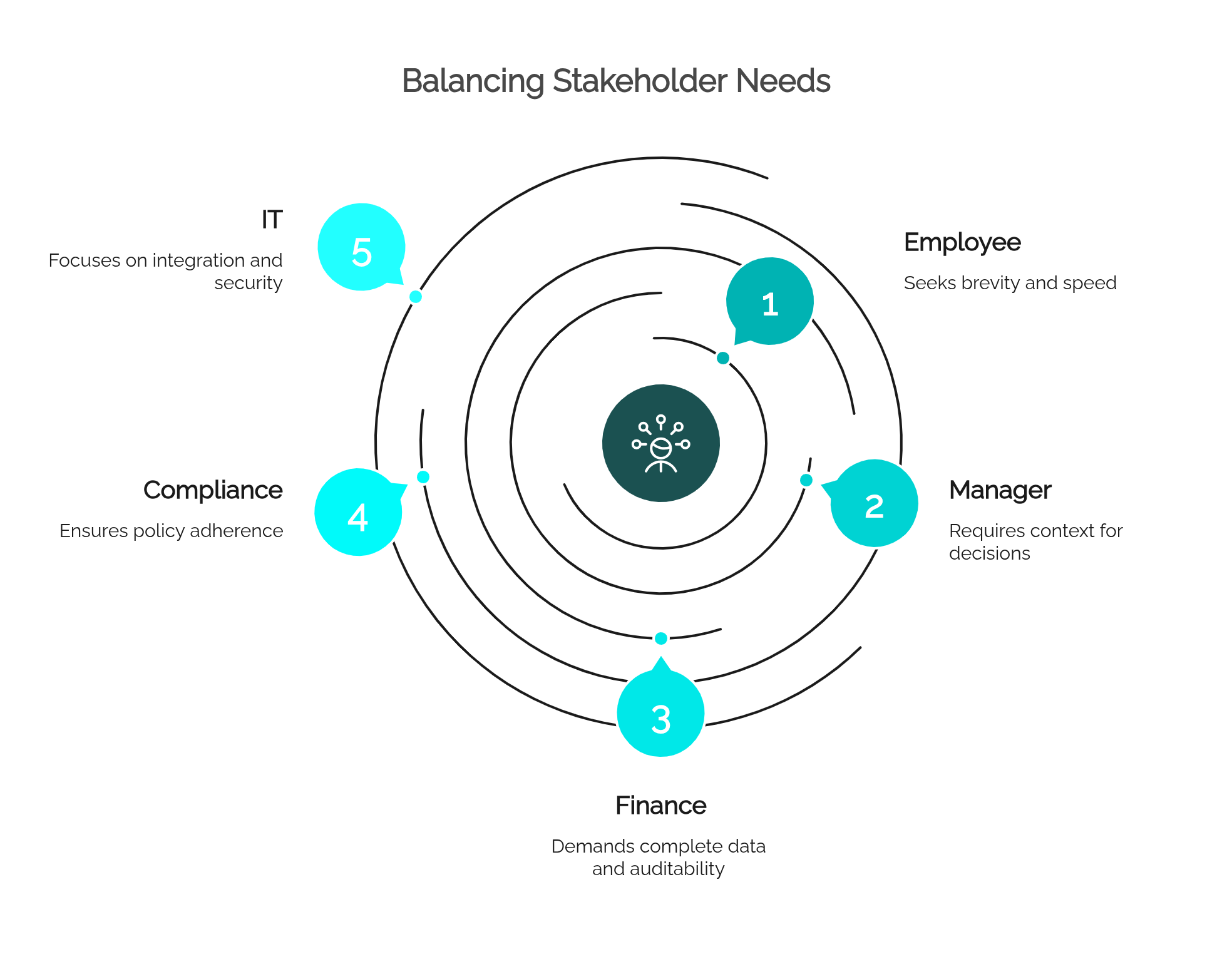
Each stakeholder sees a different slice, and each slice produces different requirements. The employee submitting an expense wants a short form and a fast answer. The manager approving it wants enough context to decide without chasing people. Finance wants complete data and a clean audit trail. Compliance wants proof that policy was followed. IT wants integration and security to hold.
These views often conflict. The employee wants fewer fields; finance wants more. The manager wants speed; compliance wants checks. The analyst's job isn't to pick a winner. It's to surface the tension, trace each demand back to a need, and negotiate requirements that balance them.
This is also where hidden requirements hide. The rules people follow without thinking, the exceptions that happen every week, the informal approval someone does by email. Good stakeholder work pulls these into the open before they turn into workarounds later.
A requirement that only one stakeholder validated is fragile. A requirement that survived a conversation between the people who request, perform, and govern the process tends to hold.
How requirements connect to business processes
Requirements don't live in a document. They live in a process, and that's where they prove their worth.
A requirement like "route requests over $5,000 to a director" only means something inside a flow. There's a submission, a check on the amount, a decision, a handoff. The requirement describes one point in a sequence of steps, roles, and decisions that carries the work from start to finish.
When you map requirements onto a business process, gaps become visible. You see where a rule has no home, where a decision has no defined path, where an exception was written down but never placed in the flow. A requirement list can look complete and still fall apart the moment you try to sequence it.
This is why analysts who work at the process level catch problems earlier. The process forces every requirement to answer practical questions. Who does this? What comes before it? What happens if the answer is no? A requirement that can't answer those isn't ready.
Connecting requirements to processes also makes them testable in context. You're no longer checking whether a feature exists. You're checking whether the process behaves the way the need demanded.
How requirements connect to BPMN models
BPMN gives requirements a shared, visual home that both business and technical teams can read.
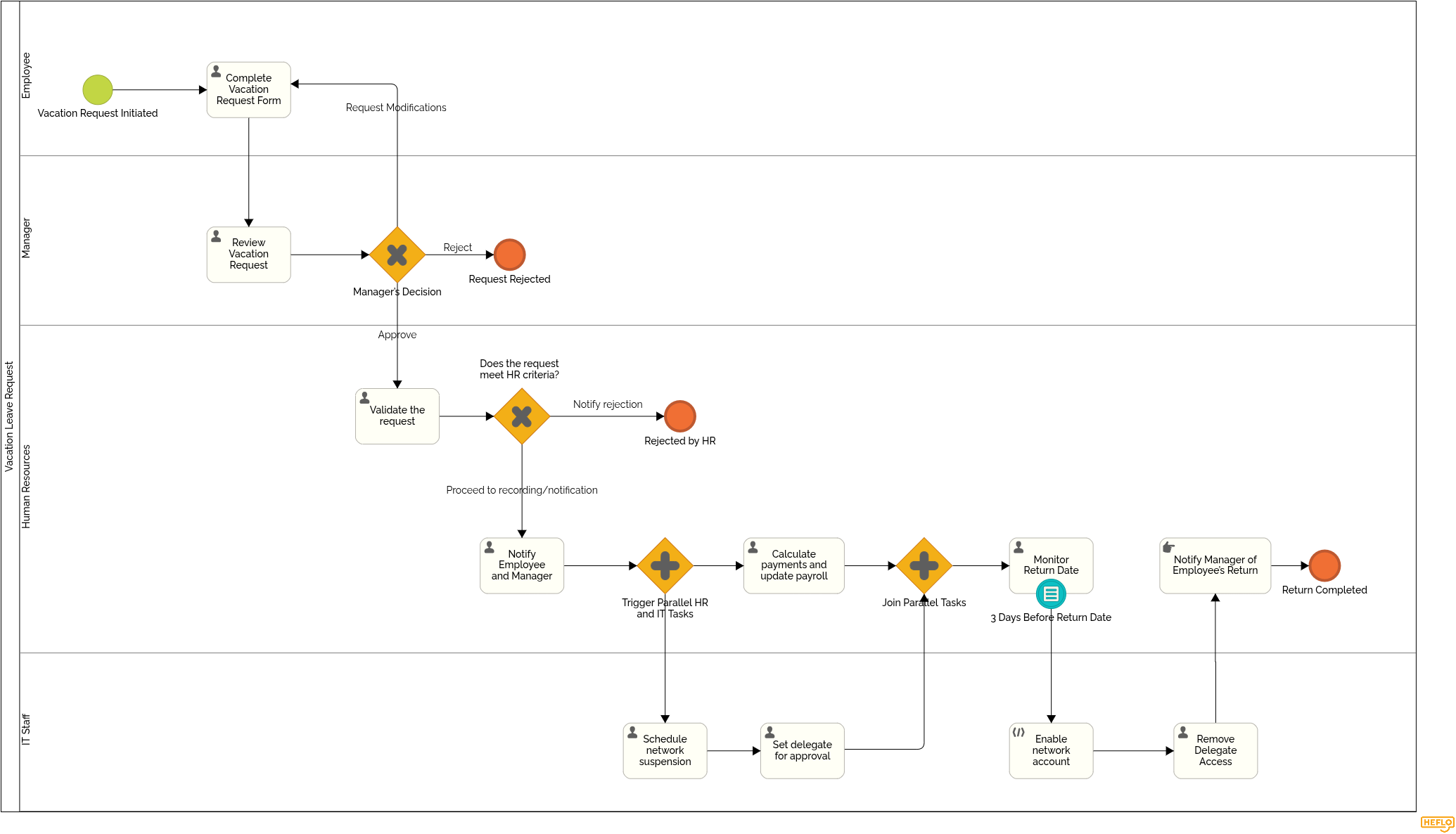
A written requirement is easy to misread. A BPMN model is harder to argue with, because it shows the requirement in place. The approval threshold becomes a gateway. The reminder becomes a timer event. The rejection path becomes an alternative flow. The handoff to finance becomes a message between participants.
This mapping does something useful. It turns a flat list into a structure you can validate. When a stakeholder looks at the diagram, they can point at the exact spot where a rule is wrong or a step is missing, which is far more precise than reacting to a paragraph.
BPMN also exposes what plain requirements tend to hide: what triggers the process, where it waits, which decisions change its path, what happens on the unhappy paths, and where systems have to exchange information. These questions are easy to skip in a requirements document and impossible to skip in a well-built model.
For the analyst, BPMN becomes the bridge between what the business asked for and what will actually run. A requirement that fits cleanly into the model is usually a requirement that's been thought through.
Want to see this in practice? Explore a ready-made Vacation Leave Request BPMN diagram and open it directly in HEFLO's process editor to inspect how the tasks, gateways, and exceptions fit together.
How requirements support automation
Automation is where clear requirements pay off, and where fuzzy ones do the most damage.
An automated process executes exactly what it was told, without judgment. When requirements are complete and well-structured, that precision is a strength. Routing happens the same way every time, deadlines get enforced, records get written, and exceptions follow a defined path. The process behaves consistently because the requirements told it how.
When requirements are incomplete, automation multiplies the gaps. A missing exception rule doesn't disappear; it becomes a stuck case with no path forward. An undefined threshold becomes an approval nobody handles. Automation doesn't fix weak analysis. It runs it faster and makes it visible to everyone.
This is why requirements aimed at automation have to go further than requirements for a manual process. A human performer improvises around a gap. Software doesn't. Every decision needs a rule, every path needs a definition, every exception needs a response. The discipline that feels like overkill during analysis is exactly what keeps the automated process from breaking on its first real edge case.
Well-defined requirements are what let automation deliver consistency, traceability, and speed instead of just a digital version of the old confusion.
From requirements to execution with HEFLO
Requirements become far more useful when they stop living in a separate document and start living inside the process itself.
That's the connection HEFLO is built around. The analyst models the flow in BPMN, attaches the rules and responsibilities to the steps where they apply, documents the process knowledge in one place, and then moves the same model into execution and monitoring. The requirement about director approval isn't a line in a spec anymore; it's a gateway in a running process. The requirement about audit traceability isn't a promise; it's a record the system keeps automatically.
This matters because requirements lose value when they're scattered. When rules sit in one document, responsibilities in another, and the running system somewhere else, nobody can tell whether what's executing still matches what the business needed. When the process model carries the requirements, the rules, the responsibilities, and the automation together, that gap closes.
The result is requirements that don't just describe a solution. They drive one, and stay connected to the need that created them.
FAQ: Requirements vs Business Needs
What is the difference between a business need and a requirement?
A business need is the problem or outcome the organization wants to address, such as reducing approval delays. A requirement is a specific, verifiable thing the solution must do to satisfy that need, such as routing high-value requests to a director. The need explains why; the requirement explains what.
Why do projects fail when needs and requirements are confused?
Because requirements written without a clear need behind them tend to describe features instead of outcomes. Teams build exactly what the document says and still leave the original problem unsolved, while scope grows and no one can say which items actually matter.
Can you give an example of a business need versus a requirement?
For a reimbursement process, the need might be "employees wait too long to get paid and finance can't track requests." Requirements serving that need include returning submissions with missing receipts, routing large amounts to a director, and recording every approval with a timestamp.
How do stakeholders influence requirements?
Each stakeholder sees a different part of the process and produces different requirements. Requesters want speed, approvers want context, finance wants complete data, and compliance wants proof. The analyst surfaces these views, traces each back to a need, and negotiates requirements that balance them.
How do requirements connect to business processes?
A requirement only means something inside a flow of steps, roles, and decisions. Mapping requirements onto a process reveals gaps, such as a rule with no home or an exception that was never placed in the flow, and makes each requirement testable in context.
How does BPMN help with requirements?
BPMN turns written requirements into a visual model both business and technical teams can read. Thresholds become gateways, reminders become timer events, and exceptions become alternative paths, which makes requirements easier to validate and harder to misread.
Why do requirements matter more for automation?
Automated processes execute exactly what they're told, with no improvisation. Complete requirements produce consistent, traceable execution, while missing rules or undefined paths become stuck cases. Automation runs weak analysis faster rather than fixing it.
How does HEFLO connect requirements to execution?
HEFLO lets analysts model the process in BPMN, attach rules and responsibilities to the relevant steps, document the process knowledge, and move the same model into execution and monitoring, so requirements stay connected to the need that created them.