Why Requirements Should Be Connected to Business Processes

Most requirements documents are technically correct and practically useless. The sentences are well formed, the acceptance criteria are numbered, the stakeholders signed off. Then development starts, and someone asks a question nobody can answer: who approves this when the manager is on vacation? The document is silent. The process, of course, is not — it happens every day, with workarounds nobody wrote down.
That gap between what gets documented and what actually happens is where projects lose money. And the reason the gap exists is almost always the same: the requirement was captured as a standalone statement, disconnected from the business process it belongs to.
Why requirements are not enough by themselves
A requirement answers the question "what should the system do?" It rarely answers "when", "for whom", "under which conditions", or "what happens next". Those answers live in the process.
Take a typical requirement: "The system shall allow managers to approve purchase requests." On its own, it looks complete. In practice, it hides a dozen open questions. Which managers — the requester's direct manager, or the budget owner? What amount thresholds change the approval path? What does the requester see while waiting? Can an approval be delegated, escalated, or withdrawn?
None of that is pedantry. Each unanswered question becomes either a developer's guess, a late-stage change request, or a production incident. Requirements describe intent; processes describe reality. You need both, and you need them linked.
The risk of isolated requirements
When requirements are written and maintained apart from process documentation, a few predictable failure modes appear:
Contradiction without detection. Two requirements from different workshops can conflict — one says finance validates before procurement, another implies the opposite order — and nobody notices, because there is no shared process model where the conflict would be visible as two arrows pointing in different directions.
Scope defined by imagination. Without a process boundary, every stakeholder fills the blank space with their own assumptions. The requirement "notify the customer" means an email to marketing, a WhatsApp message to support, and an SMS to the product owner. All three are now expecting different systems.
Orphaned requirements. Some requirements survive from projects long dead. They keep getting re-implemented because they exist in the backlog, even though the process step they supported was eliminated two reorganizations ago. Connecting requirements to processes gives you a natural expiration mechanism: when the process step goes away, its requirements become visibly obsolete.
Rework as a business model. Studies on software defects have pointed at requirements problems as a leading cause of rework for decades. The pattern hasn't changed because the practice hasn't: teams still validate requirements as isolated sentences instead of validating them against the flow of work.
How processes reveal context
A business process is, in essence, a context machine. It tells you where a requirement lives: which activity triggers it, which role executes it, what came before, what depends on it afterward, and which events can interrupt it.
Reading a requirement inside its process changes how people evaluate it. A stakeholder reviewing a list of 80 requirements will skim and approve. The same stakeholder walking through a process model will stop at an activity and say "wait — that's not how we do it when the client is international." The process format invites the memory of exceptions; the list format suppresses it.
Context also exposes non-requirements — things everyone assumed the system would handle because they happen in the process, but nobody wrote down. Handoffs are the classic case. Requirements tend to describe what happens inside an activity; failures tend to happen between activities.
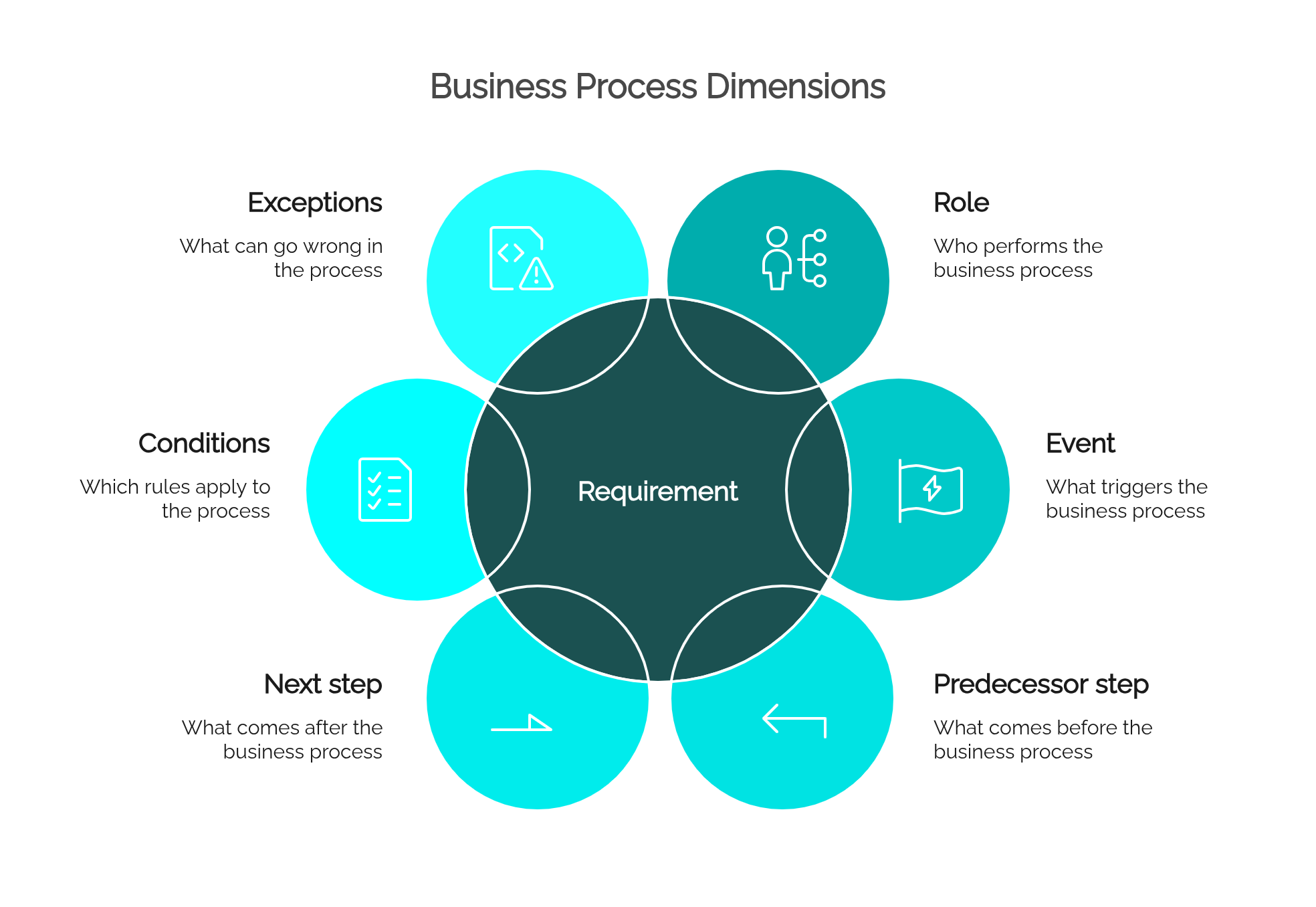
Requirements, roles and responsibilities
"The system shall allow approval" is a different requirement depending on who approves. Roles carry authority, workload, availability and skill — and each of those shapes the solution.
If the approver is a director who handles five requests per month, a simple email link may be enough. If the approver is a shared-services analyst processing two hundred requests a day, you need queues, bulk actions, SLAs and delegation rules. Same verb, "approve"; completely different products.
Process models make this explicit through lanes and participants. When a requirement is attached to an activity inside a lane, the question "who is responsible?" is answered structurally rather than left to interpretation. It also surfaces organizational questions early: if nobody can say which lane an activity belongs to, you've found a governance problem before it became a software problem — much cheaper to fix at that stage.
Requirements, business rules and exceptions
Business rules are where isolated requirements suffer most. A rule like "purchases above €10,000 require a second approval" isn't just a validation to code somewhere. Inside a process, it's a gateway: it splits the flow, creates an additional path, involves another role, and introduces a new waiting state that the requester will experience.
Exceptions are even more revealing. Ask a stakeholder to list requirements and you get the happy path. Ask them to walk through a process model and you get the truth: the supplier that sends invoices in the wrong format, the approval that times out, the request that gets cancelled halfway. In most operational processes, handling exceptions consumes more effort than the happy path — yet exception handling is chronically underrepresented in requirements written without a process view.
When rules and exceptions are modeled as gateways and boundary events attached to specific activities, each one becomes traceable: you can point at the diagram and ask "what should the system do here?" That question is answerable. "List all the business rules" is not.
Requirements and BPMN process models
BPMN gives this connection a concrete, standardized form. Every element in a BPMN model is a natural anchor point for requirements:
- Tasks anchor functional requirements — what the system must support at that step, including the form fields, validations and integrations involved.
- Gateways anchor business rules — the decision logic that routes the flow.
- Lanes and pools anchor responsibility and access requirements — who can do what, and where organizational boundaries (and therefore system boundaries) sit.
- Events anchor triggers, timers and integration requirements — what starts the process, what interrupts it, what deadlines apply.
- Message flows anchor interface requirements between systems or between the organization and external parties.
This mapping turns traceability from a spreadsheet exercise into something structural. Instead of a requirements matrix maintained by hand and outdated by Friday, the model itself holds the relationship: open the activity, see its requirements; change the flow, see which requirements are affected.
It also disciplines the requirement's granularity. A requirement that can't be attached to any specific element is usually either a non-functional requirement (fine — those attach to the process as a whole) or a vague wish that needs decomposition before anyone builds it.
Reading a real model: Employee Termination Process
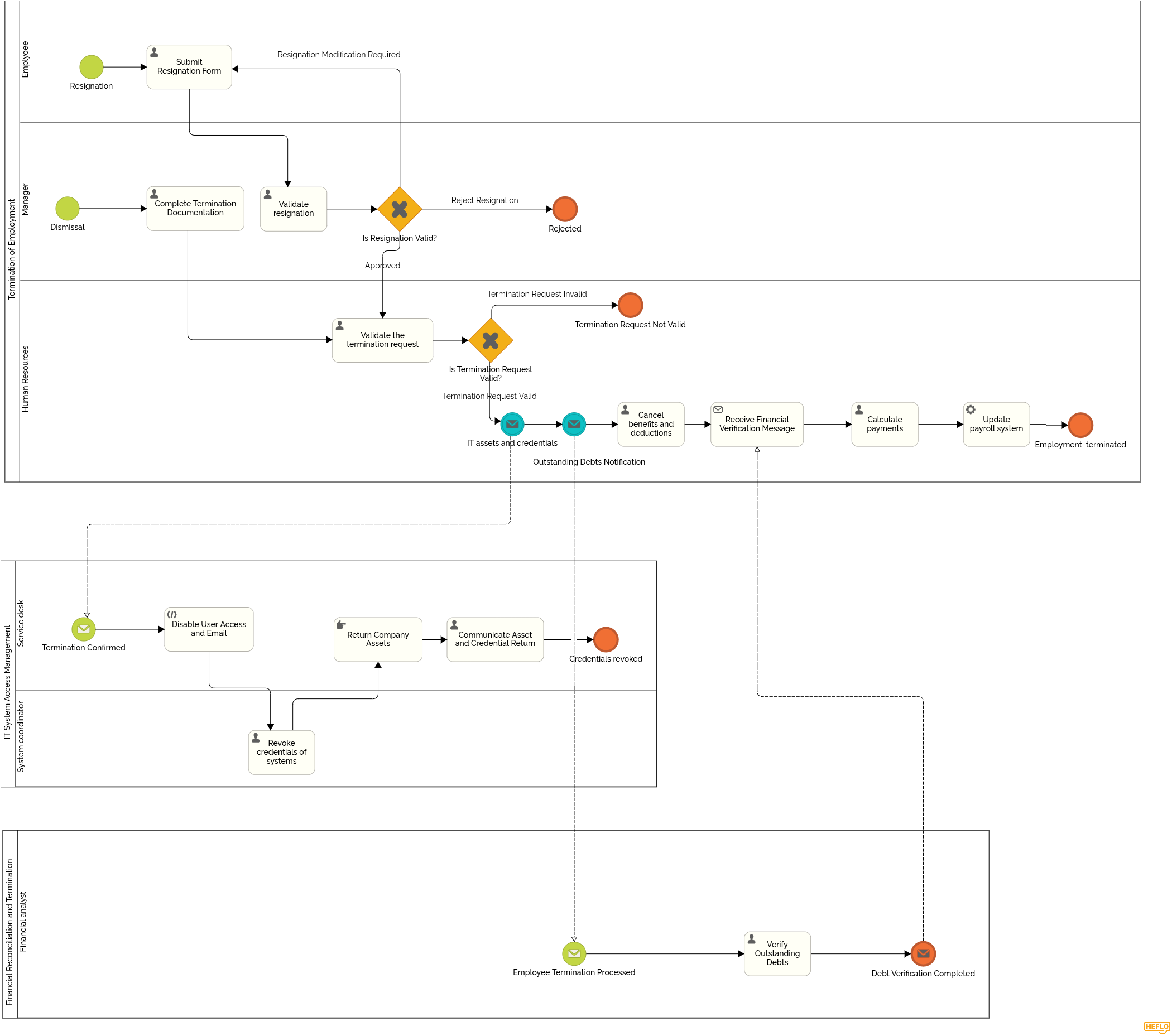
The diagram above models an employee termination process, and every concept from the list is visible in it.
Start with the events. The process has two triggers: a Resignation start event in the Employee lane and a Dismissal start event in the Manager lane. Same process, two entry points — which already implies two different requirements. A resignation begins with a form the employee fills in; a dismissal begins with documentation the manager completes. An isolated requirement saying "the system shall register terminations" would flatten that distinction, and someone would discover it during development.
The lanes and pools carry the responsibility map. Inside the main pool, Employee, Manager and Human Resources each own specific activities — access requirements come straight from that layout. The other two pools, IT System Access Management and Financial Reconciliation, are separate processes entirely, possibly separate systems. Pool boundaries are where interface requirements live.
The gateways hold the business rules. Is Resignation Valid? isn't decoration — it forces the question "what makes a resignation invalid?", and the answer (notice period, pending projects, contract clauses) is a set of rules someone must specify. Note the return path labeled Resignation Modification Required, looping back to the resignation form: a rework path that almost never shows up in a requirements list, yet here it's drawn explicitly.
The tasks show that not every activity implies the same kind of requirement. Update payroll system carries a gear icon — a service task, meaning the requirement is an integration, not a screen. Return Company Assets is a manual task; its requirement is about tracking and confirmation, not automation. Disable User Access and Email is a script task — a candidate for full automation, with its own security requirements.
Finally, the message flows — the dashed lines crossing pool boundaries — are integration requirements made visible. HR throws IT assets and credentials to the Service desk and Outstanding Debts Notification to the Financial analyst, then the process stops at Receive Financial Verification Message and waits. That waiting state is a requirement hiding in plain sight: what payload does each message carry? How long can HR wait for the debt verification before someone escalates? What happens to Calculate payments if finance never answers? None of those questions exists in a requirements list; all of them exist in the diagram, waiting to be asked.
How connected requirements improve stakeholder alignment
Stakeholders don't think in requirement IDs. They think in the work they do: "when a request arrives, I check the budget, then I send it to John in procurement." A process diagram speaks that language; a requirements list does not.
Reviewing requirements inside the process model changes the dynamics of validation sessions. Business people can follow the flow and correct it, because it mirrors their day. Disagreements between departments become visible as conflicting paths on the same diagram, and get resolved in the room instead of surviving quietly until integration testing. The model becomes the shared artifact that business, analysts and developers all point at — which is worth more than any sign-off signature on a 60-page document nobody fully read.
There's a subtler alignment benefit too: connected requirements expose ownership. When a requirement hangs off an activity in the finance lane, finance owns the answer to questions about it. Isolated requirements have authors; connected requirements have owners.
How connected requirements support automation
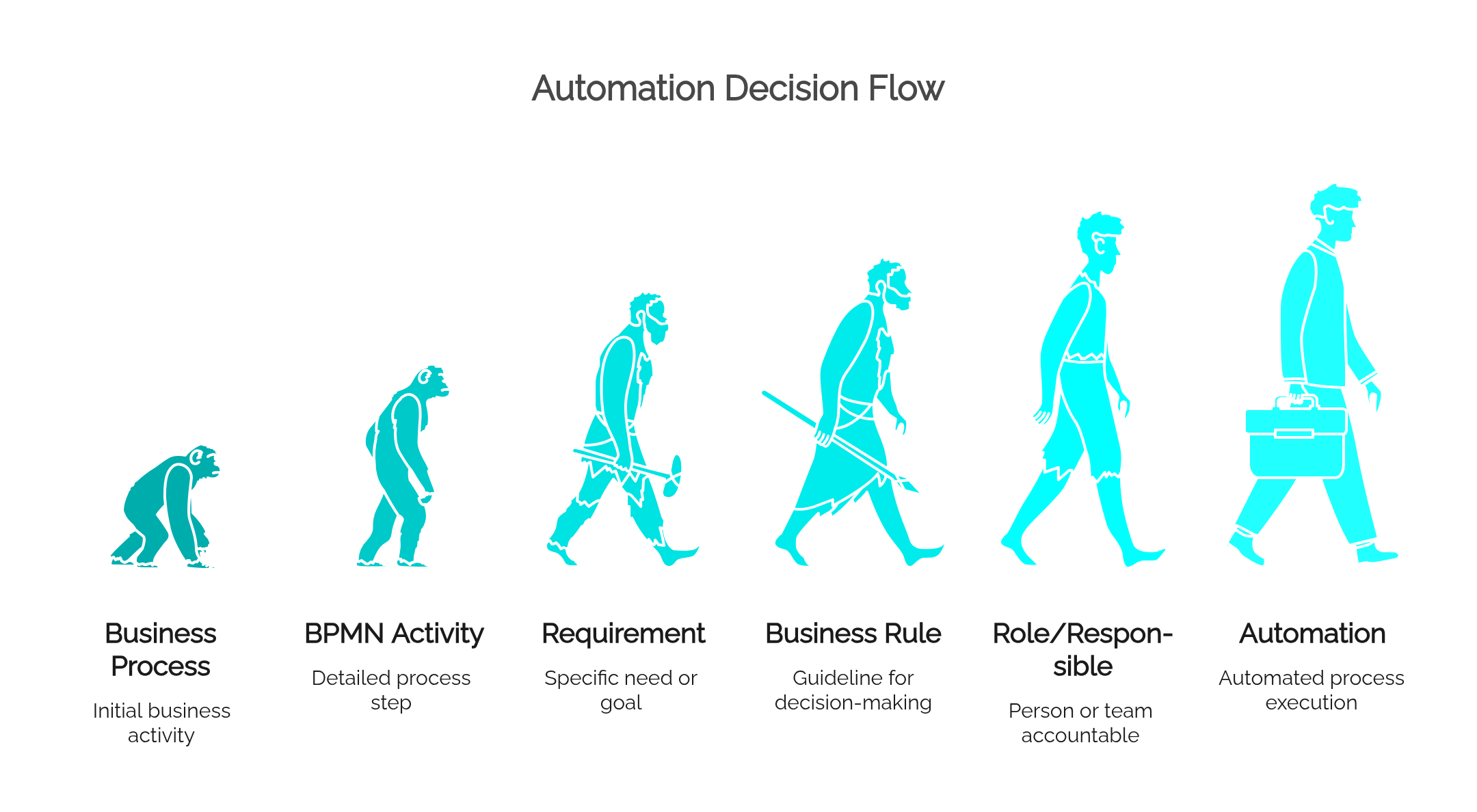
Automation decisions are process decisions wearing a technology costume. Choosing what to automate, in what order, with which tool — RPA, workflow engine, API integration, AI agent — depends on information that only the process view provides: volume per path, handoff frequency, exception rates, waiting times, and which role's time you're actually trying to free up.
Automating from isolated requirements produces a familiar disaster: the happy path runs beautifully in the demo, then production traffic arrives and 30% of cases fall into exceptions the automation never contemplated. Humans are pulled back in, now with a worse tool, because the system handles part of the work and blocks the rest.
When requirements are anchored in a modeled process, the automation scope is honest. You can see which paths are covered, which exceptions still route to a human, and where the process must be redesigned before automating — because automating a broken process just produces broken outcomes faster. For process execution engines specifically, the connection is even more direct: the BPMN model with its attached requirements, rules and role assignments is a large part of the implementation, not just its documentation.
Practical example: an approval process with missing context
A mid-sized company requests a purchase approval feature. The requirement, as delivered: "The system shall send purchase requests to the manager for approval. Approved requests go to procurement."
The team builds exactly that. Two weeks after go-live:
- Requests above a certain value sit unanswered, because those actually require the finance director — a rule everyone in the office knew and nobody wrote down.
- A manager goes on vacation and requests pile up for eleven days. There was a delegation practice ("send it to whoever is covering"), invisible to the system.
- Procurement rejects a third of approved requests because supplier data is incomplete — a verification step that used to happen informally, over chat, before anything was "submitted".
- One urgent request is approved verbally and executed outside the system entirely. The audit trail now has a hole.
None of this is a coding failure. Every one of these problems was sitting in the real process, and a one-hour modeling session would have surfaced them: the value gateway, the delegation rule, the data-completeness check before submission, and the escalation path for urgent cases. The requirement wasn't wrong — it was alone.
Redone with a process model, the same feature ships with a threshold gateway, a delegation mechanism attached to the approval task, a validation step in the requester's lane, and a timer event that escalates stalled approvals. Four requirements that only exist because the process made them visible.
Checklist: questions to ask before accepting a process requirement
Use this before adding any requirement to your backlog or specification:
- Which process — and which activity in it — does this requirement belong to? If nobody can answer, the requirement is floating.
- Who performs this activity, and does the requirement change if a different role performs it?
- What triggers this step? An event, a schedule, a previous task, an external message?
- What happens immediately after? Who consumes the output, and in what format?
- Which business rules apply, and where do they come from? Policy, regulation, habit? Habits deserve extra scrutiny.
- What are the known exceptions? Ask specifically: "when does this not work the normal way?"
- Is there a value, volume or time threshold that changes the path?
- Can this step be delegated, escalated, cancelled or reversed? Each "yes" is at least one more requirement.
- What does the requester or customer experience while this step is pending?
- If this activity disappeared from the process tomorrow, would the requirement still make sense? If yes, find its real home; if no, you've confirmed the anchor.
Keeping requirements connected with HEFLO
Everything above depends on one practical condition: having a living process model where requirements can actually attach. That's the role HEFLO plays. Teams model their processes in BPMN, document each activity with its responsible roles, business rules and supporting details, and keep that documentation next to the flow rather than in a separate document that drifts out of date.
Because HEFLO also executes processes, the connection doesn't stop at documentation: the same model that carries the requirements drives forms, task assignment, deadlines and approvals in production. When the process changes, the requirements context changes with it — in one place, visible to business and technical people alike.
If your requirements currently live in spreadsheets and slide decks, disconnected from the workflows they describe, modeling those workflows is the fastest way to find out what your documents have been hiding.
FAQ
Why should requirements be linked to business processes?
Because processes supply the context a requirement needs to be implemented correctly: who performs the work, what triggers it, which rules apply, and what happens on exception paths. Requirements documented in isolation force developers and stakeholders to fill those gaps with assumptions, which is the main source of rework.
What problems do isolated requirements cause?
The most common are undetected contradictions between requirements, missing exception handling, scope disputes between departments, orphaned requirements that outlive their purpose, and automation projects that only cover the happy path.
How does BPMN help with requirements management?
BPMN elements act as anchor points: tasks hold functional requirements, gateways hold business rules, lanes define responsibilities, and events capture triggers and deadlines. This makes traceability structural — changing the flow immediately shows which requirements are affected.
Should business analysts model processes before writing requirements?
In most cases, yes. Even a rough process model exposes roles, handoffs, decisions and exceptions that a requirements interview alone tends to miss. The model then becomes the frame in which requirements are captured, reviewed and validated with stakeholders.
How do connected requirements improve automation decisions?
They reveal which paths and exceptions the automation must cover, which role's effort is actually being reduced, and where the process should be fixed before being automated. This prevents the common failure where automation handles the demo scenario but collapses under real-world exception volume.
What is the difference between a requirement and a business rule?
A requirement describes what a system or process must support; a business rule describes a condition or constraint of the business itself, such as approval thresholds or regulatory checks. In a process model, rules typically appear as gateways or task conditions, while requirements attach to the activities that implement them.