Global Business Services (GBS) vs. Shared Services: What Changes and When to Make the Move

Global Business Services (GBS) is an operating model that integrates multiple support functions — finance, HR, IT and procurement — into a single global organization serving all business units, under one governance structure. A shared services center (SSC) typically serves one function or region; GBS consolidates several SSCs, outsourcing contracts and delivery locations into one integrated service organization.
Most large multinationals have already implemented finance shared services, and many run HR and IT centers as well, in a mix of captive and outsourced operations, according to the Deloitte Shared Services Handbook. That success created a new problem: three or four functional programs running in parallel, with separate teams, separate locations and separate ways of serving the same internal customers. GBS is the answer to that fragmentation — but it is not the right answer for every organization. This guide covers what GBS actually changes, how the evolution happens, and how to know whether your organization is ready.
What is Global Business Services (GBS)?
Global Business Services (GBS) is a single support services organization that delivers services to all of a company's business units worldwide, across all relevant functions — typically finance, HR, IT and procurement. The Deloitte Shared Services Handbook describes the core idea as one organization, one governance structure and one way of interacting with internal customers, replacing the patchwork of function-by-function initiatives.
A GBS organization is rarely a single building or a single workforce. In practice, GBS combines captive shared services centers, outsourcing contracts and multiple delivery locations under unified leadership. The delivery mix that companies build when they combine shared services and outsourcing is usually the raw material that a GBS organization later consolidates — the centers and contracts already exist; GBS puts them under one roof organizationally, not physically.
The defining feature of Global Business Services is not size or scope. It is unified governance: one leadership team accountable for service delivery across functions, one service catalog, and one performance framework — instead of a separate deal between each function and the business.
What is the difference between GBS and shared services?
| Dimension | Shared services center (SSC) | Global Business Services (GBS) |
|---|---|---|
| Functional scope | Single function (e.g., finance or HR) | Multifunctional: finance, HR, IT, procurement |
| Geographic reach | Typically one region or country cluster | Global, serving all business units |
| Governance | Owned by the function (e.g., reports to the CFO) | Unified governance above the functions (COO/CEO level) |
| Delivery mix | Usually captive centers | Captive centers + BPO partners + multiple locations, managed as one network |
| Customer interface | Function-specific SLAs and contact points | Single service catalog, one "look and feel" for internal customers |
| Process model | Functional processes (e.g., accounts payable) | End-to-end processes crossing functions (e.g., procure-to-pay) |
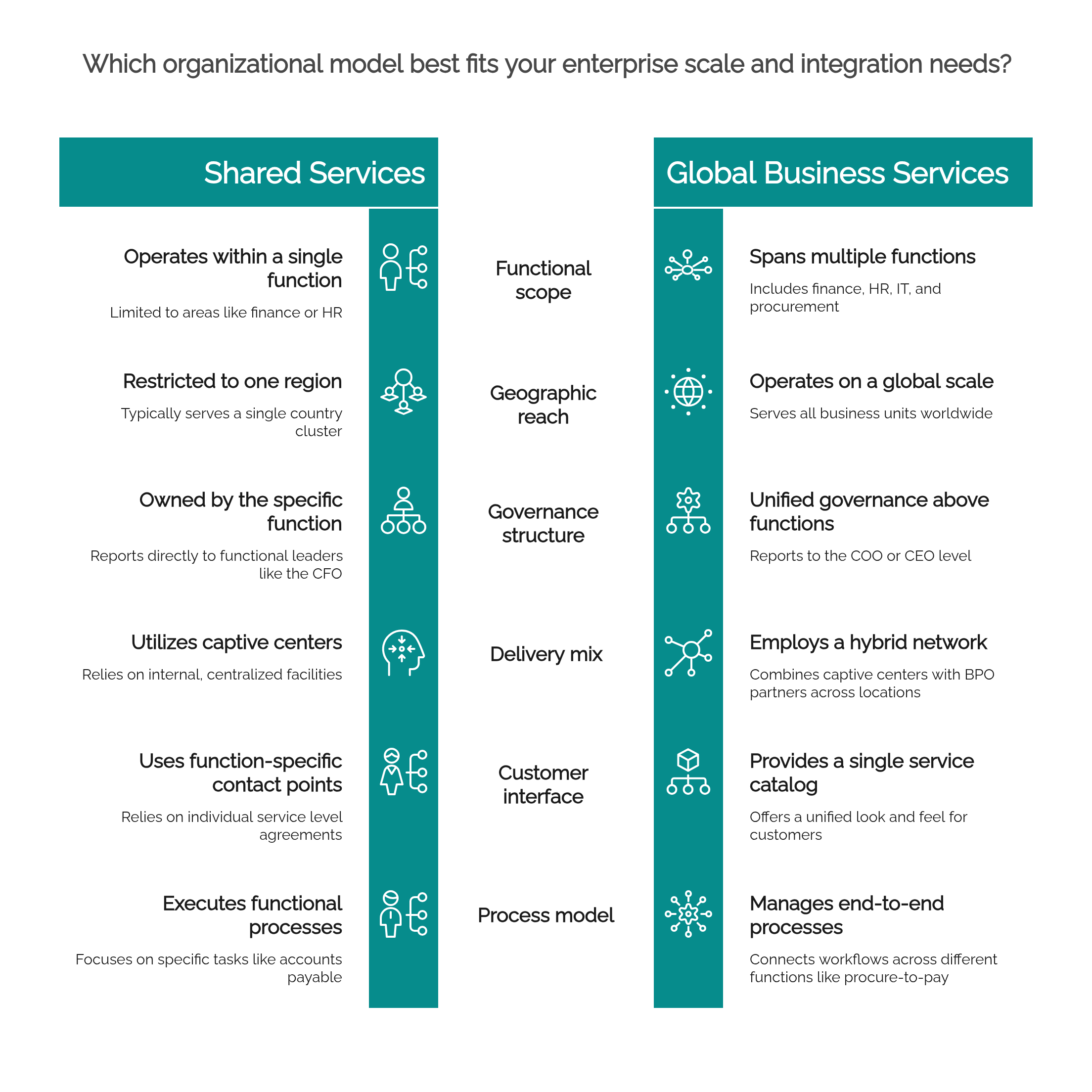
The comparison table above captures the structural differences, but the essential point is simpler: GBS is not a bigger SSC — it is a change of governance. A shared services center consolidates work within a function. Global Business Services consolidates the functions' service organizations themselves, moving from several parallel functional initiatives to one integrated service business with a single leadership team.
That governance shift explains every other row in the table. A single global organization can rationalize locations because no function "owns" a site. It can define end-to-end processes because no functional boundary stops at the handoff. And it can present one interface to internal customers because there is one service catalog instead of four. An SSC optimizes a function; a GBS organization optimizes service delivery for the whole enterprise.
How does a shared services center evolve into GBS?
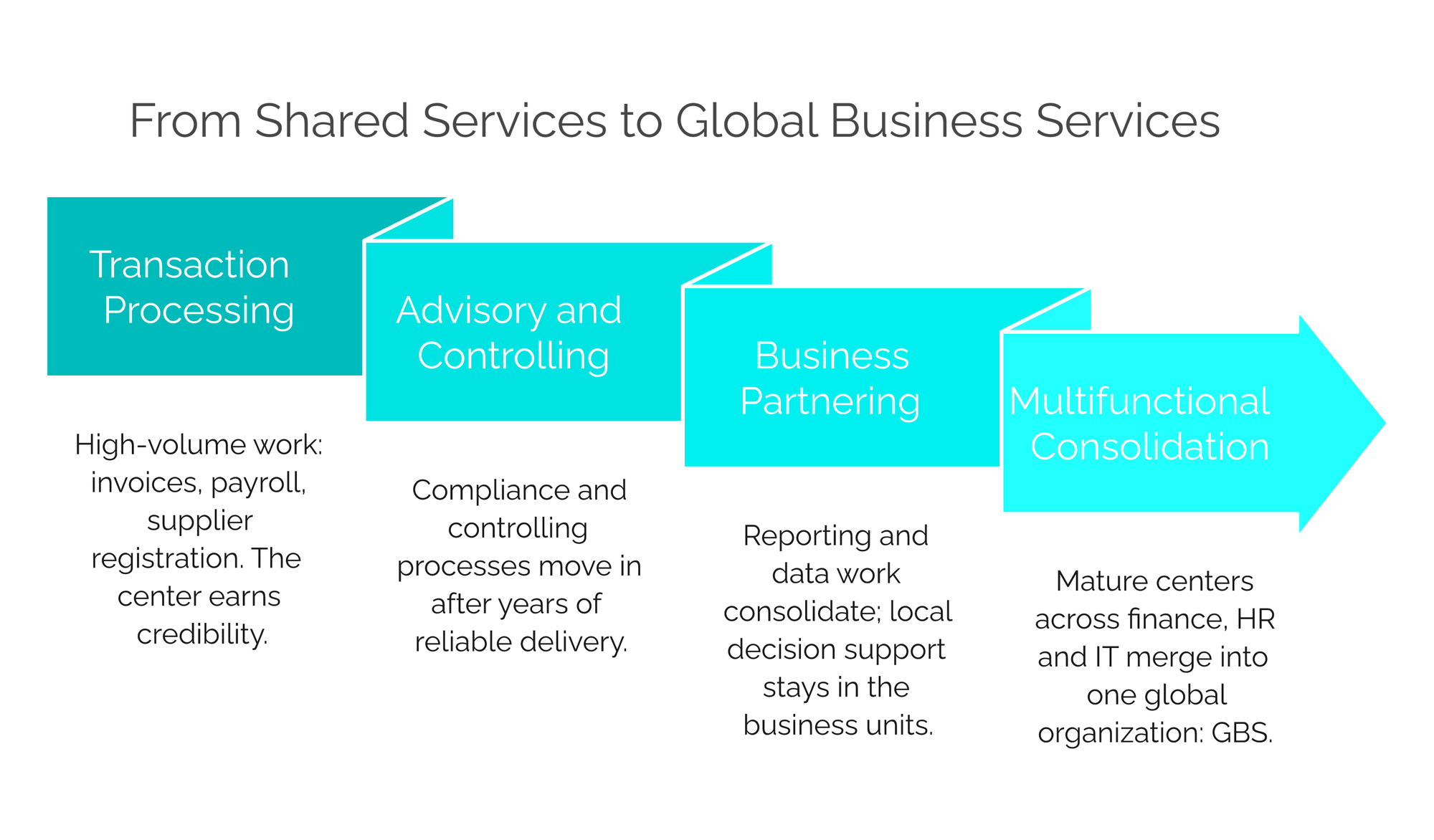
Almost no company designs GBS from scratch. Global Business Services emerges at the end of a value trail that individual shared services centers walk first. The Deloitte Shared Services Handbook describes the typical progression:
- Transaction processing. The SSC starts with high-volume transactional work — invoice processing, payroll data entry, supplier registration. This is where the center earns credibility.
- Advisory and controlling. After several years of reliable delivery, the SSC takes on more challenging processes — controlling, compliance-related work — where business-unit resistance is higher but the center has "earned the right" to handle them.
- Business partnering (partial). Data extraction, manipulation and reporting activities can be consolidated into the center. Genuine decision support that requires local presence stays with the business units.
- Multifunctional consolidation = GBS. Once two or more functions have mature centers, leadership starts asking the question that triggers most GBS programs: why are finance, HR and IT running separate shared services initiatives, with different project teams, different locations and different ways of interacting with the same customers?
Each stage demands a higher level of process maturity than the last, and functions rarely move at the same speed — a gap that becomes critical when consolidation is on the table, as the risks section below shows. A shared services center evolves into GBS not by growing, but by proving enough maturity that consolidating it with its peers becomes the obvious next question.
What does a GBS organization deliver? End-to-end processes
The operational differentiator of Global Business Services is the end-to-end process: a flow that crosses functional boundaries and is managed by a single process owner. Two examples show what that means in practice.
Procure-to-pay. In a functional SSC landscape, Acquisition of Goods and Services and Register Suppliers live in the procurement center, while Goods Receiving and Accounts Payable live in the finance center. Every handoff between them — a purchase order that accounts payable can't match, a supplier record that doesn't reconcile with an invoice — crosses an organizational boundary with its own SLAs and its own queue. A GBS organization runs these four processes as one flow, with one owner accountable from purchase requisition to payment.
Hire-to-retire. The same logic applies to the employee lifecycle: Hiring → Registration and Integration of New Employee → Vacation/Leave Request → Termination of Employment. Under GBS, one process owner is accountable for the full cycle, instead of recruiting, onboarding and offboarding operating as separate services with separate backlogs.
One honest caveat, straight from the Deloitte Shared Services Handbook: there are not as many genuinely cross-functional end-to-end processes as GBS business cases tend to assume. Procure-to-pay and hire-to-retire are real; a long tail of "integrated" processes often isn't. A GBS organization delivers its value through a small number of high-volume end-to-end flows — which is exactly why identifying them honestly matters before committing to the model.
What are the benefits of GBS over standalone SSCs?
The Deloitte Shared Services Handbook identifies three core advantages of Global Business Services over standalone shared services centers:
- Common sites and infrastructure. Local IT and HR support, facilities and enabling technology are shared across what used to be separate functional centers, instead of each SSC maintaining its own.
- End-to-end process improvement. Processes that cross functions — finance and procurement being the classic pairing — can be redesigned and measured as single flows rather than optimized in functional silos.
- A single "look and feel." Internal customers get one way of interacting with support services: one catalog, one request channel, one performance framework — instead of learning a different interface for each function.
To these, add the second-order effects: economies of scale in technology investment (one workflow platform, one data model instead of four) and simpler data governance, because master data such as supplier and employee records has a single owner. The benefits of GBS are real — but they are governance benefits, and they only materialize if the governance actually changes.
What are the risks and challenges of GBS?
Most content about Global Business Services reads like a brochure. The Deloitte Shared Services Handbook is unusually blunt about the obstacles, and its warnings map to what GBS programs actually struggle with:
- Fewer end-to-end processes than expected. There are not that many genuinely cross-functional processes; if the business case rests on dozens of them, it rests on sand.
- Unequal functional maturity. Finance may be five years into its SSC journey while HR is just starting. Consolidating functions at very different maturity and readiness levels multiplies risk instead of value.
- Executive commitment is exponentially harder. Getting management commitment for a single-function finance SSC is difficult on its own. Securing commitment for a program that touches every function — and every functional leader's span of control — is, in Deloitte's words, exponentially more difficult.
- Governance is the central challenge. Defining a governance structure that functional leadership will agree with and support is the particular sticking point. GBS takes power from functions; functions rarely volunteer for that.
"GBS will become more prevalent but it is not a solution that will work for all organisations and the implementation risks can be significant." — Deloitte Shared Services Handbook
The honest conclusion: the risks of GBS are organizational, not technical. Companies that fail at GBS usually fail at governance and sponsorship, not at process design.
When should you move from shared services to GBS? Readiness checklist
Use the SSC-to-GBS Readiness Checklist — five filters that translate the obstacles above into a go/no-go test:
- Do two or more functions already operate stable SSCs? GBS consolidates mature centers; it does not rescue struggling ones.
- Are the functions' processes at comparable maturity? A finance center at business-partnering stage and an HR function still decentralizing should not be merged yet.
- Are there real end-to-end processes to capture? Name them specifically — procure-to-pay, hire-to-retire — with volumes. If you can't, the business case is functional consolidation wearing a GBS badge.
- Is there executive sponsorship above the functions? A GBS program sponsored only by the CFO is a finance program with a bigger name. It needs COO- or CEO-level ownership.
- Is there a governance proposal the functions will accept? If functional leaders haven't agreed on who decides what, no operating-model slide will save the program.
The rule of thumb: if the answer is "no" on two or more filters, mature the SSC model first and revisit GBS in 12–24 months. Moving early doesn't accelerate the destination; it usually delays it.
Not sure where your shared services organization stands on these filters? Run the Shared Services Adoption Assessment — a structured way to benchmark your SSC's maturity before committing to a GBS program.
FAQ
What is the difference between GBS and shared services?
A shared services center (SSC) typically consolidates one function — such as finance or HR — for one region. Global Business Services (GBS) integrates multiple functions and geographies into a single global organization with unified governance, often combining internal centers and outsourcing partners.
Is GBS the same as shared services?
No. GBS is an evolution of the shared services model. Shared services consolidates processes within a function; GBS consolidates multiple functional shared services organizations — finance, HR, IT, procurement — under one global governance structure and a single way of serving internal customers.
What functions are included in Global Business Services?
A GBS organization typically covers finance and accounting, human resources, IT services, and procurement, delivered through end-to-end processes such as procure-to-pay (from purchase requisition and supplier registration to goods receiving and accounts payable) and hire-to-retire (from hiring to employee termination).
Do you need a shared services center before GBS?
In practice, yes. Most organizations reach GBS by consolidating mature functional shared services centers. According to the Deloitte Shared Services Handbook, functions at very different maturity levels are one of the main obstacles to a GBS program, so stabilizing individual SSCs first reduces implementation risk.
Is GBS right for every company?
No. The Deloitte Shared Services Handbook notes that GBS will become more prevalent but is not a solution that works for all organizations, and implementation risks can be significant. Companies without mature SSCs in at least two functions, executive sponsorship above the functional level, or genuine end-to-end processes to capture should mature their shared services model first.
Build the process foundation GBS requires
A GBS organization only works on top of processes that are standardized, documented and measurable — you cannot unify governance over processes nobody can see. HEFLO lets your process analysts model those processes in BPMN and put them into production without code and without depending on IT, so finance, HR and procurement flows run on the same platform from day one. Unified SLA tracking and a single service catalog give the GBS organization the "one way of interacting" that defines the model — captured automatically from the processes in execution, not from spreadsheets.