Elicitation Techniques for Business Analysts and Process Analysts

Every failed project has a moment, usually early on, where someone assumed they understood what the business needed. Elicitation exists to replace those assumptions with evidence. It is the disciplined work of drawing out information from stakeholders, documents, systems and real-world observation, then validating that what you captured actually reflects how the business operates.
This guide covers the main elicitation techniques used by business analysts and process analysts, when each one works best, and how to turn raw findings into process models, documentation and automation rules that hold up in production.
What elicitation means
Elicitation is the activity of discovering, exploring, validating and clarifying information relevant to a change initiative. The BABOK Guide treats it as one of the core knowledge areas of business analysis, and for good reason: everything downstream — requirements, process models, business rules, acceptance criteria — is only as reliable as the elicitation that produced it.
The word matters. "Gathering" requirements suggests they are lying around waiting to be collected. In practice, stakeholders rarely hand you complete, consistent, articulated needs. They hand you fragments: how they think the process works, what annoys them, what they believe the system does. The analyst's job is to draw out what is tacit, reconcile what is contradictory, and surface what nobody thought to mention.
Elicitation applies to more than requirements. Process analysts elicit how work actually flows across departments, where handoffs break, which exceptions occur and how often. Both roles depend on the same core techniques, adapted to different outputs.
Why elicitation is more than asking questions
A common misconception is that elicitation equals interviewing. Asking questions is one channel among several, and often not the most reliable one.
People describe their work imperfectly. They omit steps they perform automatically, describe the official procedure rather than the real one, and forget the exceptions that consume most of their time. A warehouse supervisor might tell you receiving takes twenty minutes; observation reveals it takes twenty minutes when the delivery note matches the purchase order, which happens in roughly seven cases out of ten. The other three cases involve phone calls, emails and a spreadsheet nobody mentioned.
Effective elicitation triangulates. You interview to understand intent and pain points, observe to see actual behavior, analyze documents and system data to quantify what people estimate, and run workshops to resolve the conflicts between all three. When two sources disagree, that disagreement is a finding, not a nuisance — it usually points at an undocumented rule or a workaround worth understanding.
Elicitation is also iterative. You do not finish it in week one and move to modeling. Each model draft, each prototype, each mapped process generates new questions that send you back to stakeholders. Planning for that loop is part of the technique.
Interviews
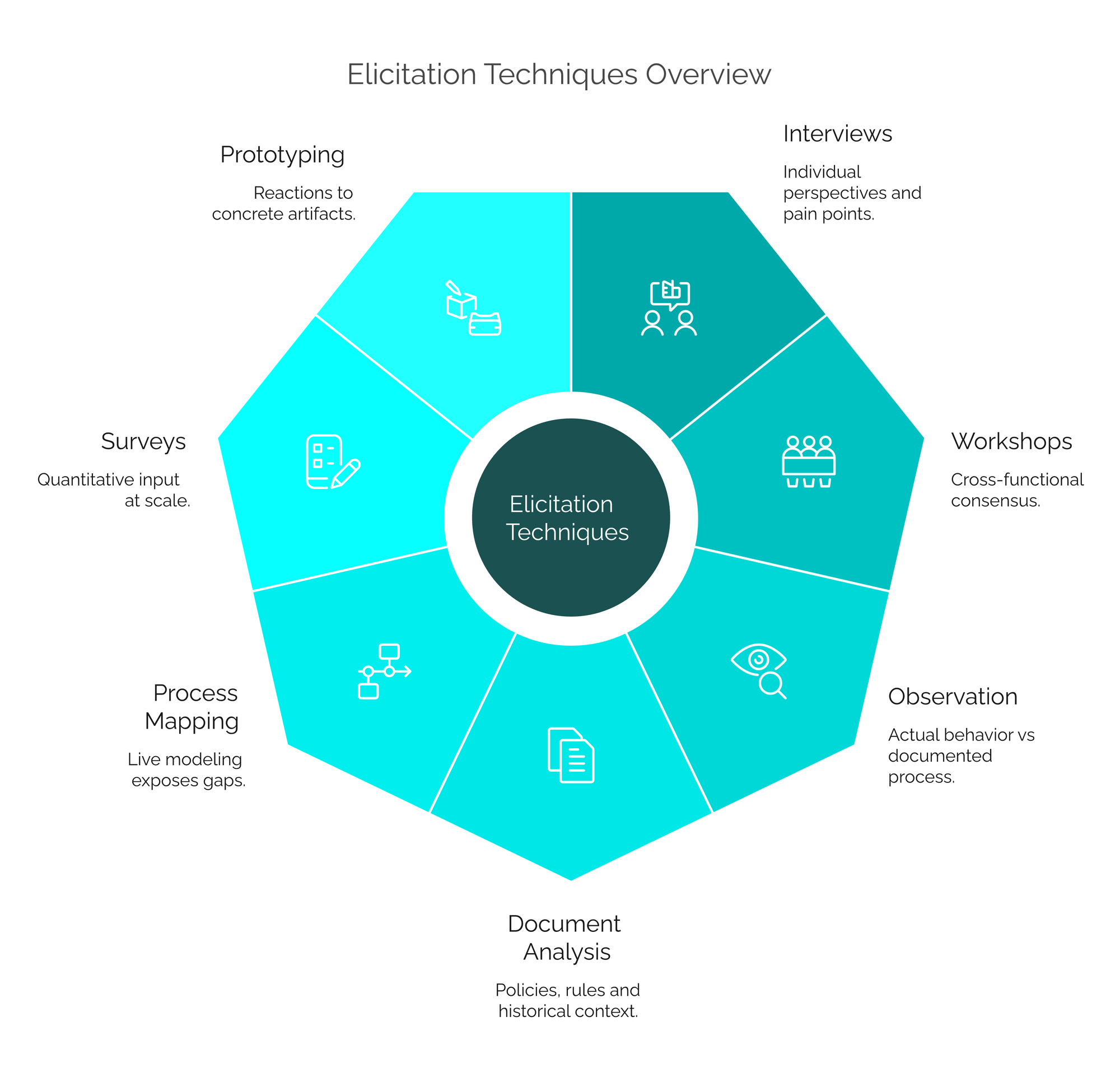
Interviews remain the workhorse of elicitation: one-on-one or small-group conversations with stakeholders, structured around prepared questions but flexible enough to follow unexpected threads.
They work best for understanding individual perspectives, sensitive topics people will not raise in a group (workarounds, political friction, distrust of a system), and deep dives with subject matter experts. They work poorly for reaching consensus across departments or for quantifying anything.
Practical guidance that separates useful interviews from wasted hours:
Prepare, but do not script. Know the process area, review existing documentation, and bring an outline of topics rather than a rigid questionnaire. The most valuable answers come from follow-ups you could not have planned.
Ask about the last time, not the typical case. "Walk me through the last purchase order you approved" produces concrete detail. "How does approval usually work?" produces the idealized version.
Probe for exceptions explicitly. "When does this not work that way?" and "What happens if the customer disputes the invoice?" are where business rules hide.
Close the loop. Send a written summary and ask the interviewee to correct it. This validates your understanding and creates a traceable record.
Workshops
Workshops bring multiple stakeholders into the same room (physical or virtual) to elicit, negotiate and validate information collaboratively. They are the fastest way to resolve cross-functional disagreements, because the finance manager and the operations lead hear each other's constraints directly instead of through the analyst as intermediary.
Use workshops for scoping a process end to end, prioritizing requirements, agreeing on definitions ("what exactly counts as an approved order?"), and validating draft models. Avoid them when the topic is politically charged enough that people will not speak honestly in front of colleagues — handle those threads in interviews first.
A workshop succeeds or fails on facilitation. Define a concrete objective and deliverable ("by 4 pm we will have the order-to-cash process mapped to level 2 with open issues logged"), timebox each segment, and separate divergent activities (brainstorming pain points) from convergent ones (agreeing on the future state). Assign a scribe so the facilitator can focus on the room. Capture parking-lot items visibly, because unresolved tangents that vanish silently destroy trust in the process.
Observation
Observation, sometimes called job shadowing or contextual inquiry, means watching people do the actual work in their actual environment. It is the antidote to the gap between the documented process and the real one.
There are two modes. In passive observation you watch without interrupting, which preserves natural behavior but leaves you guessing about motivation. In active observation you ask questions as the work happens ("why did you switch to that spreadsheet just now?"), which yields richer explanation at the cost of some distortion.
Observation excels at surfacing things stakeholders cannot report because they no longer notice them: the double data entry between two systems, the printed form that gets re-typed, the tribal knowledge about which supplier's invoices need manual checking. It is also the only reliable way to estimate task durations and interruption rates.
Its limits are equally real. It is time-consuming, it covers only the days you were present (rare exceptions will not conveniently occur on schedule), and people behave differently when watched. Treat observed data as one input to triangulate, and complement it with system logs or event data where available.
Document analysis
Document analysis means mining existing materials for information: procedure manuals, policy documents, system specifications, training guides, audit reports, contracts, regulatory texts, support tickets, and the informal layer of spreadsheets and email templates that often encodes the real process.
It is the cheapest technique per insight, requires no stakeholder time, and provides the historical and regulatory context interviews rarely cover. It is particularly strong for eliciting business rules, because rules tend to live in policies and contracts even when nobody can recite them.
Its main risk is staleness. Documentation describes the process as it was designed, or as it existed when someone last updated the manual — which may be years ago. Use documents to prepare better interview questions and to spot contradictions ("the manual says three-way match is mandatory, but the team says they skip it under €500 — which is current?"), never as a sole source of truth.
System data deserves special mention here. Transaction logs, workflow histories and ERP records are documents in the broadest sense, and they quantify what interviews can only estimate: actual volumes, cycle times, rework rates and exception frequencies.
Process mapping sessions
For process analysts, collaborative mapping is elicitation and modeling fused into a single activity. Instead of interviewing people and drawing the diagram later at your desk, you build the model live with the people who execute the process, whether on a whiteboard with sticky notes or directly in a BPMN tool projected on screen.
The technique works because a visual model exposes gaps that conversation hides. The moment you draw a handoff from Sales to Fulfillment, someone will say "actually, it goes to Credit first if the customer is new" — a branch nobody mentioned in three interviews. Sequence flows force chronological honesty; swimlanes force ownership honesty. Questions like "who does this step?", "what triggers it?" and "what happens if it's rejected?" become natural artifacts of drawing, not items on a checklist.
A few practices raise the quality of these sessions. Map the as-is before discussing the to-be, or the group will jump to solutions before agreeing on the problem. Keep the notation lightweight in the room — boxes, arrows, decision diamonds — and refine into proper BPMN afterwards. Record open questions directly on the model as annotations rather than in a separate list, so every unresolved point stays attached to its context. And validate the finished model in a short follow-up session, because the person who was quiet in the workshop will spot errors when reviewing calmly.
Surveys and questionnaires
Surveys collect structured input from many respondents at once. They are the only practical technique when the stakeholder population is large or geographically scattered — fifty branch offices, hundreds of field technicians, thousands of customers.
They answer quantitative questions well: how often does each branch encounter exception X, which of these five pain points ranks highest, what percentage of users rely on the export feature. They answer "why" questions poorly, because you cannot probe a survey response.
Design determines value. Keep surveys short (completion rates collapse past ten minutes), pilot the questions with two or three people to catch ambiguity, prefer closed questions with an optional comment field, and avoid leading phrasing. Most importantly, decide in advance what you will do with each answer — a question whose result would not change any decision should be cut.
Surveys pair naturally with interviews in both directions: run interviews first to discover the right questions, or run the survey first and interview the outliers.
Prototyping and examples
Some information cannot be elicited through description at all, because stakeholders do not know what they want until they see something concrete. Prototyping addresses this by putting an artifact in front of them — a clickable mockup, a draft form, a sample report, a simulated process — and eliciting reactions instead of specifications.
The related technique of working through examples is just as powerful and cheaper. Instead of asking "what are the rules for discount approval?", present concrete scenarios: "A returning customer orders €12,000 with a requested 8% discount — who approves it? Same order, but the customer is 60 days late on a previous invoice — what changes?" Stakeholders who cannot articulate a rule in the abstract can almost always adjudicate a specific case, and a well-chosen set of cases reconstructs the rule.
This scenario-driven style, formalized in approaches like specification by example, doubles as validation: the examples you elicit become the test cases for the eventual implementation. For process work, walking a single real order, claim or request through the draft process model step by step is one of the highest-yield validation techniques available.
How to elicit business rules, exceptions and constraints
Business rules are where automation projects succeed or fail, and they are systematically under-elicited because the happy path dominates every conversation. A deliberate strategy helps.
Start from decision points. Every gateway in a process model implies at least one rule. For each decision, ask what information the decision uses, who is authorized to make it, what the thresholds are, and where those thresholds come from (policy, regulation, contract, habit).
Hunt exceptions with frequency questions. "How often does that happen?" transforms vague acknowledgments into data. An exception occurring in 20% of cases is not an exception — it is an alternative flow that needs first-class treatment in the model.
Trace rules to sources. A rule with no traceable origin is often a fossilized workaround. When someone says "orders over €10,000 need director approval," ask where that limit is written. Sometimes the answer is a policy document; sometimes it is "that's what my predecessor told me," which flags the rule for review before you automate it.
Distinguish constraints from preferences. Regulatory requirements, contractual obligations and technical limits are non-negotiable constraints. "We've always done it this way" is a preference wearing a constraint costume. Redesign efforts depend on telling them apart.
Express rules in structured form. Capture each rule as condition and outcome ("IF order total exceeds €10,000 AND customer credit rating is below B, THEN route to credit committee"), with an owner and a source. Rules written this way translate almost directly into gateway conditions and automation logic later.
Common mistakes in elicitation
Interviewing only managers. Managers describe the process as designed; operators know the process as executed. Both perspectives are necessary, and the gap between them is often the most valuable finding.
Accepting the first answer. Initial answers describe the typical case. The second and third follow-up questions reach the exceptions, and the exceptions carry most of the complexity.
Confusing solutions with needs. Stakeholders frequently state requirements as solutions: "we need a shared Excel file with everyone's approvals." The underlying need — visibility into approval status — admits far better solutions. Asking "what would that let you do?" recovers the need behind the request.
Skipping validation. Elicitation without playback is guesswork with extra steps. Every significant finding should return to its source in written or modeled form for confirmation.
Stopping too early. Analysts under schedule pressure stop when they have an answer rather than a validated answer. One-source findings on critical rules are a known cause of expensive rework during implementation.
Letting findings decay in documents. Interview notes and workshop photos that never become models, requirements or rules produce no value. The elicitation-to-artifact pipeline needs to be as deliberate as the elicitation itself.
Elicitation questions for process analysts
A field-ready question set, organized by what you are trying to discover. Adapt the wording; keep the intent.
Scope and triggers
- What event starts this process? Are there other ways it can start?
- How do you know the process is finished? What does "done" look like?
- How many instances run per day, week or month? Is volume seasonal?
Flow and handoffs
- Walk me through the last instance you handled, step by step.
- Who do you receive work from, and who do you pass it to?
- How do you know when it is your turn to act? How does the next person know?
- Where does work wait, and for how long?
Decisions and rules
- At this point, how do you decide what to do next?
- What information do you need to make that decision? Where does it come from?
- Who is allowed to approve, reject or override here? Up to what limit?
- Where is that rule written down?
Exceptions and problems
- When does this process not go smoothly? How often?
- What is the most annoying case you deal with? Describe the last one.
- What do you do when required information is missing or wrong?
- When something fails, who fixes it, and how do they find out?
Systems and data
- Which systems, spreadsheets or documents do you touch during this process?
- Do you ever enter the same information twice? Where?
- What do you keep outside the official system, and why?
Improvement signals
- If you could change one thing about this process, what would it be?
- What questions do people constantly ask you about this process?
- What do you check manually that a system should check for you?
From elicitation to execution: where HEFLO fits
Elicitation findings lose value the longer they sit in notes and slide decks. The techniques above produce three kinds of assets — process knowledge, documentation and business rules — and each becomes dramatically more useful when translated into an executable form.
This is the transition HEFLO is built for. Process knowledge captured in mapping sessions becomes BPMN diagrams that stakeholders can review and correct, turning validation into a continuous activity rather than a sign-off ritual. Documentation attaches directly to process elements, so the answer to "why does this step exist?" lives next to the step instead of in a forgotten wiki. And elicited business rules — the approval thresholds, routing conditions and exception handling you extracted through examples and decision-point questioning — become gateway logic and task assignments in an automated process, where they are enforced consistently instead of remembered inconsistently.
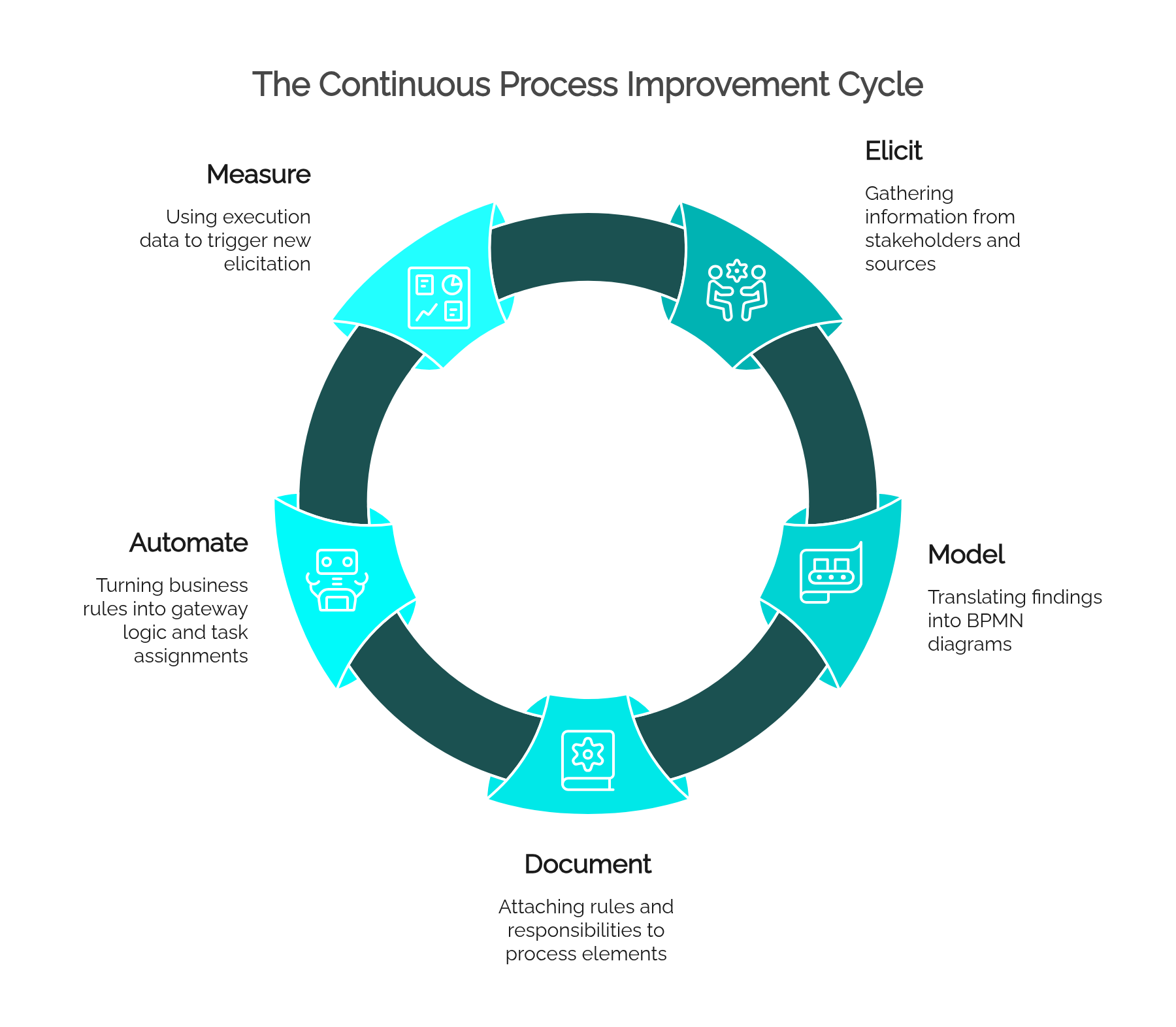
The feedback loop matters as much as the initial translation. Once a process runs in HEFLO, execution data shows real volumes, cycle times and exception rates, which either confirms what stakeholders told you or sends you back to elicit what actually changed. Elicitation stops being a project phase and becomes an ongoing conversation between the modeled process and the real one.
Frequently Asked Questions
What is elicitation in business analysis?
Elicitation is the activity of discovering, exploring, validating and clarifying information from stakeholders, documents, systems and observation. It goes beyond collecting stated requirements: analysts draw out tacit knowledge, reconcile conflicting accounts and surface unstated rules and constraints that stakeholders would not volunteer on their own.
What are the main elicitation techniques?
The most widely used techniques are interviews, workshops, observation (job shadowing), document analysis, collaborative process mapping, surveys and questionnaires, and prototyping with concrete examples. Strong analysts combine several techniques and triangulate their findings, since each technique has blind spots the others compensate for.
What is the difference between elicitation and requirements gathering?
"Gathering" implies requirements exist ready-made and only need collecting. Elicitation recognizes that most relevant information is tacit, incomplete or contradictory, and must be actively drawn out and validated. The distinction is practical: teams that "gather" tend to accept first answers, while teams that elicit probe for exceptions, rules and the gap between documented and actual practice.
Which elicitation technique is best for process analysis?
Collaborative process mapping sessions tend to deliver the highest yield for process analysts, because building the model live with participants exposes gaps and undocumented branches that interviews miss. They work best when combined with observation to verify actual behavior and document or system-data analysis to quantify volumes and exception rates.
How do you elicit business rules effectively?
Start from the decision points in the process and ask what information each decision uses, who is authorized to decide, and where the thresholds are documented. Use concrete example scenarios rather than abstract questions, ask "how often?" to size every exception, and record each rule in condition-outcome form with an owner and a source so it can later become automation logic.
How does elicitation connect to process automation?
Automation is only as good as the rules and flows fed into it. Elicited process knowledge becomes BPMN models, elicited rules become gateway conditions and assignments, and elicited exceptions become alternative flows — in a platform like HEFLO these translate directly into executable processes. Execution data then feeds back into elicitation, revealing where reality diverges from what stakeholders described.