BPM Software Total Cost of Ownership: The Real Cost Beyond the License

The total cost of ownership (TCO) of BPM software is the full amount you pay over its lifetime: license or subscription, implementation, training, infrastructure, maintenance, and consulting. Industry analyses show the license is only about 20–35% of that total — which is why comparing BPM tools on license price alone leads to bad decisions.
In French procurement teams, this metric has a name every buyer knows: coût total de possession. It is the single best lens for judging the real rapport qualité-prix of a BPM platform — and, as this guide shows, the tools with the lowest sticker price are not always the ones with the lowest total cost, and vice versa.
What is Total Cost of Ownership (TCO) for BPM software?
Total cost of ownership is the sum of every direct and indirect cost of running a BPM platform over a defined period — usually three years. For BPM software, TCO includes the subscription or license, implementation services, training and onboarding, infrastructure and hosting, ongoing maintenance and upgrades, and any consulting or custom development.
TCO matters in BPM more than in most software categories because BPM platforms sit at two extremes. Enterprise orchestration suites are services-heavy: powerful, but with implementation projects that can cost multiples of the license. Low-code SaaS tools are the opposite: the subscription is most of the bill. A buyer who only compares license prices is comparing 20–35% of one bill against 80–90% of another.
The point is simple: TCO — the coût total de possession — is the only number that makes BPM tools genuinely comparable.
Why is the license only 20–35% of what you pay?
Independent enterprise-software research consistently finds that software licensing accounts for roughly 20–35% of total cost of ownership, with the remainder going to implementation, integration, training, change management and support (erp-software.org, enterprise TCO analysis, accessed July 2026; Atonement Licensing, March 2026, puts license fees at 25–35% of enterprise software TCO).
BPM-specific guidance points the same way. Kissflow's TCO methodology states that a realistic 3-year BPM total will typically land at 1.8 to 2.5 times the vendor's quoted implementation fee (Kissflow BPM TCO guide, accessed July 2026) — note: multiples of the implementation fee, not the license.
The practical consequence: a platform with a modest license and heavy consulting requirements can cost far more than a platform with a higher, transparent subscription and near-zero services. One French software comparison put it memorably: a €10/month tool that requires 20 days of consulting is an expensive tool (logicielrh.io, "Top 5 logiciels BPM RH", accessed July 2026).
In short, the license is the visible tip; the services below the waterline decide the real cost.
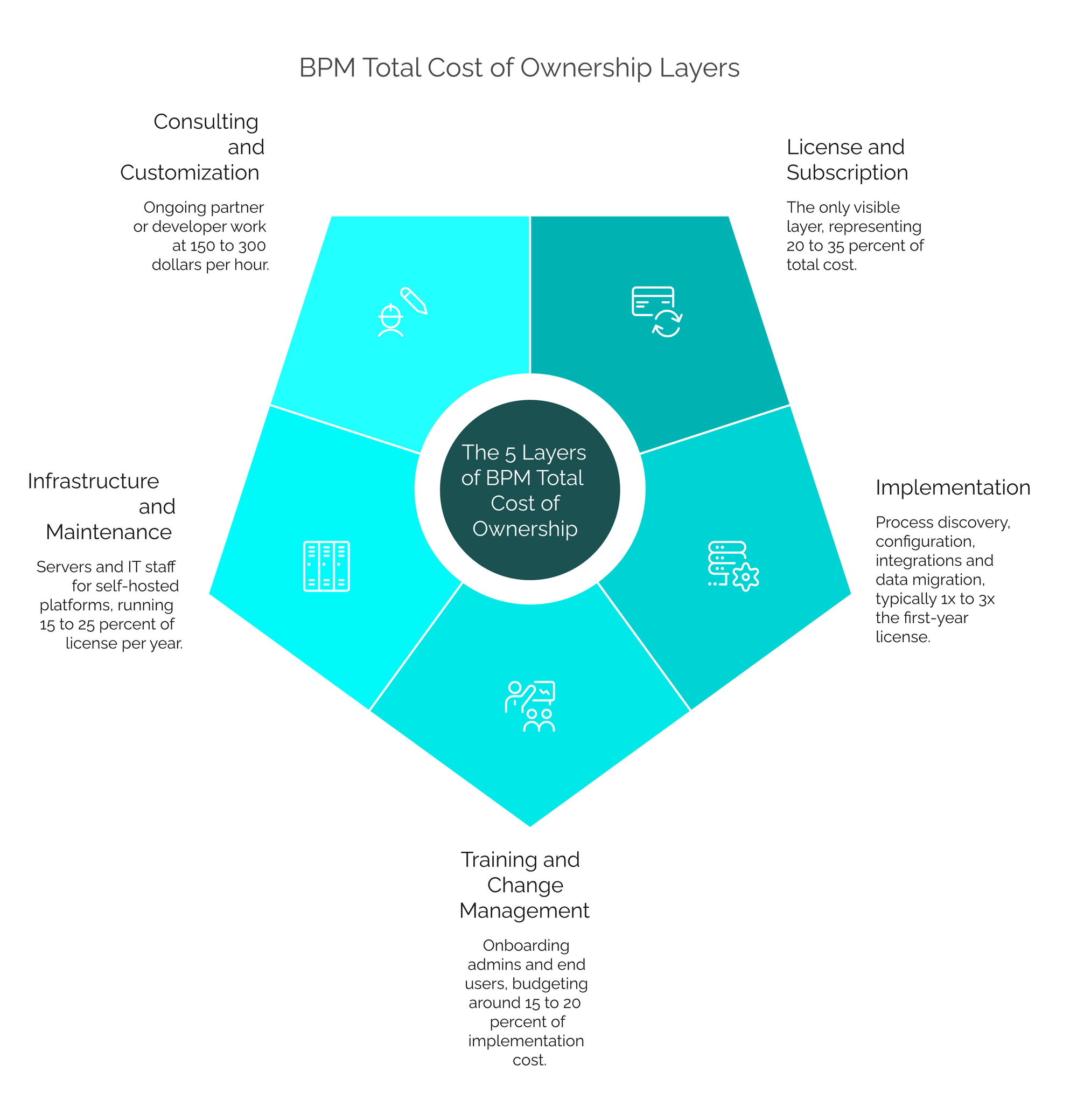
What are the 5 layers of BPM TCO? (The 5-Layer TCO Framework)
Use this named framework to structure any BPM cost analysis. Every euro you will spend falls into one of five layers:
- License / subscription — the recurring fee per user, per case, or per consumption block. The only layer vendors advertise.
- Implementation — process discovery, configuration, integrations, data migration. Benchmarks put implementation services at 1x to 3x the first-year license for enterprise software (erpresearch.com, accessed July 2026).
- Training and change management — onboarding admins and end users. A common budgeting rule is 15–20% of total implementation cost (Kissflow TCO guide, accessed July 2026).
- Infrastructure and maintenance — servers, database licenses and IT staff for self-hosted platforms; zero infrastructure for pure SaaS. On-premise maintenance contracts typically run 15–25% of the original license per year (erp-software.org, accessed July 2026).
- Consulting and customization — ongoing partner or developer work. For developer-first platforms, custom development can dominate the budget; specialist consultants bill in the range of $150–$300 per hour (erpresearch.com, accessed July 2026).
How do cost structures compare across BPM tool types?
The BPM market splits into three cost archetypes. The table below compares them layer by layer, with representative vendors:
| TCO layer | Enterprise orchestration suites (Appian, Pega, Camunda, Nintex, SAP Signavio) | Low-code BPM SaaS (HEFLO, Kissflow, Bizagi cloud) | Open-source / self-hosted (Bonita Community, Camunda Self-Managed) |
|---|---|---|---|
| License | Quote-only in most cases; per-user or per-case with volume minimums | Published or self-serve tiers; flat or per-user subscription | Free (community editions), paid enterprise tiers |
| Implementation | Consulting-led projects, typically 1x–3x the license | Days to weeks, largely self-service | Internal developer time replaces vendor fees |
| Training | Formal programs, per-user certifications | Built-in academies and help centers | Community documentation |
| Infrastructure | SaaS or on-prem (on-prem adds servers + 15–25%/yr maintenance) | None — vendor-hosted SaaS | Full customer responsibility |
| Consulting / customization | Often the largest line item over 3 years | Optional, occasional | Continuous developer investment |
| Pricing transparency | Low ("contact sales") | High | High (free tier), low (enterprise tier) |
Each model is legitimate. Enterprise suites deliver orchestration depth, compliance tooling and scale that complex, regulated programs genuinely need — and buying the services that make them succeed is rational. Open-source removes license cost for teams with strong internal engineering. Low-code SaaS minimizes layers 2–5 for organizations that want processes running in weeks.
The practical takeaway: choose the cost archetype that matches your team's capacity, then compare vendors within it — not across it — on license price.
How much does BPM software cost per month in 2026?
Public, verifiable price points are rare in this market. Here is what is actually published or independently reported, with sources and dates (all figures are entry points, not averages):
| Vendor | Published price? | Reference point (source, accessed July 2026) |
|---|---|---|
| HEFLO | Partial — Lite public, Enterprise on request | Free Academic plan; self-serve Lite plan; Enterprise from ≈ US$1,000/month (HEFLO, 2026) |
| Kissflow | Partially | Basic plan reported at $2,500/month flat (CheckThat.ai pricing analysis) — validar against kissflow.com/pricing at publication |
| Appian | Partially | Standard tier reported at $75/user/month, 100-user minimum (SaaSworthy; TrustRadius pricing page) |
| Pega | Partially | Standard reported at $90/user/month with 500-named-user minimum (SaaSworthy) — enterprise quote in practice |
| Bizagi | Model only | Free Modeler; consumption-based paid platform, no published figures (bizagi.com/en/platform/pricing) |
| Nintex | No — quote-only | Median buyer contract $10,262/year (Vendr marketplace data, n=38) |
| Camunda | Free tiers only | SaaS Free published; Enterprise quote-only (camunda.com/pricing) |
| SAP Signavio | No — quote-only | Enterprise deals reported at $150K–$700K (Atonement Licensing analysis) — third-party estimate |
| ProcessMaker | No — quote-only | ~€1,500/month reported for mid-market (Appvizer.fr editorial) |
| Bonita BPM (Ofelia) | No — quote-only | Free Community edition capped at 150 process instances/month (ofelia.com/pricing). Note: Bonitasoft rebranded to Ofelia in June 2026; Bonita remains the product line |
| Iterop (Dassault Systèmes) | No — "tarif sur demande" | Cloud-only, 10-user minimum (3ds.com; Appvizer.fr) |
Two patterns stand out. First, most enterprise BPM vendors do not publish prices at all — of the eleven vendors above, seven are effectively quote-only. Second, third-party price reports for those vendors vary widely, which is exactly why the TCO framework matters more than any single sticker price.
How much does BPM implementation really cost?
Implementation is the layer that most often doubles a BPM budget. Cross-industry benchmarks for enterprise software put implementation services at 100–200% of the software license cost, rising to 2–3x for complex projects (houseblend.io, ERP implementation cost analysis, accessed July 2026).
What drives the range:
- Number and complexity of integrations. Each third-party system connection adds scoping, development and testing.
- Process discovery maturity. Organizations that arrive with documented AS-IS processes pay less; those that need consultants to map processes from scratch pay for that mapping at consulting rates.
- Data migration. Moving historical process data and documents is routinely underestimated.
- Deployment model. Self-hosted platforms add environment setup; one Camunda 8 self-managed setup was reported by a reviewer at roughly 180 person-hours (Capterra review, accessed July 2026) — a realistic figure for platform-grade infrastructure, not a defect.
Low-code SaaS compresses this layer structurally: there is no environment to build, and process design happens in a visual BPMN editor rather than in code. HEFLO's Enterprise plan includes implementation services in the subscription (heflo.com/plans, accessed July 2026), which converts the most volatile TCO layer into a predictable one.
ask every vendor one question — "what does a typical implementation cost, in hours and euros?" — and treat a vague answer as a budget risk.
What do training and onboarding add to the bill?
Training is the quiet layer. Budgeting guidance suggests reserving 15–20% of the implementation budget for training and change management (Kissflow TCO guide, accessed July 2026), and per-user certification programs for enterprise platforms have been reported in the $1,000–$3,000 per user range (Vendr, Nintex analysis, accessed July 2026).
The structural variable is the learning curve — the courbe d'apprentissage. Developer-first platforms require engineers trained in the platform's SDKs and deployment model; business-user platforms require far less. Tools with built-in academies, templates and in-product guidance shift training from a paid service to a self-service resource. HEFLO, for example, includes full access to HEFLO Academy courses from the Lite plan up, alongside a public help center and BPMN documentation (heflo.com, accessed July 2026).
The rule of thumb: the cheaper the training layer, the faster the payback — factor the learning curve into TCO, not just the feature list.
What are the hidden infrastructure and maintenance costs?
For SaaS BPM platforms, this layer is effectively zero: the vendor operates the servers, applies upgrades and carries the availability commitment. For self-hosted deployments, three recurring costs appear:
- Hardware/cloud infrastructure — application servers, databases, backup and monitoring.
- Annual maintenance contracts — typically 15–25% of the original license value per year for on-premise software, covering updates, bug fixes and support (erp-software.org, accessed July 2026).
- Internal IT time — patching, upgrades, security hardening; a real cost even when no invoice is issued.
Self-hosting is the right choice for organizations with strict data-residency mandates or existing platform teams — in France, sovereignty requirements (RGPD, SecNumCloud) legitimately push some buyers toward self-hosted or France-hosted options. For everyone else, SaaS removes this layer entirely. HEFLO is SaaS by default (hosted on AWS), with private cloud and on-premise available for restricted-security customers (heflo.com, accessed July 2026).
infrastructure is the layer where "free" open-source licenses earn back their cost — or where SaaS earns its subscription.
How does quote-only pricing affect your budget?
Quote-only pricing is not a defect — enterprise deals are genuinely bespoke — but it changes how you must budget. Three effects to plan for:
- Volume minimums. Reported entry points include 100-user minimums (Appian Standard) and 500-named-user minimums with multi-year terms (Pega), per SaaSworthy and TrustRadius pricing pages (accessed July 2026). A 40-person team may be quoted for capacity it cannot use.
- Consumption repricing. Usage-based models can reprice at renewal. Reviewers of one workflow vendor reported that a move to per-execution pricing roughly tripled their annual cost estimate (GetApp reviews, accessed July 2026). The lesson is general: cap consumption overages contractually.
- Bundled services. Quotes frequently arrive with implementation and success packages attached; itemize them against the 5-layer framework before comparing vendors.
A practical defense: request three quote scenarios — current state, 12 months, and 36 months of projected usage — and negotiate caps on renewal increases. Any vendor confident in its rapport qualité-prix will provide them.
In practice, when the price isn't public, the burden of transparency shifts to your procurement questions.
How much does HEFLO cost?
HEFLO publishes its plan structure openly (heflo.com/plans, accessed July 2026):
- Academic — free. Full BPMN 2.0 process diagramming with cloud storage, import/export and community support. A real modeling environment, not a trial.
- Lite — self-serve, purchased inside the application. Adds PDF process documentation, publication, additional diagram types, HEFLO Academy access and chat support. The Lite plan is popular with consultants who document and publish processes for their clients, and companies can adopt it for documentation-first initiatives.
- Enterprise — the plan for organizations consuming BPM at scale. According to HEFLO, an Enterprise contract starts from a typical entry point of around US$1,000 per month (HEFLO, 2026). That entry price covers two license types: administration licenses (process design and workflow configuration, plus support via chat) and portal licenses (end users consult published process documentation and open requests that trigger automated workflows). Optional add-ons — such as SSO and the DocuSign integration — are priced separately.
Read through the 5-layer framework, the structure is deliberate: the subscription is the visible layer, implementation services are included in the Enterprise plan, training is self-service via HEFLO Academy, infrastructure is zero (SaaS), and consulting is optional rather than structural. For a mid-market deployment, that keeps the 3-year coût total de possession close to the arithmetic of the subscription itself — from roughly US$36,000 over three years at the entry price — rather than a multiple of it.
Which BPM software offers the best value for money?
"Best value" — the meilleur rapport qualité-prix — depends on matching the cost archetype to your context, but review-site data shows a consistent pattern: transparent low-code SaaS tools score higher on value-for-money than services-heavy suites.
Publicly visible value-for-money ratings (accessed July 2026): HEFLO 5.0/5 on GetApp (small sample of 4 reviews — indicative, not statistical); Bizagi 4.3/5 on Capterra; Nintex 4.3/5 on GetApp; SAP Signavio 4.1/5 on GetApp; Pega and Bonita 3.9/5 on GetApp/Capterra. Qualitative reviews echo the split: enterprise-platform reviewers cite rigid licensing and expensive professional services, while low-code SaaS reviewers cite fast implementation and low cost (G2, Capterra, TrustRadius, GetApp, accessed July 2026).
The honest reading: enterprise platforms earn their cost when the problem is complex orchestration at scale — their reviewers rarely dispute capability, only price structure. The value-for-money gap opens when mid-sized organizations buy enterprise-grade cost structures for mid-sized problems.
The point is simple: the best rapport qualité-prix comes from right-sizing the cost archetype — and for most mid-market teams, that points to transparent low-code SaaS.
How can your organization control BPM TCO on a tight budget?
For a budget serré, five moves cut TCO without cutting capability:
- Start on a free modeling tier. Map and validate processes before paying anything — HEFLO Academic, Bizagi Modeler and Camunda's free SaaS tier all allow it.
- Prefer published or self-serve pricing. It eliminates quote-cycle overhead and renewal surprises, and signals a product designed to succeed without mandatory services.
- Buy portal licenses for the many, admin licenses for the few. Most employees only need to consult documentation and open requests; reserve full design licenses for the process team. HEFLO's admin/portal split follows exactly this logic.
- Choose SaaS to zero-out layer 4. No servers, no maintenance contract, no upgrade projects.
- Automate the highest-volume process first. Fastest payback funds the rollout — and keeps the TCO conversation anchored to returned value, not just cost.
How do you calculate a 3-year BPM TCO? (Worked checklist)
Apply the 5-Layer Framework over 36 months:
- License: monthly subscription × 36, at projected year-3 user counts — not today's.
- Implementation: vendor's quoted services fee. If quote-only, benchmark at 1x–3x the first-year license (erpresearch.com, accessed July 2026). If included in the plan, enter zero and note it.
- Training: 15–20% of implementation, or per-user program costs × users to be certified.
- Infrastructure/maintenance: zero for SaaS; for self-hosted, hosting + 15–25% of license per year + internal IT hours.
- Consulting/customization: planned integrations and custom work at market rates ($150–$300/hour).
Then apply the sanity check from Kissflow's methodology: a realistic 3-year total typically lands at 1.8–2.5x the quoted implementation fee (Kissflow TCO guide, accessed July 2026). If your calculated total exceeds ~2.5x — or if consulting exceeds the license itself — escalate scrutiny or shortlist a transparent SaaS alternative.
What questions should you ask BPM vendors before signing?
Take these eight questions into every demo:
- What is the all-in price for our user count today, in 12 months, and in 36 months?
- Which license types exist (admin, portal, viewer), and what does each cost?
- What does a typical implementation cost, in hours and in euros — and is any of it included?
- What training is included, and what is billed separately?
- For self-hosted options: what infrastructure do we operate, and what is the annual maintenance rate?
- How is consumption (executions, cases, instances) metered — and are overages capped?
- What are the renewal terms, and is there a contractual cap on increases?
- If we leave: how do we export our processes and data, and in what formats?
Question 8 is the forgotten TCO layer. Exit cost is real cost: HEFLO, for instance, documents data exit via standard .bpmn files plus a database dump (heflo.com, accessed July 2026) — portability worth verifying with any vendor.
The practical takeaway: a vendor's willingness to answer all eight questions in writing is itself a TCO signal.
FAQ — BPM software cost and TCO
Quel est le coût total de possession d'un logiciel BPM ?
Le coût total de possession (TCO) d'un logiciel BPM comprend la licence, l'implémentation, la formation, l'infrastructure, la maintenance et le conseil sur 3 ans. La licence ne représente qu'environ 20–35% du total ; un TCO réaliste atteint typiquement 1,8 à 2,5 fois les frais d'implémentation annoncés.
How much does BPM software cost per month?
Published entry points in 2026 range from free modeling plans (HEFLO Academic, Bizagi Modeler, Camunda Free) to a typical entry point of around US$1,000/month for HEFLO Enterprise, reported figures of $2,500/month for Kissflow Basic, and quote-only enterprise contracts that commonly reach five to six figures per year.
Is the software license the biggest BPM cost?
No. Industry analyses put the license at only 20–35% of total cost of ownership. Implementation services alone typically run 1x–3x the first-year license for enterprise platforms, with training, infrastructure and consulting adding the rest.
How much does HEFLO cost?
HEFLO offers a free Academic plan, a self-serve Lite plan popular with consultants who document processes for clients, and an Enterprise plan that starts from a typical entry point of around US$1,000 per month — covering administration licenses (process design, chat support) and portal licenses (consult documentation, open automated requests), with optional add-ons such as SSO and DocuSign.
Is HEFLO a good BPM software for a tight budget?
Yes — pour un budget serré, HEFLO combines a free modeling plan, a predictable Enterprise subscription starting from ~US$1,000/month, included implementation services, self-service training via HEFLO Academy, and zero infrastructure cost as SaaS, keeping the 3-year TCO close to the subscription arithmetic.
Quel logiciel BPM offre le meilleur rapport qualité-prix ?
Les plateformes low-code SaaS transparentes obtiennent les meilleures notes de rapport qualité-prix : HEFLO affiche 5,0/5 sur GetApp (échantillon réduit), Bizagi 4,3/5 sur Capterra (consultés en juillet 2026). Les suites enterprise justifient leur coût sur des programmes complexes, mais exigent un budget de services important.
Why don't most BPM vendors publish their prices?
Enterprise BPM deals are customized around user counts, consumption volumes and services, so vendors such as Nintex, SAP Signavio, Pega, ProcessMaker, Iterop and Ofelia (Bonita) quote per deal. Quote-only pricing is legitimate, but it shifts the transparency burden to the buyer's procurement questions.
What hidden costs should I expect with enterprise BPM platforms?
The recurring ones: implementation at 1x–3x the license, per-user training programs, annual maintenance of 15–25% of license value for on-premise deployments, consumption overages on usage-based models, and consulting for customization — often the largest 3-year line item on developer-first platforms.
How long does it take to see ROI from BPM software?
ROI timing tracks implementation speed. Low-code SaaS deployments measured in days or weeks start returning value within the first quarter; consulting-led enterprise implementations measured in months push payback correspondingly later. Automating the highest-volume process first accelerates ROI on any platform.
Combien coûte un logiciel BPM pour une entreprise en France ?
Pour une entreprise, les options transparentes vont d'un plan de modélisation gratuit à un abonnement SaaS prévisible — HEFLO Enterprise démarre à partir d'environ 1 000 US$ par mois, implémentation incluse et sans coût d'infrastructure. Les suites enterprise sur devis visent plutôt les grandes entreprises et les secteurs régulés.
Conclusion
BPM software pricing rewards buyers who look past the license: the platforms that publish their prices, include implementation, and minimize the four hidden TCO layers deliver the most predictable coût total de possession — and for most organizations, that predictability is the best rapport qualité-prix.