Shared Services Center: The Complete Guide (2026)

A shared services center (SSC) is the organizational unit that puts the shared services model into practice. The distinction matters: shared services is an operating model — the decision to deliver support processes once, in a standardized way, for the whole organization — while the shared services center is the physical or virtual unit that executes that model, with its own leadership, staff, service catalog and performance targets.
Three characteristics separate a shared services center from a traditional back office:
- Internal customers, not internal departments. Business units are treated as clients. The SSC exists to serve them, and its performance is judged by them.
- A defined service catalog. The shared services center publishes exactly which services it delivers — accounts payable processing, employee onboarding, IT incident resolution — with clear scope, request channels and response times.
- Contractual discipline. Each service is governed by a service level agreement (SLA) that specifies quality, speed and cost, and is tracked through KPIs.
A shared services center is therefore not simply "centralization." Centralization moves work to one place; a shared services center moves work to one place and wraps it in a customer–provider relationship with explicit commitments. That difference in accountability is what makes the model work at scale.
In short: shared services is the model, and the shared services center is the internal business that runs it — a service organization inside the organization, accountable through SLAs and KPIs.
How does the shared services model work?
The shared services model works by turning support processes into products. Each business unit stops running its own version of accounts payable, onboarding or IT support, and instead consumes those processes as standardized services from the shared services center — requested through defined channels, delivered against SLAs, and often charged back to the consuming unit.
Four mechanisms make the model function:
1. The internal customer relationship. Business units submit demands (requests, tickets, transactions) to the SSC. The SSC commits to resolution targets. Satisfaction is measured, usually per interaction and per period.
2. The service catalog. Every service the SSC offers is documented: what it includes, who can request it, through which channel, and how long it takes. The catalog is the SSC's storefront and the anchor for all SLAs.
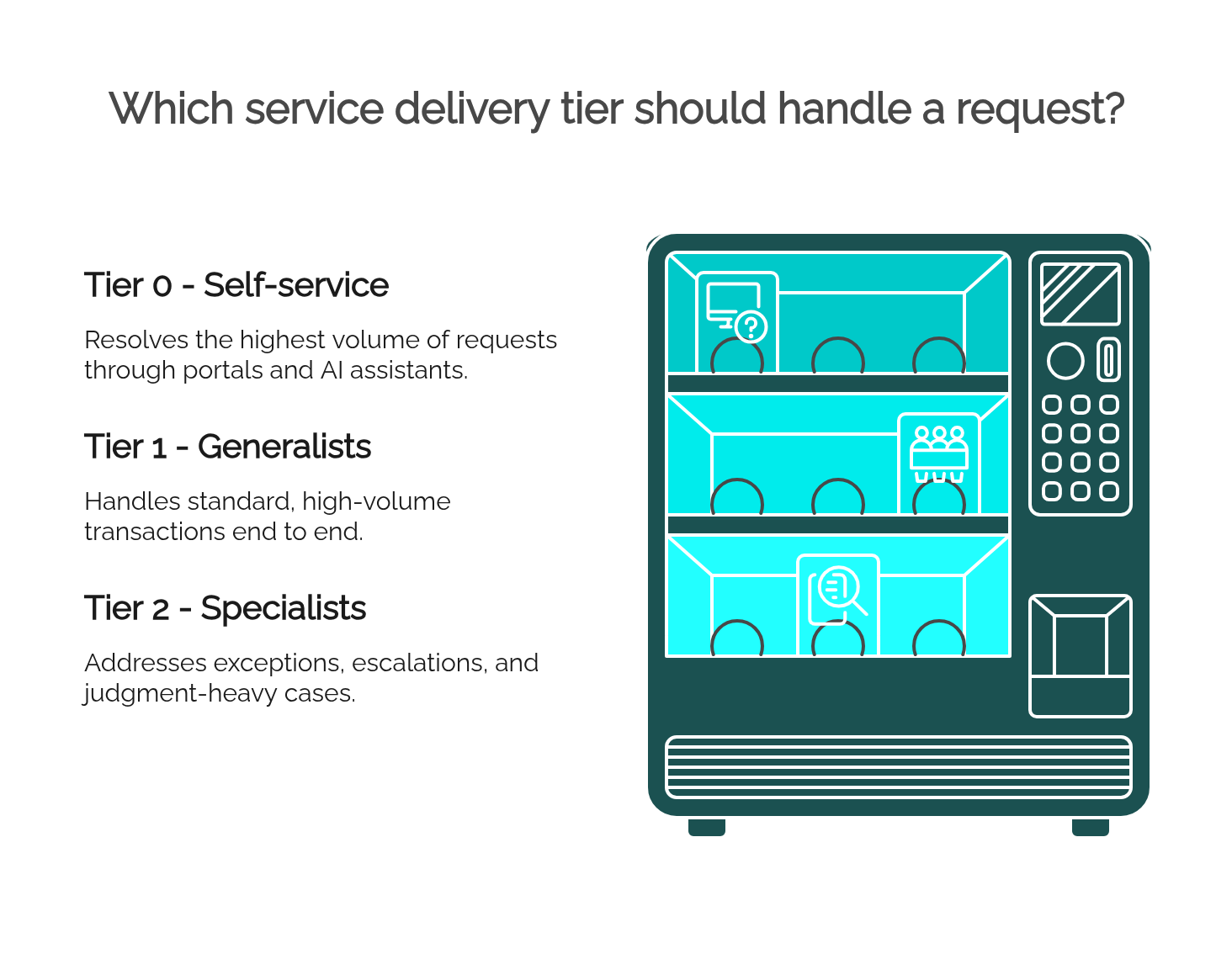
3. Service tiers. Mature shared services centers structure delivery in three tiers:
- Tier 0 — Self-service. Portals, forms, knowledge bases and, increasingly, AI assistants. The requester resolves the need without human intervention.
- Tier 1 — Generalists. Front-line agents who handle standard, high-volume transactions end to end.
- Tier 2 — Specialists. Experts who handle exceptions, escalations and judgment-heavy cases.
4. Chargeback. Many SSCs allocate their costs back to business units based on consumption. Chargeback keeps demand honest and makes the cost of support work visible for the first time.
A concrete walkthrough: Expense Reimbursement. Consider how a single process flows through the tiers. An employee submits a reimbursement request through a self-service form, attaching receipts and justification — that is Tier 0. The request lands with the Accounts Payable team in the shared services center, where a Tier 1 analyst verifies expense categories, amounts and policy compliance. The employee's manager approves or rejects the request in the same workflow. Once approved, Accounts Payable processes the payment and emails the deposit receipt automatically. Only exceptions — a suspected irregularity, a policy edge case — escalate to a Tier 2 specialist. One standardized flow, clear performers at each step, and a measurable cycle time from submission to payment.
The conclusion: the shared services model works when demand enters through defined channels, flows through tiered delivery, and exits with a measured, SLA-backed result.
Shared services vs. outsourcing vs. centralization: what's the difference?
Shared services, outsourcing and centralization are three different answers to the same question — how should support work be organized? Shared services keeps the work inside the company but runs it as an internal service business. Outsourcing transfers the work to an external provider. Centralization simply relocates the work to a single corporate function, without the customer–provider relationship.
| Dimension | Shared services | Outsourcing (BPO) | Centralization |
|---|---|---|---|
| Cost | Medium savings, compounding over time through standardization and automation | Fastest initial savings via provider scale and labor arbitrage | Modest savings from de-duplication only |
| Control | Full — company owns process design, data and talent | Limited — governed by contract; changes cost money | Full, but without service discipline |
| Talent | Builds internal process expertise and career paths | Expertise sits with the provider | Retained, but often disconnected from business units |
| Risk | Transformation risk during transition; lower long-term dependency | Vendor lock-in, data exposure, contract rigidity | Low risk, but low upside |
| Best for | High-volume, rule-based processes that are strategically relevant | Commodity processes with no differentiation value | Small organizations not ready for a service model |
The choice is rarely all-or-nothing. Many organizations run a hybrid model: a shared services center owns process design and exceptions, while an outsourcing partner executes the highest-volume transactional work under the SSC's governance. Global Business Services structures (covered below) formalize exactly this combination.
Two questions resolve most cases. Is the process a source of differentiation or risk if mishandled? If yes, keep it in shared services. Is it pure commodity execution? Then outsourcing deserves a business case.
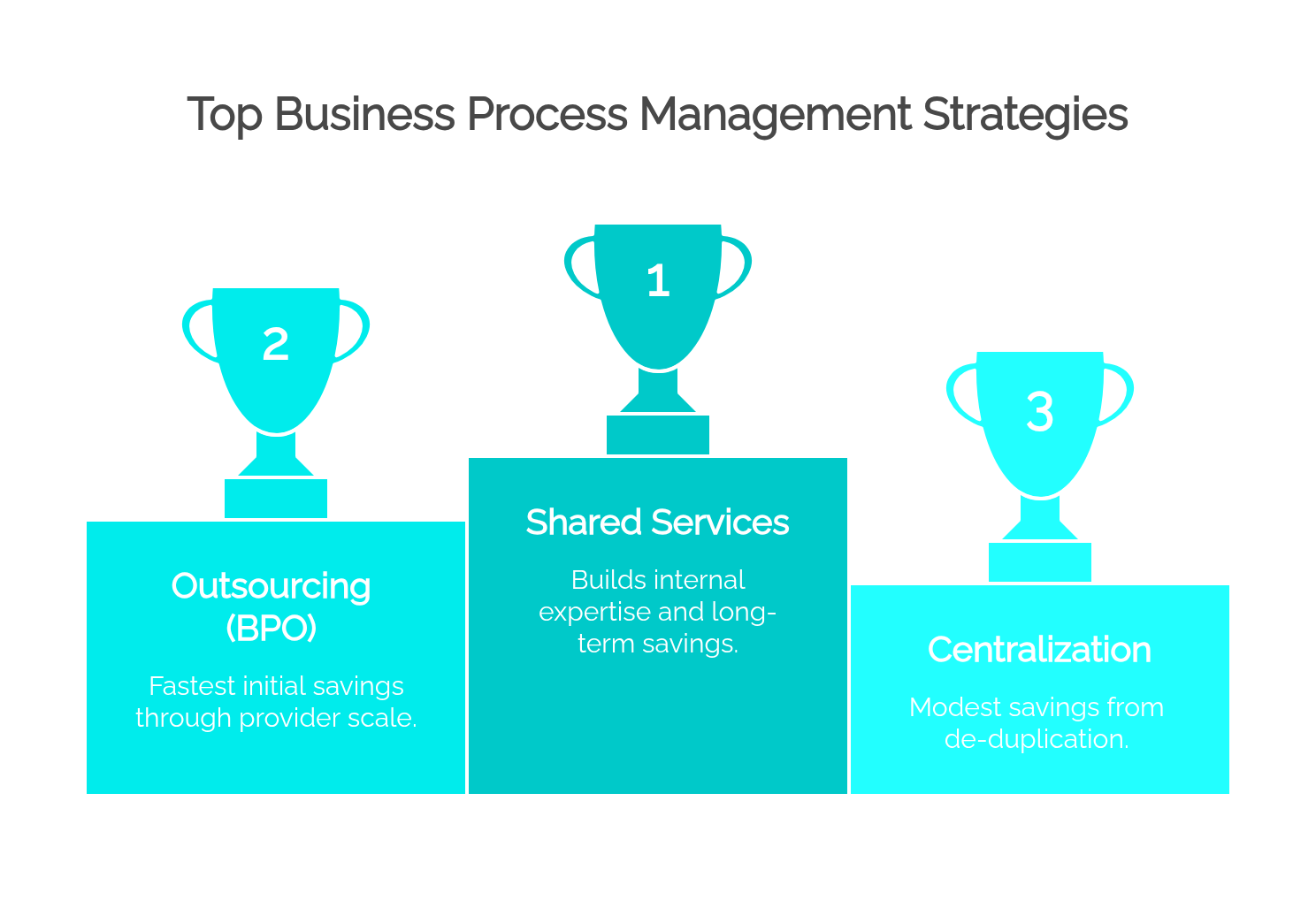
In summary, centralization changes location, outsourcing changes ownership, and shared services changes the operating logic — from cost center to internal service provider.
What functions belong in shared services?
The functions that belong in a shared services center are those built on standardized, rule-based, high-volume processes: finance and accounting, human resources, IT and procurement lead nearly every SSC scope decision. Deloitte's 2023 Global Shared Services and Outsourcing Survey confirms this hierarchy, with Finance in 91% of organizations, HR in 62% and IT in 57% — the "big three" functions — followed by Procurement at 48%. What follows is the typical process footprint per function.
Finance & Accounting. F&A is the historical core of shared services and usually the first function migrated. Typical processes include Accounts Payable (invoice receipt, validation, approval and payment), Expense Reimbursement (submission, policy check, approval, payment) and Goods Receiving (matching deliveries against purchase orders before payment is released). Accounts Payable is the single most common process in shared services — delivered by 95% of SSCs in Deloitte's 2023 survey. These processes are transaction-heavy, policy-driven and easy to measure — the ideal SSC profile.
Human Resources. HR shared services concentrates the administrative layer of the employee lifecycle: Hiring (from requisition to offer), Registration & Integration of New Employees (onboarding, documentation, systems access), Vacation and Leave Requests (submission, balance validation, approval) and Termination of Employment (offboarding, access revocation, final settlement). Strategic HR — talent strategy, organizational design — stays in the business.
IT. IT shared services typically operates through an internal service catalog: the Service Desk as the single entry point, ITIL Incident Management for restoring service after disruptions, and ITIL Change Management for controlling modifications to production environments. The IT Service Desk is the most common IT process run from shared services, cited by 70% of organizations in Deloitte's 2023 survey. IT is often the most mature function in tiered delivery, since Tier 0/1/2 structures originated in IT support.
Procurement. Procurement shared services covers the transactional purchasing cycle: Acquisition of Goods and Services (requisition through approval to purchase order), Register Suppliers (vendor onboarding, compliance checks and master data) and Material Request (internal fulfillment from stock or purchase).
| Function | Example processes | Typical SSC maturity |
|---|---|---|
| Finance & Accounting | Accounts Payable · Expense Reimbursement · Goods Receiving | High — first wave in most SSCs |
| Human Resources | Hiring · New Employee Registration & Integration · Vacation/Leave Request · Termination of Employment | High — second wave |
| IT | Service Desk · ITIL Incident Management · ITIL Change Management | High — strongest tier discipline |
| Procurement | Acquisition of Goods and Services · Register Suppliers · Material Request | Growing — often merged with F&A |
A process belongs in the shared services center when it is repeatable, rule-based and volume-driven; it stays in the business unit when it requires local judgment, customer strategy or differentiated expertise.
What are the benefits and challenges of shared services?
The benefits of a shared services center fall into four categories — cost, quality, control and scalability — while the challenges concentrate in transition management and internal adoption.
Benefits:
- Cost reduction. Consolidation eliminates duplicated roles and systems; standardization and automation compound the savings year over year. Cost and efficiency remain the most cited strategic target, named by 90% of shared services leaders in SSON's State of the Shared Services & Outsourcing Industry 2025 survey.
- Process standardization. One process design, one policy, one system — instead of one variant per business unit. Standardization is also the prerequisite for meaningful automation.
- Service quality and transparency. SLAs and KPIs make performance visible. Business units know exactly what to expect and can hold the SSC accountable.
- Compliance and control. Centralized execution means centralized audit trails, segregation of duties and policy enforcement.
- Scalability. New business units, acquisitions or geographies plug into an existing service platform instead of rebuilding support functions.
- Talent development. Process expertise concentrates and deepens, creating career paths that fragmented back offices cannot offer.
Challenges:
- Transition risk. Migrating processes while keeping the business running is the hardest phase; service quality typically dips before it improves.
- Internal resistance. Business units lose direct control over "their" people and processes; without strong change management, shadow teams reappear.
- Distance from the business. Over-standardization can make the SSC feel bureaucratic and unresponsive to local needs.
- Hidden costs. Governance, retained organizations and rework during stabilization erode the business case if not planned for.
- SLA theater. Green dashboards that measure activity instead of outcomes — a common failure mode when KPIs are chosen poorly.
According to SSON's State of the Shared Services & Outsourcing Industry 2025 report, roughly half of shared services organizations name the shift from transactional back-office work to core business support as a key focus (48%), with another 35% considering the move — confirming the drift toward broader, higher-value mandates.
Shared services centers reliably deliver cost and control gains, but only organizations that invest in change management and honest measurement capture the full value.
What are the main shared services operating models?
Shared services operating models differ mainly along two axes: geographic scope and functional scope. Four models dominate in practice.
1. Regional SSC. One center serves one region (e.g., a center in Poland for Europe, one in Costa Rica for the Americas). Regional models balance cost with language coverage, time zones and regulatory proximity. They are the most common entry point for multinationals.
2. Global SSC. A single center — or a small set of centers acting as one — serves the entire company for a given function. Global models maximize standardization and scale but concentrate location risk and stretch time-zone coverage.
3. Hybrid model. The shared services center owns governance, process design and exceptions, while outsourcing partners execute selected high-volume work. Hybrid models let organizations combine internal control with provider scale, and they have become the default for large enterprises.
4. Global Business Services (GBS). Global Business Services (GBS) is the evolution of the SSC model: instead of one function per center, GBS integrates multiple functions — finance, HR, IT, procurement — and multiple geographies under a single global governance structure, often blending internal centers with outsourcing partners. Where an SSC optimizes a function, GBS optimizes the enterprise's entire service delivery layer, with end-to-end process ownership (order-to-cash, hire-to-retire) replacing functional silos. The direction of travel is clear: 69% of organizations already operate as GBS or are actively transitioning toward it, and 85% are committed to the model, per SSON's 2025 industry survey.
Most organizations progress along this path: single-function regional SSC → multifunctional SSC → GBS. The right model depends on scale, geographic footprint and process maturity — not on ambition alone.
How do you implement a shared services center?
Implementing a shared services center is a structured transformation program, typically spanning 12 to 24 months from business case to stabilization. The proven path follows eight steps:
- Build the business case. Baseline current costs, volumes and service levels per business unit; quantify the savings and quality targets an SSC would deliver.
- Define the scope. Select which functions and processes migrate first — high-volume, rule-based processes with low local variation lead the sequence.
- Choose the location and sourcing model. Onshore, nearshore or offshore; captive, hybrid or GBS — decided by cost, talent availability and risk.
- Design the processes. Document and standardize every in-scope process before migration. Mapping the as-is and designing the to-be in BPMN is the step that determines whether the SSC industrializes good processes or centralizes bad ones.
- Select the technology. Workflow automation, service catalog, SLA tracking and reporting — the platform layer that makes tiered delivery and measurement possible.
- Plan and execute the transition. Migrate in waves, with knowledge transfer, parallel runs and clear cutover criteria. Governance makes or breaks this phase: in Deloitte's 2023 survey, clear definition of roles and accountability was the top success factor for end-to-end processes (85%), ahead of a top-down mandate (55%) and empowering process owners (51%).
- Stabilize operations. Hold service levels through the dip, staff the exception queues, and resist scope creep until performance is steady.
- Drive continuous improvement. Use KPI data to eliminate rework, extend self-service and automate the next layer of transactions.
Each of these steps has its own deliverables, owners and failure modes — the full 8-step roadmap with templates deserves (and has) a dedicated guide.
The implementation rule that outlives every methodology: standardize before you centralize, and document before you automate.
Not sure where your organization stands? HEFLO's free Shared Services Adoption Assessment benchmarks your readiness across scope, process maturity and governance in a few minutes.
Which KPIs and SLAs should an SSC track?
A shared services center should track a compact set of KPIs that cover cost, speed, quality and customer experience — and every service in the catalog should carry an SLA that makes those targets contractual.
| KPI | Formula | Typical target / benchmark |
|---|---|---|
| Cost per transaction | Total function cost ÷ transactions processed | Varies widely by process; track the trend, not an absolute value |
| Cycle time | Avg. time from request submission to resolution | Process-dependent (e.g., AP invoice cycle time benchmarks cluster under 9 days)* |
| SLA compliance rate | Requests resolved within SLA ÷ total requests | Typical operational target ≥ 95% |
| First contact resolution | Requests solved at Tier 0/1 without escalation ÷ total | Typical operational target 70–80% |
| Error / rework rate | Transactions requiring correction ÷ total transactions | Typical operational target < 2% |
| Internal customer satisfaction (iCSAT) | Avg. satisfaction score per interaction or period | Typical operational target ≥ 4.0 / 5.0 |
*Benchmark ranges vary by industry and region. For validated peer data, see APQC Open Standards Benchmarking or the SSON Metric Benchmarker.
Three rules keep measurement honest. First, measure outcomes, not activity — tickets closed says nothing if they reopen. Second, pair every SLA with a volume assumption; service levels collapse silently when demand doubles. Third, publish the numbers to internal customers — transparency is what separates a service provider from a back office.
Tracking these KPIs manually in spreadsheets is where most SSCs stall. A BPM platform like HEFLO captures cycle times, SLA status and volumes automatically from the workflow itself, so the dashboard reflects the operation in real time instead of last month's export. Book a demo →
An SSC without KPIs is a cost center with a new name; an SSC with five or six well-chosen KPIs, contractually anchored in SLAs, is a managed business.
What is the future of shared services? Automation and AI
The future of shared services is a shift in what the center sells: from processing transactions to operating automated processes. Three forces drive the shift.
Workflow automation as the backbone. The first wave of SSC technology digitized requests; the current wave automates the flow itself — routing, approvals, escalations, notifications and SLA tracking executed by the workflow engine, with humans handling only decisions and exceptions. This is where BPM platforms outperform task-level tools: they automate the process, not the keystroke.
RPA vs. BPM — complements, not competitors. Robotic process automation (RPA) mimics human actions in existing systems and excels at repetitive data entry between applications that lack integrations. BPM orchestrates the end-to-end process — people, systems and bots — against a designed model with SLAs. Mature SSCs use BPM as the orchestration layer and deploy RPA (and increasingly APIs) inside individual steps.
AI agents at Tier 0. AI assistants are absorbing the front line of internal service: answering policy questions, guiding form submission, classifying and routing requests, and resolving standard cases outright. The measurable effect is a rising share of demand resolved at Tier 0 — which frees Tier 1 for processing and Tier 2 for judgment. The shift is already mainstream: by Q4 2024, nearly 80% of shared services organizations had adopted generative AI, and GenAI now tops technology investment priorities (48% of leaders), ahead of RPA at 43%, according to SSON's State of the Shared Services & Outsourcing Industry 2025 report.
The organizations capturing this value share one trait: their processes were documented and standardized before the technology arrived. Automation multiplies whatever it finds — good processes or bad ones.
Ready to move? Document your shared services processes in BPMN, automate the workflows, track SLAs and publish your service catalog — all in one platform. Book a demo →
FAQ
Is shared services the same as outsourcing?
No. A shared services center (SSC) is an internal unit owned by the company, while outsourcing transfers processes to an external provider. Shared services retain full control over data, talent and process design; outsourcing trades control for lower cost and faster scaling.
What does a shared services center do?
A shared services center consolidates support processes — such as accounts payable, expense reimbursement, employee onboarding, service desk and procurement — and delivers them as standardized services to multiple business units under service level agreements (SLAs).
What is the difference between SSC and GBS?
An SSC typically serves one function or region, while Global Business Services (GBS) integrates multiple functions and geographies under a single global governance model, often combining internal centers and outsourcing partners.
How many FTEs justify a shared services center?
There is no fixed threshold. Organizations typically evaluate a shared services center when transactional teams performing the same rule-based, high-volume work are duplicated across multiple business units. The decision depends on process overlap, volume and standardization potential rather than headcount alone.
Is shared services cheaper than outsourcing?
Not always. Outsourcing usually delivers faster initial savings, while shared services generate higher long-term value through process ownership, continuous improvement and automation. The right choice depends on process maturity and strategic importance.
What functions should not be in shared services?
Functions that require deep local judgment, direct customer strategy or differentiated expertise — such as sales strategy, product decisions and core R&D — should stay in the business units. Shared services fit standardized, rule-based, high-volume processes.
Run your shared services center on HEFLO
Everything this guide describes — the service catalog, the tiered delivery, the SLAs, the KPIs — depends on processes that are documented, standardized and automated. Most SSCs stall at exactly this point, for two practical reasons: the operation still runs on spreadsheets and email, and every process change requires an IT project.
HEFLO removes both bottlenecks:
- Process analysts implement, not just document. HEFLO is built so the people who design the processes — your process analysts — can model them in BPMN and put them into production themselves, without coding and without joining the IT backlog. The SSC iterates at the speed of the business, not the speed of the release calendar.
- Out of spreadsheets and email. Requests, approvals, escalations and handoffs run inside the workflow engine, with full traceability — instead of scattered across inboxes and shared files where deadlines and accountability disappear.
- Deadline and SLA control by design. Every step carries its own deadline; cycle times and SLA status are captured automatically from the running process. The KPI table in this guide becomes a live dashboard, not a monthly export.
- A published service catalog. Business units get one place to request every service, with scope and response times made explicit.
If you are still assessing whether shared services is the right move — or how mature your current operation is — start with the free Shared Services Adoption Assessment. If you are ready to see the platform: