Requirements Traceability: Why It Matters in Process Improvement

Every process improvement initiative produces requirements. Interviews, workshops, RFPs and audits generate dozens or hundreds of statements about what the future process must do. The problem rarely lies in gathering them. It lies in what happens six months later, when someone asks "why does this approval step exist?" and nobody can answer.
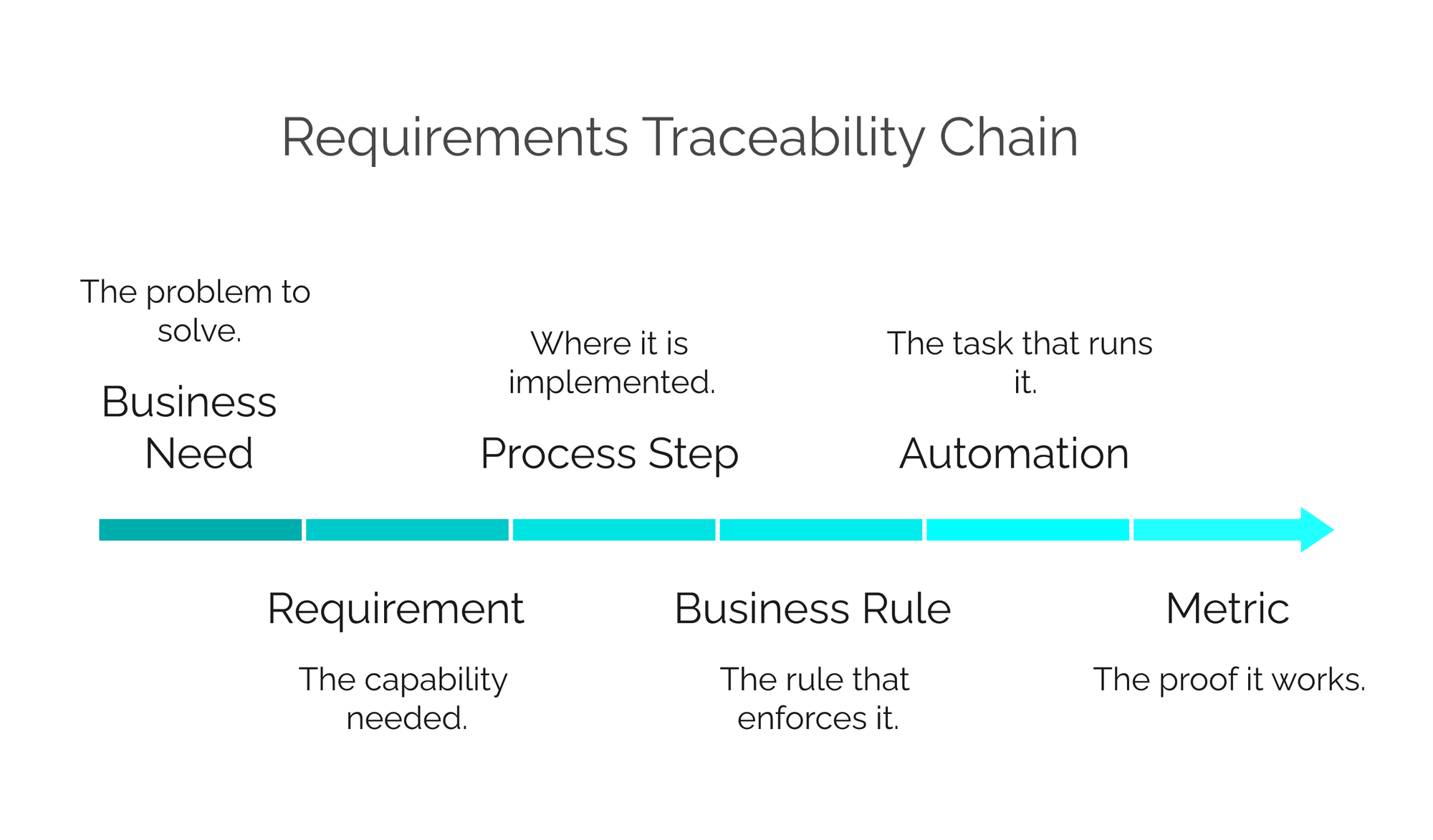
Requirements traceability is the discipline that prevents that scenario. It keeps every requirement connected to the business need that justified it, the stakeholder who owns it, the process step that implements it, and the outcome that proves it worked.
What Requirements Traceability Means
Requirements traceability is the ability to follow the life of a requirement in both directions: backward to its origin and forward to its implementation.
Backward traceability answers questions like: Which business need does this requirement serve? Who requested it? What regulation or policy motivated it?
Forward traceability answers the opposite set: Where in the process is this requirement implemented? Which business rule enforces it? Which automated task executes it? Which metric tells us it is being met?
In practice, traceability takes the form of explicit links between artifacts: business needs, requirements, stakeholders, BPMN process models, business rules, system configurations and performance indicators. The links can live in a requirements management tool, a traceability matrix, or directly inside process documentation. What matters is that they exist, stay current, and can be queried when a decision needs to be made.
Why Traceability Matters
Untraced requirements behave like orphaned code: they accumulate, nobody dares to remove them, and they silently increase the cost of every future change.
Traceability matters because process improvement is continuous. A process redesigned this year will be revised next year, and the team doing the revision is rarely the team that did the original design. Traceability transfers context across time and across people. It lets a new analyst understand not only what the process does but why it does it.
It also matters because requirements compete. When budgets shrink or timelines compress, teams must decide which requirements to defer. Without traceability, those decisions are guesses. With traceability, the team can see which requirements serve regulatory obligations, which serve a single stakeholder's preference, and which underpin the metrics executives actually track.
Traceability Between Needs and Requirements
A business need describes a problem or opportunity: "invoice approval takes too long and delays supplier payments." A requirement describes a capability the solution must provide: "the system must route invoices under €5,000 to a single approver."
The link between the two is where analysis quality shows. Every requirement should trace back to at least one need; every need should trace forward to at least one requirement. Gaps in either direction reveal problems early. A requirement with no need behind it is scope creep. A need with no requirements addressing it is a promise the project will quietly break.
This bidirectional check is one of the cheapest quality gates in business analysis, and frameworks such as the BABOK Guide treat it as a core task within requirements life cycle management.
Traceability Between Requirements and Process Models
Process models are where requirements stop being abstract. A requirement like "purchases above €50,000 require two approvals" becomes visible as a gateway and two user tasks in a BPMN diagram.
Tracing requirements to specific process elements — tasks, gateways, events, lanes — gives the team a shared, visual answer to "where is this requirement implemented?" It also works in reverse: when someone proposes removing or merging a process step, the trace immediately shows which requirements would be affected and which stakeholders should be consulted.
Teams that document processes in BPMN have a natural anchor for this. Each element in the diagram can carry documentation that references the requirements it satisfies, turning the process model into a living traceability record instead of a static picture.
Traceability Between Requirements and Business Rules
Business rules are the most volatile part of any process: approval thresholds, eligibility criteria, escalation timers, segregation-of-duties constraints. They change more often than the process structure itself.
Tracing requirements to rules keeps those changes safe. When finance raises the auto-approval threshold from €1,000 to €2,500, the trace shows which requirement authorized automatic approval in the first place, which stakeholder owns it, and which controls depend on the old value. Without that trace, rule changes happen in system configuration screens with no record of intent, and audits become archaeology.
A useful convention is to give rules their own identifiers (BR-001, BR-002) and reference them both in the requirement documentation and in the process model element where they apply.
Traceability Between Requirements and Automation
When a process is automated, requirements become executable. A routing requirement becomes gateway logic. A notification requirement becomes a service task. A data validation requirement becomes a form constraint.
This is where traceability pays off most directly, because automated processes are tested, versioned and deployed. If each automated element traces back to a requirement, then every deployment can answer: which requirements changed in this release? Which test cases cover them? Which stakeholder should sign off?
The inverse is equally valuable. When an automated step fails or produces complaints, the trace leads from the failing task back to the requirement and the need behind it — which is often the fastest way to decide whether to fix the implementation or revisit the requirement itself.
How Traceability Supports Governance and Compliance
Regulated processes must demonstrate that controls exist, that they were designed intentionally, and that they operate as designed. Traceability is the evidence chain that makes this demonstration possible.
Consider an auditor asking about a payment approval control. With traceability in place, the answer is a short walk: the control traces to a requirement, the requirement traces to a regulatory need (say, an internal financial policy or SOX-style control objective), the requirement traces forward to a specific gateway in the process model, the gateway references a documented business rule, and execution logs show the rule firing on real cases.
Traceability also supports change governance. When a compliance requirement changes, forward traces identify every process, rule and automation affected — turning what would be a manual investigation into a query.
How Traceability Reduces Rework
Rework in process projects usually comes from three sources: requirements that were misunderstood, requirements that were forgotten, and changes whose side effects were not anticipated. Traceability attacks all three.
Misunderstanding drops because each requirement is anchored to a concrete process element the stakeholder can see and validate before implementation. Forgotten requirements surface in coverage checks: any requirement without a forward trace to a process step or rule is, by definition, not yet implemented. Side effects become visible because impact analysis is a matter of following links rather than relying on the memory of whoever has been on the team longest.
The effect compounds over time. Each improvement cycle starts from documented, connected knowledge instead of rediscovering the process from scratch.
Practical Example: An Invoice Approval Process
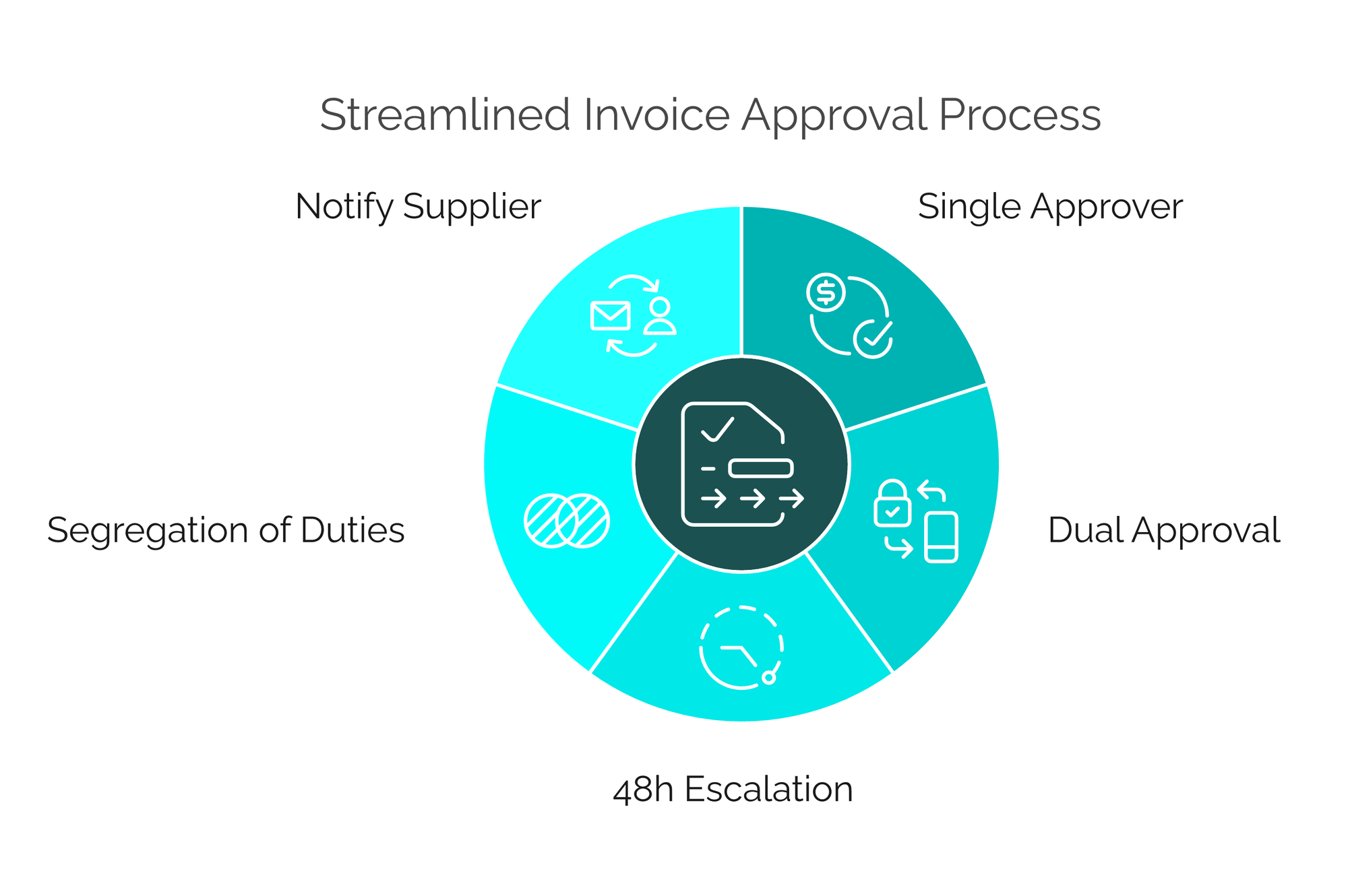
Imagine a company improving its invoice approval process. Discovery produced a business need: supplier payments are late because approvals are slow and inconsistent. Analysis produced requirements, each traced through the process design.
| Requirement | Business need | Stakeholder | Process step | Rule | Metric |
|---|---|---|---|---|---|
| REQ-01: Invoices under €5,000 are approved by a single approver | Reduce approval cycle time | Finance Manager | "Approve invoice" user task | BR-001: single-approval threshold = €5,000 | Average approval time |
| REQ-02: Invoices of €5,000 or more require manager and director approval | Ensure financial control on large payments | Finance Director | "Director approval" user task after exclusive gateway | BR-002: dual approval above threshold | % invoices with dual approval |
| REQ-03: Invoices pending more than 48h are escalated | Prevent payment delays | Accounts Payable Lead | Timer boundary event on approval task | BR-003: escalation timer = 48h | % invoices escalated |
| REQ-04: Approver cannot be the invoice requester | Segregation of duties (compliance) | Internal Audit | Task assignment logic | BR-004: requester ≠ approver | Audit exceptions found |
| REQ-05: Supplier is notified upon approval | Improve supplier relationship | Procurement Manager | "Notify supplier" service task | BR-005: notify within 1h of approval | Supplier satisfaction score |
Each row is a complete trace. When the finance director later proposes raising the dual-approval threshold to €10,000, the team can see in seconds that REQ-02 and BR-002 are affected, that Internal Audit is a stakeholder in the surrounding control (REQ-04), and that the "% invoices with dual approval" metric will need a new baseline.
Keeping Requirements Connected to Real Work with HEFLO
Traceability fails when it lives in a spreadsheet nobody opens. It works when it lives where the process itself lives.
This is where process documentation platforms like HEFLO change the economics of traceability. When processes are documented as BPMN models, each task, gateway and event can carry its own documentation — including the requirements it implements and the business rules it enforces. The model becomes the single place where analysts, process owners and auditors see how a requirement translates into actual work.
When those same models are executed through workflow automation, the trace extends into operation: every process instance generates execution data tied to the modeled elements, so metrics like approval time or escalation rate connect directly back to the requirements that defined them. The chain from business need to measured outcome stays intact — not because someone maintains a separate matrix, but because the documentation, the automation and the measurement share the same model.
Frequently Asked Questions
What is requirements traceability in business analysis?
Requirements traceability is the practice of linking each requirement backward to the business need and stakeholder that originated it, and forward to the process steps, business rules, automation and metrics that implement and measure it. It allows teams to answer why a requirement exists and where it is fulfilled.
What is the difference between forward and backward traceability?
Backward traceability follows a requirement to its origin — the business need, regulation or stakeholder request behind it. Forward traceability follows it to its implementation — the process tasks, rules, system configurations and indicators that realize it. Mature analysis practices maintain both directions.
What is a requirements traceability matrix (RTM)?
A requirements traceability matrix is a table that maps requirements to related artifacts such as business needs, stakeholders, process steps, business rules, test cases and metrics. It is used to check coverage, support impact analysis and provide audit evidence.
How does requirements traceability support compliance audits?
Traceability provides an evidence chain: a control can be traced from the regulation or policy that requires it, through the documented requirement, to the process step and business rule that enforce it, and finally to execution records that prove it operates. Auditors can verify design and operation without reconstructing the history manually.
How do BPMN process models improve requirements traceability?
BPMN models give requirements a concrete anchor. Each requirement can be linked to specific diagram elements — tasks, gateways, events — so the team can see exactly where it is implemented. When the model is also used for automation, execution data connects requirements to real performance metrics.
Does requirements traceability reduce project rework?
Yes. Traceability exposes unimplemented requirements through coverage checks, reduces misunderstandings by anchoring requirements to visible process elements, and makes impact analysis systematic — so changes are made with full knowledge of their side effects instead of discovering them after deployment.