Current State Analysis: Why Process Improvement Starts with Reality

Every process improvement project begins with a tempting shortcut: skip the messy present and jump straight to the elegant future. Teams sketch the ideal workflow, pick an automation tool, and start building. Months later, the new process collides with exceptions nobody documented, handoffs nobody mapped, and workarounds that were quietly holding the operation together.
Current state analysis exists to prevent exactly that. Before you redesign or automate anything, you need an honest picture of how work actually happens today — not how the procedure manual says it happens.
What Is Current State Analysis?
Current state analysis (also called as-is analysis) is the structured study of a business process as it operates right now. It documents the real sequence of activities, the people and systems involved, the decisions made along the way, and the results the process produces.
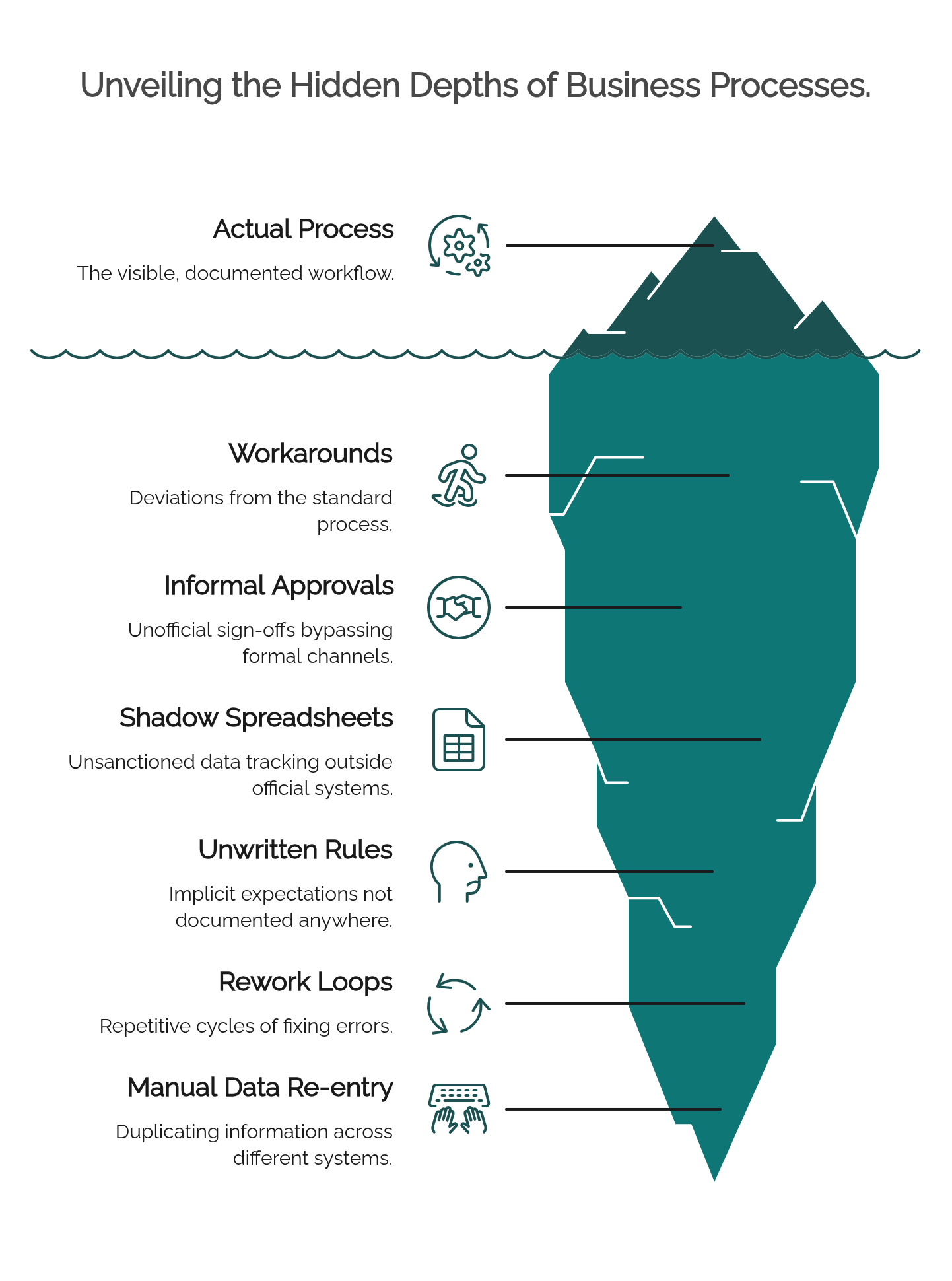
The key word is real. Most organizations have some form of official process description, but the documented version and the executed version tend to drift apart over time. People adapt. They create workarounds for system limitations, informal approval channels, and spreadsheets that live outside any official tool. Current state analysis captures this lived reality, usually through a combination of interviews, direct observation, document review, and data from the systems that support the process.
The typical output is an as-is process model — often in BPMN — supported by written documentation covering roles, rules, systems, metrics, and known pain points.
Why Current State Analysis Matters
Improvement is a comparison. You cannot measure progress against a baseline you never established, and you cannot fix a problem you have not located. Current state analysis matters because it turns opinions about a process into evidence.
Without it, improvement discussions default to the loudest voice in the room. The sales team blames legal for slow contract turnaround; legal blames incomplete submissions from sales. An as-is analysis replaces this blame cycle with facts: where requests actually wait, how long each step takes, and how often work bounces back for correction.
It also protects investment decisions. Automation amplifies whatever process it touches. Automating a well-understood process multiplies its efficiency; automating a poorly understood one multiplies its defects, at scale and at speed.
What to Observe in the Current Process
A useful current state analysis goes beyond drawing boxes and arrows. The goal is to understand the process across several dimensions at once, because problems rarely live in the flow alone — they hide in the roles, the systems, the rules, and the exceptions.
Bottlenecks, Delays, and Rework
Start with time. For each step, distinguish between processing time (someone actively working) and waiting time (the request sitting in a queue). In most administrative processes, waiting time dominates — a purchase order that takes ten minutes of actual work can spend five days in approval queues.
Then look for rework loops: points where work is returned for correction or clarification. Rework is one of the strongest signals in an as-is analysis because it usually indicates a defect upstream — an unclear form, missing information at intake, or ambiguous acceptance criteria. Quantify it where possible: what percentage of requests are returned, and at which step?
Roles, Responsibilities, and Handoffs
Map who does what, and be alert to two common findings. The first is ambiguity: steps where two people believe the other is responsible, or where nobody is. The second is handoff friction: every transfer of work between people, teams, or departments is an opportunity for delay, information loss, and misinterpretation.
Count the handoffs in your process. Each one adds coordination cost, and processes with many handoffs across departments are usually the ones where requests get lost and customers hear "let me check with another team."
Systems and Data Involved
Document every system the process touches — the official ERP or CRM, but also the unofficial layer: shared spreadsheets, email threads used as approval records, personal notes that hold institutional knowledge. This shadow layer is often where the process actually lives, and it is invisible to anyone who only reads the system architecture diagram.
Pay attention to data as well. Where is information entered manually more than once? Where do people copy data between systems? Duplicate data entry is both a waste and a defect source, and it is one of the most common (and most automatable) findings in current state work.
Business Rules and Exceptions
Every process runs on rules: approval thresholds, eligibility criteria, escalation conditions. Some are written in policy documents; many exist only in the heads of experienced staff. Current state analysis needs to surface both, because a future process designed only around the written rules will fail the moment it meets reality.
Exceptions deserve special attention. Ask process participants: "When does this not follow the normal path?" The answers reveal the variants that consume disproportionate effort. A process that handles 80% of cases smoothly but requires manual intervention for the other 20% may spend most of its total labor on that 20% — and any redesign that ignores those cases will simply push them further into the shadows.
The Risks of Skipping Current State Analysis
Teams under pressure often argue that the current process is "obviously broken," so why document it? The argument sounds efficient but carries predictable costs:
Automating the wrong process. Without an as-is baseline, teams frequently automate the documented process rather than the real one. The automation then fails on the exceptions and workarounds it never accounted for, and users route around it — recreating the shadow process the project was meant to eliminate.
Solving symptoms instead of causes. A visible delay in approval might be caused by an invisible defect at intake. Redesigning the approval step treats the symptom; the rework keeps flowing.
Losing critical knowledge. Workarounds usually exist for a reason. Some compensate for a regulatory requirement or a customer constraint that the redesign team never heard about. Discovering that reason after go-live is far more expensive than discovering it during analysis.
No baseline for ROI. If you never measured cycle time, cost, or error rate before the change, you cannot demonstrate the improvement afterward — which weakens the case for the next initiative.
Resistance from the people who do the work. When frontline staff see a redesign that ignores how their work actually happens, they conclude the project team does not understand the operation. Adoption suffers accordingly.
How Current State Analysis Supports To-Be Design
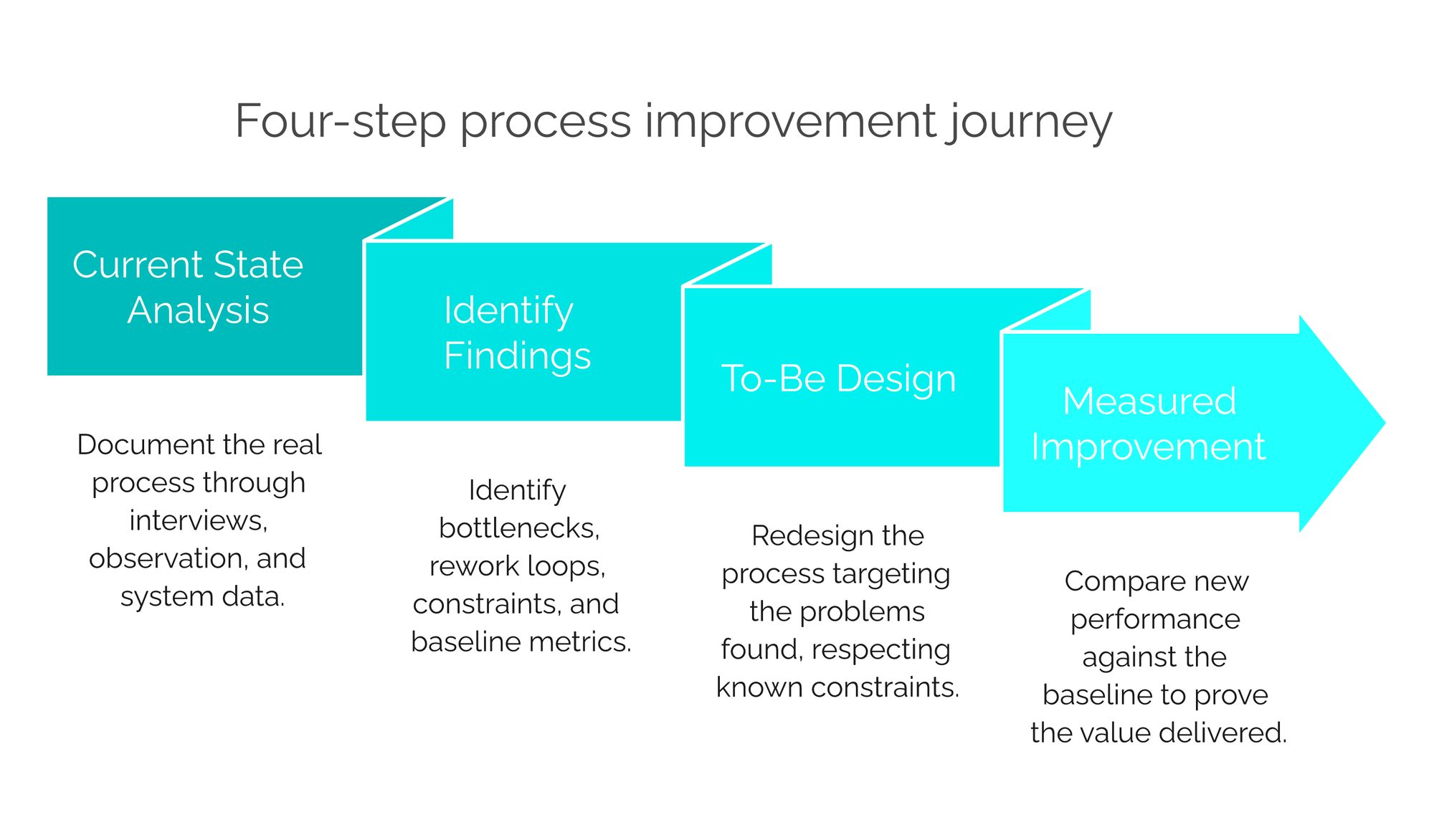
The as-is model is not the destination; it is the launchpad for the to-be design. A well-executed current state analysis feeds the future design in concrete ways.
It provides a prioritized problem list. Instead of redesigning everything, the team can target the specific bottlenecks, rework loops, and handoffs that the analysis exposed, and estimate the value of fixing each one.
It defines the constraints the new design must respect — regulatory requirements, system limitations, contractual obligations — so the to-be process is ambitious but implementable.
It establishes the baseline metrics (cycle time, cost per case, error rate, volume) against which the redesigned process will be judged.
And it identifies what already works. Not everything in the current process is broken; effective steps and useful controls should be carried forward deliberately rather than lost in a blank-slate redesign.
Checklist: What to Capture in a Current State Process Analysis
Use this checklist to structure your as-is documentation:
- Process scope and boundaries — where the process starts, where it ends, and what triggers it
- Activities and sequence — the actual steps performed, including informal ones
- Roles and responsibilities — who performs, approves, and is consulted at each step
- Handoffs — every transfer of work between people, teams, or departments
- Systems and tools — official applications plus spreadsheets, email approvals, and other shadow tools
- Data inputs and outputs — what information each step consumes and produces, and where duplicate entry occurs
- Business rules — approval thresholds, eligibility criteria, and escalation conditions, written and unwritten
- Exceptions and variants — the cases that leave the happy path, their frequency, and how they are handled
- Volumes and frequency — how many cases flow through, and how demand varies
- Cycle time and waiting time — total elapsed time per case, separated into work and wait
- Rework points — where work is returned for correction, and how often
- Known pain points — problems reported by participants, customers, and management
- Baseline metrics — the numbers the future process will be measured against
- Compliance and control requirements — regulatory or audit constraints the process must satisfy
Building a Shared View of Reality with HEFLO
A current state analysis is only useful if everyone can see it, question it, and agree on it. When the as-is process lives in one analyst's slide deck, it stays an individual interpretation. When it lives in a shared BPMN model, it becomes an organizational asset.
This is where a platform like HEFLO fits into the work. Teams can model the as-is process in standard BPMN notation, attach documentation for roles, rules, systems, and metrics directly to the diagram, and share it with process participants for validation — so the people who actually do the work can confirm or correct the picture before any redesign begins. Because the current and future versions live in the same environment, the transition from as-is to to-be stays traceable: every design decision can point back to the finding that motivated it.
Documenting reality is not the glamorous part of process improvement. But it is the part that determines whether the glamorous part succeeds.
Frequently Asked Questions
What is the difference between as-is and to-be process analysis?
As-is analysis documents how a process currently operates, including its real activities, roles, systems, and problems. To-be design defines how the process should operate in the future. The as-is provides the evidence and baseline; the to-be defines the target. Skipping the as-is means designing a future state without knowing what you are changing or why.
How long should a current state analysis take?
It depends on process complexity, but most single-process analyses take between one and four weeks. The goal is sufficient understanding, not exhaustive documentation — capture enough to identify the main problems, constraints, and baseline metrics. If the analysis stretches for months, the scope is probably too broad or the level of detail too deep.
What techniques are used in current state analysis?
The most common techniques are interviews with process participants, direct observation of work, review of existing documentation, analysis of system data (timestamps, volumes, error rates), and collaborative process mapping workshops. Combining at least two techniques matters, because interviews alone tend to capture the idealized version of the process rather than the executed one.
Should I document the current process if I plan to replace it completely?
Yes. Even a full replacement needs to understand the volumes, exceptions, business rules, and compliance requirements the new process must handle. Many "complete replacements" fail because they discarded constraints that existed for good reasons. The depth of documentation can be lighter, but the analysis itself should not be skipped.
What is the biggest mistake in current state analysis?
Documenting the official process instead of the real one. If the analysis relies only on procedure manuals and management interviews, it will miss the workarounds, shadow systems, and informal decisions where most problems — and most improvement opportunities — actually live. Always validate the model with the people who execute the work daily.
How does current state analysis support process automation?
Automation encodes a process into software, so any misunderstanding of the process becomes a defect in the system. Current state analysis identifies the exceptions the automation must handle, the data sources it must integrate, the business rules it must enforce, and the baseline metrics that will prove its value. It is the requirements foundation for any automation project.