How to Build a Business Case for Process Improvement

Most process improvement initiatives don't die because the idea was bad. They die in a budget meeting, competing against projects that showed up with numbers.
Operations teams see the waste every day: rework, delays, manual handoffs. But decision-makers don't approve pain — they approve returns. The bridge between the two is a business case for process improvement: a short, structured argument that translates operational friction into money, risk, and strategic impact.
In this guide, you'll learn what a process improvement business case must contain, how to quantify benefits credibly (even the soft ones), and how to present it so it gets approved. You'll also find a worked example with real numbers you can adapt.
What Is a Business Case for Process Improvement?
A business case for process improvement is a decision document that justifies investing time and money in changing how a process works. It defines the problem, quantifies its current cost, compares options, estimates costs and benefits, and recommends a course of action with measurable targets.
It is not a project plan. The business case answers "why should we do this and what will we get back?" — the plan that follows answers "how and when will we do it?". If you need the second document, see our guide to the process improvement plan.
A business case converts "this process is painful" into "this problem costs us X per year, fixing it costs Y, and here is when the investment pays back."
Why Good Improvement Ideas Don't Get Funded
Before writing, it helps to understand why so many proposals fail. Four patterns come up constantly:
- Vague benefits. "This will make us more efficient" is not an argument. Without a number, leadership can't compare your initiative against anything else asking for the same budget.
- No baseline. If you can't say what the process costs today — hours, errors, cycle time — you can't prove any improvement tomorrow. This is where a current state analysis earns its keep.
- The wrong language. A proposal written in process jargon (swimlanes, handoffs, SLAs) forces executives to do the translation into financial terms themselves. Most won't.
- Ignoring the alternative. Every business case competes with "do nothing." If you don't price the cost of inaction, doing nothing looks free.
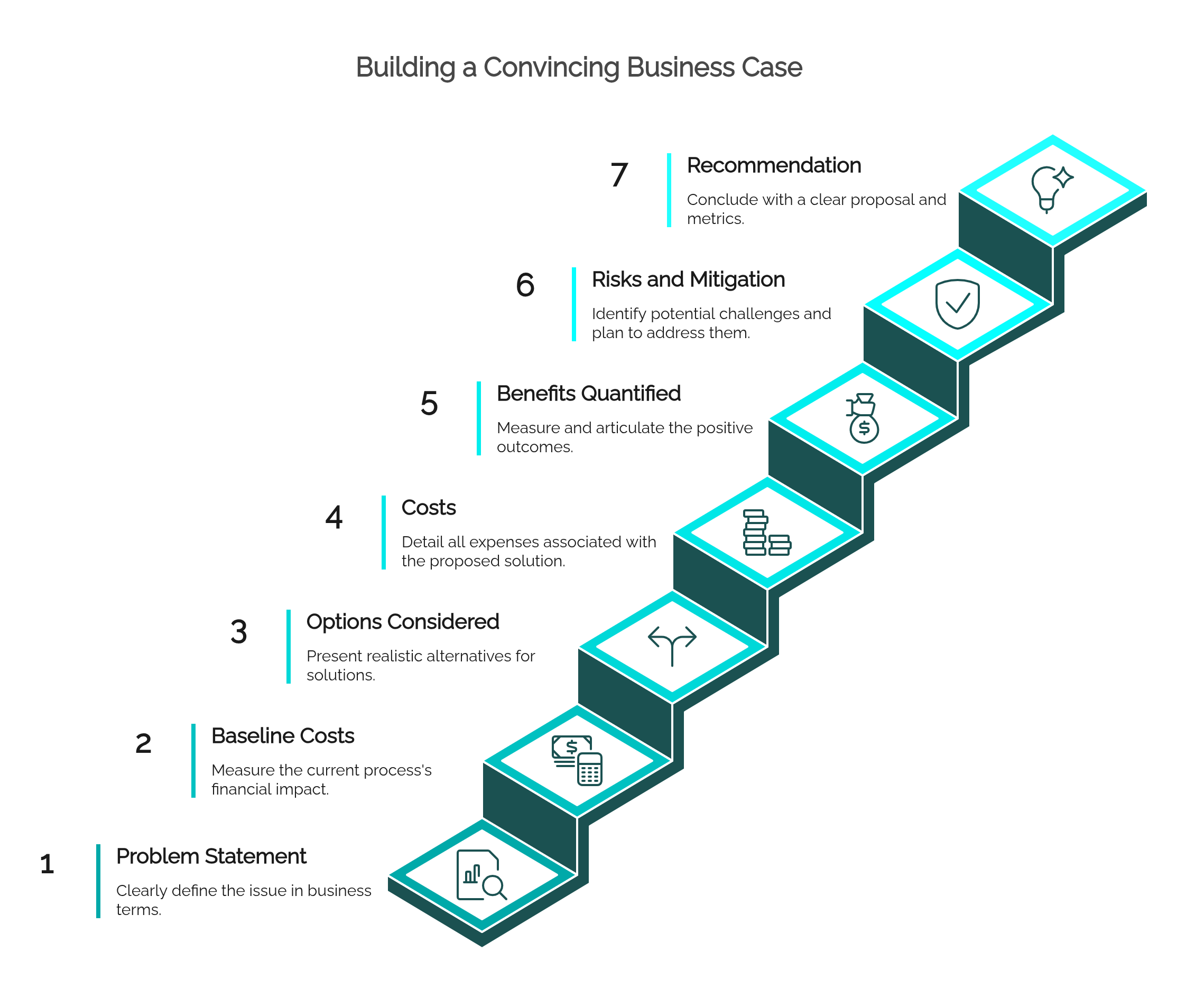
The 7 Building Blocks of a Convincing Business Case
Format varies by company, but a process improvement business case that gets approved almost always contains these seven elements, in roughly this order:
1. Problem statement
One paragraph, in business terms. Not "the invoice approval process has too many handoffs," but "invoices take 11 days to approve, we lose early-payment discounts, and suppliers escalate to directors weekly." Anchor it to something leadership already cares about: cost, revenue, risk, customer experience, or compliance.
2. Baseline: what the problem costs today
Measure the current process before proposing anything: volumes, time per transaction, error and rework rates, cycle time, and the people involved. Business process mapping makes this step much faster, because it exposes where time and errors concentrate. Express the result as an annual figure — money per year is the unit executives compare things in.
3. Options considered
Present two or three realistic alternatives — typically "do nothing," a low-investment redesign, and a deeper change involving automation. Showing options signals rigor and lets the sponsor make a real decision instead of a yes/no vote on your only idea.
4. Costs
Include everything: software licenses, implementation effort, training, and the hours your own team will spend on the change. Understating costs is the fastest way to lose credibility during review — and the mistake finance reviewers look for first.
5. Benefits, quantified
Separate hard benefits (time saved, errors eliminated, penalties avoided, discounts captured) from soft benefits (employee experience, scalability, auditability). Quantify the hard ones conservatively; name the soft ones honestly without inventing numbers for them. The next section shows how.
6. Risks and mitigation
What could make the initiative fail — adoption resistance, integration complexity, key-person dependency — and what you'll do about each. A business case that admits its risks is more credible than one that claims there are none.
7. Recommendation, KPIs and timeline
Close with a clear recommendation, the process automation metrics you'll track to prove the result, who owns the initiative, and the high-level timeline. Committing to measurable targets upfront is what separates a business case from a pitch.
How to Quantify the Benefits
Two formulas carry most of the weight in a process improvement business case:
Annual benefit = (hours saved per month × loaded hourly cost + error costs avoided per month) × 12
Payback period (months) = total first-year investment ÷ monthly net benefit
Three rules keep the numbers credible:
- Use loaded labor cost (salary + benefits + overhead), not raw salary — but state which rate you used.
- Be conservative on purpose. If automation could save 60–80% of touch time, model 60%. A case that survives skeptical assumptions is approved faster than an optimistic one that gets challenged.
- Don't monetize what you can't defend. "Improved morale" with a dollar figure attached invites attack. List soft benefits as qualitative supporting arguments, not as line items.
Time saved is usually the largest line, but don't overlook error costs: rework hours, duplicate payments, late-payment penalties, missed discounts, and compliance exposure often add 20–30% on top of the labor savings.
A Worked Example: Invoice Approval
A mid-sized company processes 2,500 invoices per month. Each invoice consumes about 12 minutes of manual touch time across reception, validation, and approval — roughly 500 hours per month. At a loaded cost of $30/hour, that's $15,000 per month, plus about $2,000 per month in duplicate payments, late-payment penalties, and missed early-payment discounts.
The proposal: redesign the flow and automate routing, validation, and approvals, cutting manual touch time by 60%.
| Item | Year-1 value |
|---|---|
| Time savings (300 h/month × $30 × 12) | $108,000 |
| Error and penalty reduction ($2,000 × 12) | $24,000 |
| Total annual benefit | $132,000 |
| Automation platform (annual) | –$18,000 |
| Implementation and training (one-time) | –$30,000 |
| Total year-1 investment | –$48,000 |
| Net year-1 benefit | $84,000 |
| Year-1 ROI | 175% |
| Payback period | ≈ 4.4 months |
Note what makes this table persuasive: a measured baseline, a conservative savings assumption, fully loaded costs, and two numbers — ROI and payback — that any executive can compare against other uses of the same budget. From year two onward, the recurring net benefit rises to $114,000, since the one-time implementation cost drops out.
Presenting It to Decision-Makers
How you package the case matters almost as much as its content:
- Lead with the one-pager. Problem, annual cost, recommendation, ROI, payback — on one page. The detail (process maps, calculations, risk register) goes in an appendix for those who want it.
- Speak to your audience's scoreboard. A CFO wants payback and risk; a COO wants capacity and reliability; a CIO wants integration and security. Adjust the emphasis, not the numbers.
- Show the cost of doing nothing. "Every month we wait costs $11,000" reframes the decision from spending to stopping a leak.
- Propose a pilot when the ask is large. A limited-scope pilot with defined success criteria lowers the perceived risk and creates the evidence for the full rollout.
Common Mistakes to Avoid
- Inflating soft benefits into hard numbers — one challenged assumption can sink the whole case.
- Skipping the baseline — without it, you'll never prove the improvement actually happened.
- Presenting only one option — it reads as advocacy, not analysis.
- Hiding internal effort — your team's hours are a real cost; reviewers know it.
- Stopping at approval — the business case commits you to KPIs. Report against them after implementation; it's what earns the budget for your next initiative.
Final Thoughts
A business case for process improvement is not bureaucracy — it's the discipline of proving, before spending, that a change is worth making. Baseline the current process, quantify conservatively, price the cost of inaction, and commit to measurable targets. Do that, and you turn an operational complaint into an investment decision leadership can say yes to.
When the case involves automating the redesigned process, HEFLO lets you document, automate, and measure it in one place — which also gives you the baseline and the tracking data your next business case will need.
👉 Case approved? The next step is turning it into a structured process improvement plan.
FAQ: Business Case for Process Improvement
What is a business case for process improvement?
It is a decision document that justifies investing in changing a process. It defines the problem, quantifies what the current process costs per year, compares options, estimates costs and benefits, and recommends an action with measurable targets such as ROI and payback period.
How is a business case different from a process improvement plan?
The business case answers why the initiative is worth funding and what it will return; it is written to get a decision. The process improvement plan comes after approval and details how the change will be executed: activities, owners, timeline, and controls.
How do you calculate the ROI of process improvement?
Estimate the annual benefit (hours saved multiplied by loaded hourly cost, plus error and penalty costs avoided), subtract the annual cost of the solution, and divide by the total investment. Complement ROI with the payback period — total first-year investment divided by monthly net benefit — since executives often decide on payback.
What if most benefits are intangible?
Quantify the part you can defend — even soft outcomes usually have a measurable trace, like turnover cost or audit preparation hours. Present the rest as qualitative arguments supporting the decision. Never attach invented dollar figures to intangibles; one challenged number undermines the entire case.
How long should a business case be?
Long enough to survive scrutiny, short enough to be read: a one-page executive summary plus three to five pages of supporting detail is enough for most process improvement initiatives. Large transformation programs may need more, but the decision summary should always fit on one page.
Who should sponsor and approve a process improvement business case?
The sponsor should be the leader who owns the process outcome and its budget — typically the department head or process owner. Approval usually involves whoever controls the investment: finance, an operations executive, or a governance committee, depending on the amount requested.