BABOK vs BPMN: Business Analysis vs Process Modeling
One team spends weeks writing requirements. Another draws a polished process diagram. The project still ships the wrong workflow. That gap is exactly what BABOK and BPMN exist to close — and treating them as the same thing is how teams fall into it.
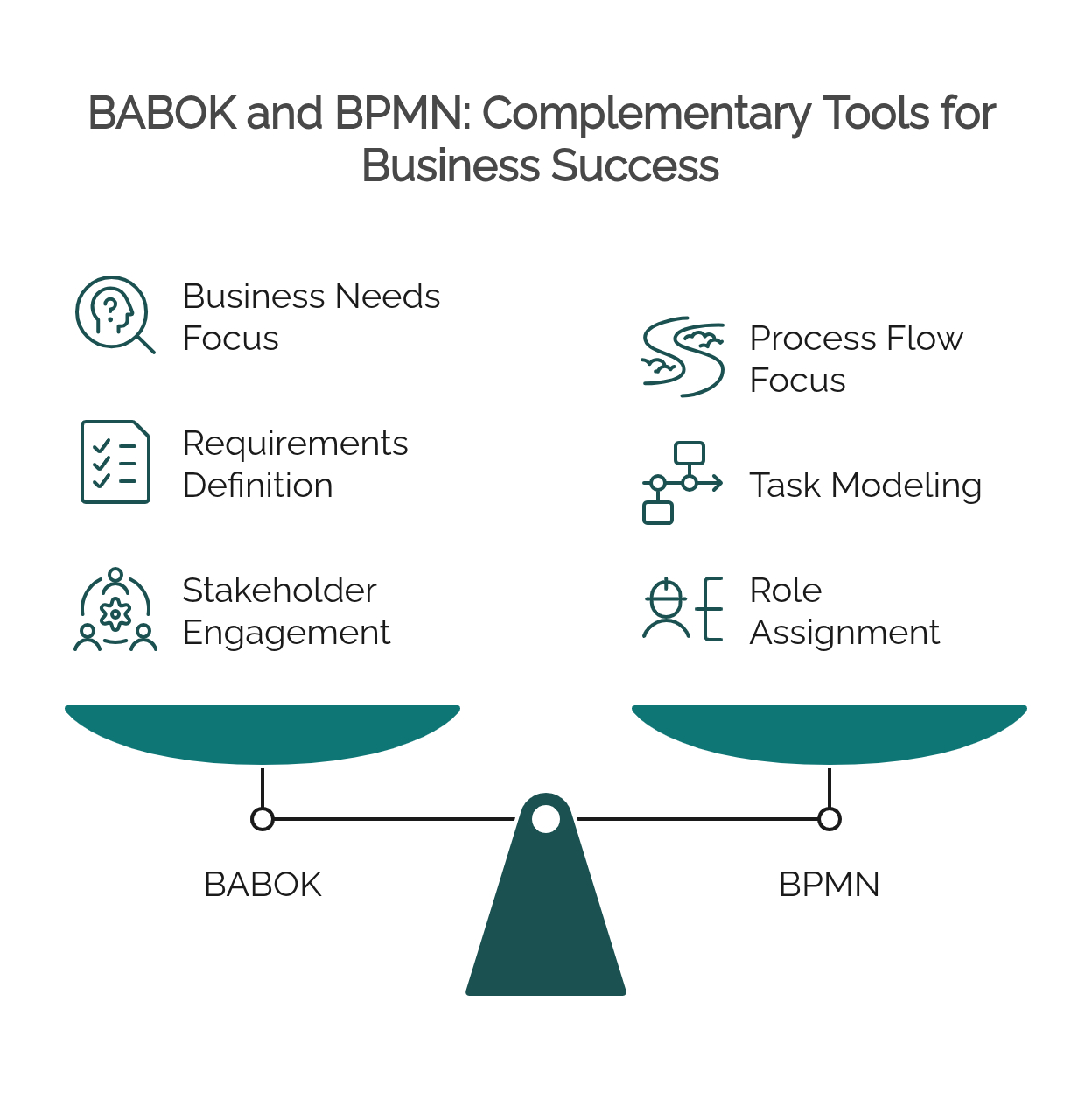
BABOK and BPMN are not competitors. BABOK is for business analysis. BPMN is for process modeling. One defines what the business needs. The other shows how the work flows.
BABOK is the reference for understanding an organization's needs — its stakeholders, requirements, solution options, and change. BPMN is a visual notation for how a process actually runs: its activities, decisions, events, responsibilities, handoffs, and exceptions.
So a business analyst uses BABOK to investigate a problem and align people around requirements. A process analyst then uses BPMN to draw the process that delivers on them. Treat the two as rivals and you pick the wrong tool. Use them together and you connect strategy to execution.
What is BABOK?
BABOK stands for Business Analysis Body of Knowledge, the standard reference for the practice of business analysis. You'll find it in the hands of business analysts, consultants, product professionals, transformation teams, and anyone studying for a business analysis certification.
It's worth being clear about what BABOK isn't. It isn't a diagramming notation, it isn't a software delivery method, and it isn't confined to process improvement. What it does is organize the discipline of business analysis around the work of understanding problems and opportunities, defining needs, analyzing stakeholders, eliciting and managing requirements, evaluating solutions, and supporting change.
In practice, BABOK concepts come into play when a team has to answer questions like these:
- What business problem are we actually trying to solve?
- Who are the stakeholders?
- What outcomes does the organization expect?
- What requirements must the solution satisfy?
- Which constraints, risks, assumptions, and dependencies are in play?
- How will we judge whether the solution worked?
The real value shows up early — before anyone designs a process, builds a system, or automates a workflow. Get the business context right first, and you avoid the classic trap of automating confusion at scale.
What is BPMN?
BPMN stands for Business Process Model and Notation, a standard way to model business processes visually.
Its job is to show how work moves from start to finish. A single diagram can capture tasks, events, gateways, decisions, parallel paths, message flows, responsibilities, exceptions, timers, and the handoffs between everyone involved. That matters because processes rarely survive a plain-text explanation. Once you've got several departments, approval rules, forms, systems, customers, suppliers, service teams, and a handful of exception paths in the mix, words alone stop being enough. BPMN turns all of that into something stakeholders can read, debate, validate, improve, document, and — on many platforms — run directly.
The questions BPMN is built to answer look like this:
- What triggers the process?
- What happens next?
- Who performs each activity?
- Where do decisions get made?
- Which rules determine the path?
- What happens when something goes wrong?
- Where are delays, handoffs, and bottlenecks likely to show up?
- How should the process be executed or automated?
The notation earns its keep whenever a team needs a single shared, structured picture of how work happens.
Main difference between BABOK and BPMN
The distinction comes down to purpose. BABOK governs business analysis; BPMN governs process modeling. One helps you investigate needs, define requirements, understand stakeholders, and evaluate solutions. The other helps you describe the sequence and logic of a process in a standardized visual model.
The table below lays the two side by side, along with the way they reinforce each other:
| BABOK | BPMN | How they complement each other |
|---|---|---|
| Guides business analysis practices | Provides a notation for process modeling | BABOK helps define the problem and requirements; BPMN helps represent the process that responds to them |
| Focuses on needs, stakeholders, requirements, value, and change | Focuses on activities, events, gateways, flows, roles, and exceptions | Requirements can be translated into process behavior |
| Helps answer "what does the business need?" and "why?" | Helps answer "how does the process work?" | The business need becomes visible through a process model |
| Useful before, during, and after solution design | Useful when modeling current-state or future-state processes | BABOK supports analysis; BPMN supports process visualization and design |
| Can apply to processes, systems, products, policies, data, capabilities, and organizational change | Applies specifically to business process structure and flow | BPMN is one possible modeling technique within a broader analysis effort |
| Produces requirements, stakeholder analysis, business cases, solution options, and change-related artifacts | Produces process diagrams and process documentation | Requirements and process models should stay connected |
| Helps prevent solution bias | Helps prevent process ambiguity | Together, they reduce the risk of building the wrong workflow |
| Supports business analysis maturity | Supports process modeling maturity | Together, they improve transformation, documentation, automation, and governance |
The scope is what really separates them. BABOK is broad — it can guide analysis across systems, products, policies, data, and organizational change. BPMN is narrower and sharper, dedicated to making a process visible and understandable. Neither makes the other redundant.
When to use BABOK
Reach for BABOK concepts when you need to understand the business situation before committing to a solution. That covers a wide range of work: investigating a problem or opportunity, defining business needs, identifying stakeholders, eliciting requirements and managing their changes, evaluating options, clarifying scope, tying business objectives to solution behavior, supporting organizational change, or preparing for certification.
Take a finance department frustrated by slow supplier payments. BABOK pushes the analyst to find the real cause before proposing anything. Are invoices going missing? Are approval rules unclear? Are purchase orders incomplete, or are there integration gaps between systems, dirty supplier data, or simply no visibility into where things stall? Skip that diagnosis and you might build a slick payment-approval workflow that automates everything except the part that was actually causing the delay.
When to use BPMN
Reach for BPMN when the goal is to describe, analyze, improve, document, or automate a process. That includes modeling the current state, designing a future state, clarifying responsibilities and handoffs, showing approval paths, representing rules and gateways, mapping exceptions and alternative flows, preparing a process for automation, documenting procedures, aligning business and IT, training users, and reviewing performance and bottlenecks.
Employee onboarding is a good example. A BPMN model can lay out the full sequence across HR, IT, facilities, finance, and the hiring manager — what happens once the offer is accepted, which tasks run in parallel, when IT provisions access, who signs off on equipment, and how the process behaves when someone's information arrives incomplete. Requirements can tell you what onboarding must achieve; the model shows you how it actually moves.
How BABOK and BPMN work together
The two are strongest when analysis and modeling stay connected. A business analyst applies BABOK concepts to surface needs, define requirements, analyze stakeholders, and weigh options. A process analyst then translates that into BPMN — modeling the current process, designing the improved one, and validating the flow with the people who live in it.
A typical sequence looks like this:
- Business need: the organization spots a problem, opportunity, or strategic goal.
- Business analysis: the analyst digs into the situation — stakeholders, goals, constraints, risks, requirements.
- Requirements: the team pins down what the future solution or process has to support.
- Process modeling: current-state and future-state processes are drawn in BPMN.
- Validation: stakeholders check the model against the requirements.
- Documentation: the model gets enriched with rules, roles, forms, policies, instructions, and performance expectations.
- Automation: where it makes sense, the model becomes the basis for execution.
- Monitoring and improvement: execution data exposes bottlenecks, delays, and exceptions to fix next time.
Analysis keeps the model honest about which problem it solves. The model, in turn, keeps the solution understandable, testable, governable, and executable.
Example: from business need to requirements to BPMN process model
Picture a company trying to fix its purchase request process. The stated need is simple enough:
"Reduce delays and improve control over purchase requests across departments."
The analysis turns up the usual mess. Requesters leave out required information, approval rules differ from one department to the next, managers approve over email, finance has no visibility, and anything urgent gets pushed through outside the formal process entirely.
From that, a set of requirements takes shape:
- Requesters submit through a structured form.
- Requests route by value, department, and budget availability.
- Managers approve anything above defined thresholds.
- Finance reviews before a purchase order is created.
- Requesters can track status.
- The process records who approved each request and when.
- Delayed approvals trigger escalation.
- Exceptions stay visible and traceable.
Those requirements then become a BPMN model: a start event for the submission, a user task to capture the requester's details, a gateway to check that the data is complete, approval tasks routed to the right manager, a second gateway weighing the purchase value, a finance review ahead of PO creation, timer events firing alerts and escalations, exception paths for rejected, incomplete, or urgent cases, and an end event closing the request as approved, rejected, or cancelled.
This is the payoff of using them together. The analysis defines and sharpens the need; the model turns that understanding into something stakeholders can see, question, and refine.
BABOK, BPMN and process automation
Automation shouldn't start with a tool. It should start with understanding — and that's exactly where these two disciplines earn their place. Analysis keeps you from automating the wrong thing; the model gives you a clear picture of the process before anything goes live.
The classic mistake is automating before the rules, exceptions, roles, and requirements are settled. All that buys you is faster confusion: the process runs quicker but still churns out delays, rework, escalations, and inconsistent decisions.
What makes BPMN the right foundation for automation is that its building blocks — tasks, decisions, gateways, events, timers, handoffs, approvals, exceptions — are executable logic, not just decoration. A requirement like "the system must support multi-level approvals" stays abstract on its own. The model is what pins down where those approvals sit, which roles touch them, what conditions send a request down each path, and how rejections and exceptions get handled. Once that model drives execution, the diagram stops being documentation and becomes the thing that actually runs the work.
That distinction matters for the business, not just the diagram. Automation should carry business intent forward, not bury it in a black box of code, spreadsheets, and disconnected tools. When the model and the execution are the same artifact, every step stays traceable to the rule it enforces and the outcome it serves — which is what gives analysts traceability, automation teams less ambiguity, and managers a visible line from strategy down to daily execution.
Which one should you learn first: BABOK or BPMN?
It depends on where your work starts.
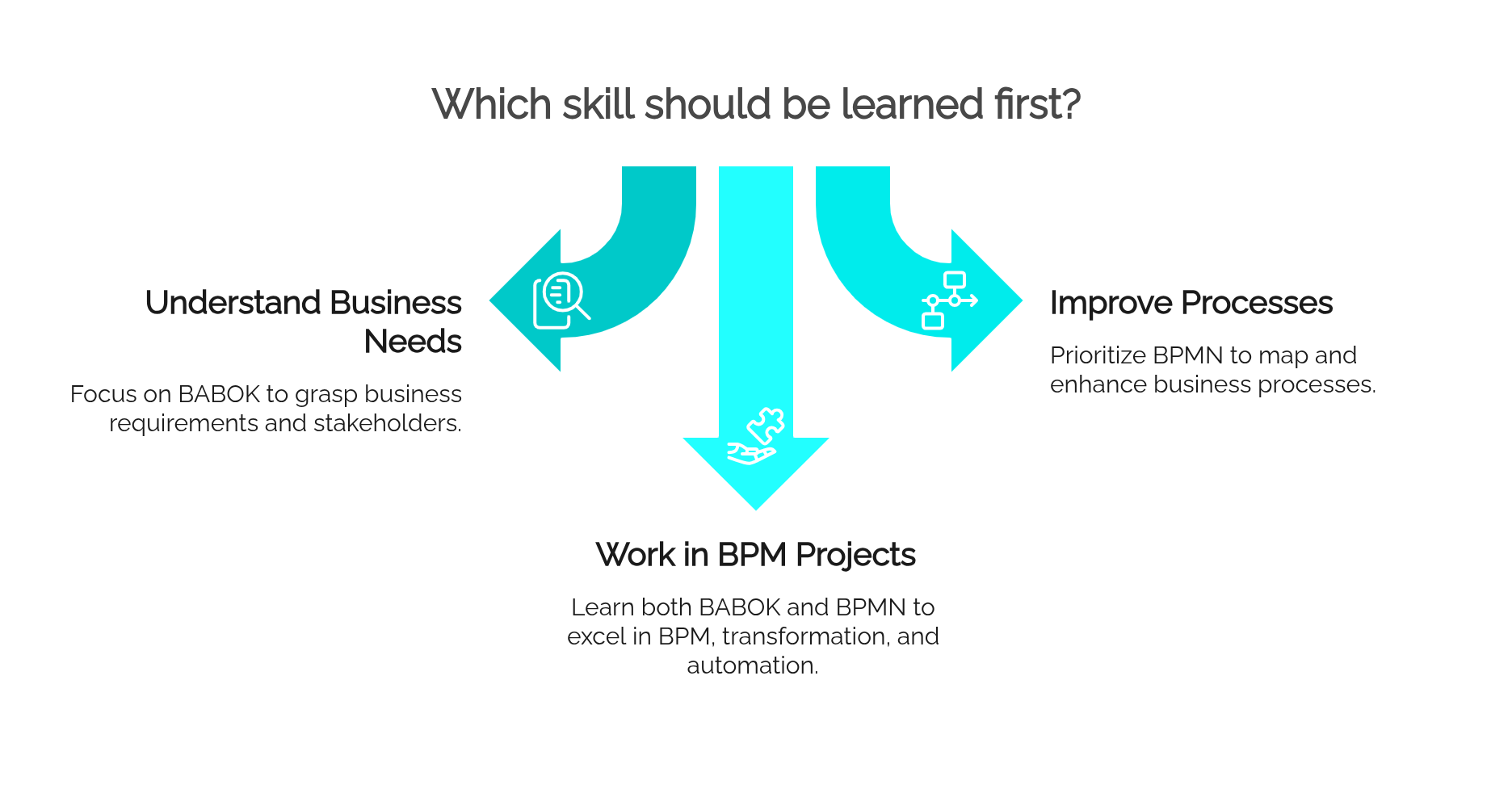
Lead with BABOK if you're building strength in business analysis — requirements, stakeholder engagement, solution evaluation, change initiatives. That's the path for business analysts, product people, consultants, transformation teams, and anyone whose job is to understand a need before proposing an answer.
Lead with BPMN if your day-to-day is mapping, documenting, improving, or automating processes. That's the path for process analysts, BPM practitioners, operations and shared-services teams, and consultants whose job is to make workflows legible.
Most people, sooner or later, want both. A reasonable rule of thumb: begin with BABOK if your work opens with business problems and stakeholder alignment, begin with BPMN if it opens with process mapping or automation, and pick up both once you're working on transformation or process improvement. For a lot of analysts, BPMN is the single most useful modeling skill to add. For a lot of process people, BABOK is what lets them tie a model back to a real business need.
From analysis to execution with HEFLO
Once the needs are understood, HEFLO is where teams turn BPMN models into something they can model, document, publish, and run.
The value is in closing the gap. Instead of keeping requirements in one place, diagrams in another, and execution in a third, HEFLO lets teams structure their BPMN models, enrich the documentation, publish approved process knowledge, and automate workflows with rules, responsibilities, deadlines, alerts, and traceability built in. That's particularly useful for analysts, process teams, BPM specialists, consultants, and transformation teams who need their business requirements to connect to real execution.
If your team is turning business requirements into process models, explore how HEFLO can help you design, document, publish, and automate BPMN-based workflows.
FAQ: BABOK vs BPMN
Is BABOK the same as BPMN?
BABOK and BPMN are not the same. BABOK (Business Analysis Body of Knowledge) is a guide for the practice of business analysis. BPMN (Business Process Model and Notation) is a standard graphical notation for modeling business processes. BABOK defines business needs and requirements. BPMN shows how a process actually flows. One is a body of knowledge. The other is a diagramming standard.
Are BABOK and BPMN competitors?
BABOK and BPMN are not competitors. They solve different problems and are often used together. BABOK governs business analysis: needs, stakeholders, requirements, and solutions. BPMN governs process modeling: tasks, events, gateways, and flows. In BPM, requirements analysis, and automation projects, teams typically use both — BABOK to define the need, BPMN to model the process that answers it.
What is the main difference between BABOK and BPMN?
The main difference is purpose. BABOK helps you analyze business needs, stakeholders, requirements, and solution options. BPMN helps you model how a process works as a standardized visual diagram. BABOK answers "what does the business need, and why?" BPMN answers "how does the process flow?" BABOK is broad and applies to processes, systems, products, and change. BPMN is specific to process structure and flow.
Can a business analyst use BPMN?
Yes, a business analyst can use BPMN. BPMN is one of the most valuable modeling skills for business analysts, especially when requirements involve processes, workflows, approvals, handoffs, or automation. A business analyst uses BPMN to turn written requirements into a visual process model that stakeholders can review and validate. BABOK even references process modeling as a core analysis technique.
Can BPMN be used without BABOK?
Yes, BPMN can be used without BABOK. A team can model a process in BPMN without formally applying BABOK practices. However, BABOK concepts improve the analysis behind the model by clarifying needs, stakeholders, requirements, and constraints first. Using BPMN alone produces a diagram; using BABOK first ensures the diagram solves the right problem.
When should I use BABOK?
Use BABOK when you need to understand a business situation before designing or automating a solution. BABOK applies when you are investigating a problem, defining business needs, identifying stakeholders, eliciting requirements, evaluating solution options, or supporting organizational change. It is most useful early — before a process is designed, a system is built, or a workflow is automated.
When should I use BPMN?
Use BPMN when you need to model, document, analyze, improve, or automate a business process. BPMN is most useful when work spans multiple steps, roles, decisions, handoffs, deadlines, or exceptions. Examples include mapping a current-state process, designing a future-state process, clarifying responsibilities, or preparing a workflow for automation.
How do BABOK and BPMN work together?
BABOK and BPMN work together by connecting analysis to modeling. BABOK defines the business need, stakeholders, and requirements. BPMN translates those requirements into a clear, executable process model. A typical sequence runs: identify the business need, analyze it with BABOK concepts, define requirements, model the process in BPMN, validate it with stakeholders, document it, and automate it. BABOK keeps the model aimed at the right problem; BPMN makes the solution visible and runnable.
Which is better for process automation: BABOK or BPMN?
For process automation, BABOK and BPMN serve different roles, and both matter. BPMN is closer to execution: its tasks, gateways, events, and timers can be turned into executable workflow logic. BABOK ensures the automation addresses the right business need before any workflow is built. The reliable approach is BABOK first to define the need, then BPMN to model the workflow that gets automated.
Which should I learn first, BABOK or BPMN?
Learn BABOK first if your goal is business analysis, requirements, and stakeholder work. Learn BPMN first if your goal is process mapping, BPM, workflow documentation, or automation. Business analysts and product professionals usually start with BABOK. Process analysts and BPM practitioners usually start with BPMN. Anyone working in process transformation benefits from learning both.
Does BPMN replace requirements documentation?
No, BPMN does not replace requirements documentation. A BPMN model shows how a process flows, but it does not capture what the business needs, which rules must be followed, what constraints exist, or how success is measured. Requirements and BPMN models are complementary: requirements state the intent, and the BPMN model shows the behavior that delivers it.
Why should requirements be connected to BPMN process models?
Requirements should be connected to BPMN process models to create traceability between business needs and process behavior. The connection lets stakeholders confirm that a process actually supports the intended outcome before it is documented, implemented, or automated. When requirements and models are disconnected, teams risk building workflows that look correct but fail to meet the business need.
What does BABOK stand for?
BABOK stands for Business Analysis Body of Knowledge. It is the standard reference guide for the practice of business analysis, used by business analysts, consultants, product professionals, and transformation teams. BABOK organizes the discipline around understanding business problems, defining needs, analyzing stakeholders, eliciting requirements, evaluating solutions, and supporting change.
What does BPMN stand for?
BPMN stands for Business Process Model and Notation. It is a standard graphical notation for modeling business processes, maintained by the Object Management Group (OMG). A BPMN diagram represents tasks, events, gateways, decisions, parallel paths, message flows, responsibilities, exceptions, and handoffs, and on many platforms it can be executed directly as an automated workflow.